Attention Is the Gate—How Movement Becomes Lasting Learning with Dr. John Medina
Author: Andrea Samadi
September 6, 2026
Duration: 46:13
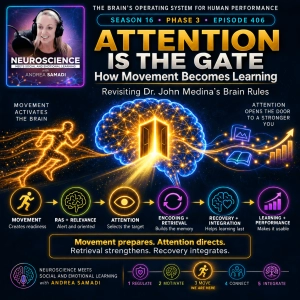
Episode 406 explains how movement prepares the brain but does not guarantee learning. It traces the full sequence—movement, RAS-driven readiness, salience and relevance, focused attention, encoding, retrieval and repetition, and recovery and sleep—that turns activation into lasting memory and performance.
The episode offers practical steps in a Move–Focus–Learn protocol: use brief movement to create readiness, clearly identify and remove distractions for one learning target, interact with material in meaningful ways, practice retrieval and spaced repetition, and protect recovery to support consolidation.
Listeners are encouraged to test these simple experiments for school, work, or personal learning to make experience more usable and improve attention, memory, and performance.
ON THIS EPISODE, YOU’LL LEARN:
✔ Why movement prepares the brain but does not guarantee learning
✔ How attention directs the capacity movement creates
✔ Why meaning and emotional relevance capture attention
✔ The difference between paying attention and actually learning
✔ How retrieval and repetition help new information stick
✔ How seeing, hearing, explaining, and applying an idea can help us remember it
✔ How restorative sleep supports memory and learning
✔ A practical Move–Focus–Learn Protocol for school, work, or your own personal learning
The central idea is simple:
Movement opens the window.
Attention determines what enters.
Repetition strengthens what remains.
And recovery helps the brain integrate what it has experienced.
Welcome back to the Neuroscience Meets Social and Emotional Learning Podcast, where we bridge neuroscience, social and emotional learning, and human performance so we can create measurable improvements in our well-being, achievement, leadership, productivity, and results.
I’m Andrea Samadi, and if you’ve been following along through Season 16, you’ll know that we have been building what I call The Brain’s Operating System for Human Performance—a neuroscience-based framework designed to help us understand how the different systems of the brain and body work together to influence how we learn, adapt, connect, lead, and ultimately, how we perform.
We are currently in Phase 3, focused on Movement, Learning, and Cognition.
As I prepared for this phase, I went back through more than 400 episodes of the podcast and organized them according to the five phases of this framework. I wanted to see whether any patterns would emerge.
And some did.
Phase 1, Regulation and Safety, includes 57 episodes.
Phase 2, Neurochemistry and Motivation, includes 41 episodes—the smallest category, possibly because this is the area I have explored the least with my learning.
Phase 3, Movement, Learning, and Cognition, includes 174 episodes—the largest category by far.
Phase 4, Perception and Social Intelligence, includes 68 episodes.
And Phase 5, Integration and Meaning, includes 71 episodes.
When I saw that 174 episodes—more than 40 percent of the entire podcast—fit into Movement, Learning, and Cognition, it immediately showed me where much of my curiosity has been directed over the years.
I have always been fascinated by learning:
How do we prepare the brain to learn?
What captures our attention?
Why do some ideas (or people) remain with us while others disappear?
How does knowledge become something we can retrieve, apply, and actually use to improve our lives?
And while I am spending most of my spare time hiking, or at the gym over the years, I wonder, how does this movement that I’m doing help to improve my attention, or memory, and finally, where does recovery fit into this process? The past few weeks, I’m finally connecting the dots with how important recovery is with this equation.
I’m also learning how to determine what’s important to me. John Medina’s Brain Rules book explains what holds our attention. He reminds us that “we don’t pay attention to boring things (or people).[i]
As we continue through these five phases of The Brain’s Oper