Phase 2 Review: The Motivation Loop: How to Keep Effort Worthwhile
Author: Andrea Samadi
June 14, 2026
Duration: 28:54
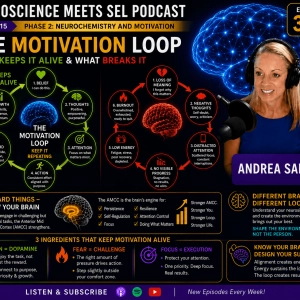
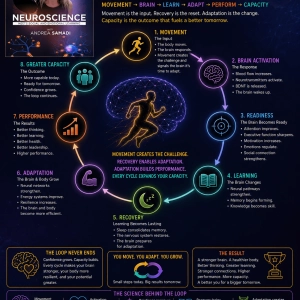
Episode 399 reviews Phase 2 of Season 15 and introduces the Motivation Loop — the sequence of meaning, belief, attention, action, reward, and recovery that drives sustained effort.
The episode explains common loop breakers (loss of meaning, negative thoughts, distracted attention, too much challenge, poor recovery, and no visible progress) and how to diagnose which link is failing.
Practical takeaway: identify your gap, reconnect purpose, protect attention, celebrate small wins, and balance challenge with recovery to keep motivation alive.
In This Episode 399, We Will Cover:
✅ The Motivation Loop — what it is, why it matters, and how it influences behavior, focus, effort, and achievement.
✅ What Keeps the Loop Alive — the role of meaning, belief, attention, action, reward, recovery, and growth.
✅ What Breaks the Loop — how loss of meaning, negative thoughts, distraction, lack of progress, poor recovery, and burnout weaken motivation.
✅ The Neuroscience of Motivation — why the brain repeats what it rewards and how dopamine reinforces behavior.
✅ The Difference Between Challenge and Burnout — finding the sweet spot where effort creates growth instead of exhaustion.
✅ My Personal Motivation Loop Story — how I watched my own loop begin to break in real time while pushing too hard with hiking and what I learned from it.
✅ How to Repair a Broken Loop — practical strategies to restore motivation before burnout takes hold.
✅ The Anterior Mid-Cingulate Cortex (AMCC) — the brain region associated with persistence, self-regulation, resilience, and doing hard things.
✅ Why Doing Hard Things Grows the Brain — how meaningful challenges strengthen the neural circuits responsible for sustained effort.
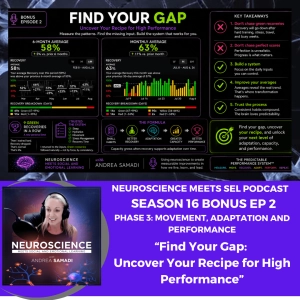
✅ Finding Your Gap — using our Brain's Operating System framework to identify where your system may be out of alignment.
✅ The Biggest Lessons from Phase 2: Neurochemistry & Motivation — insights from Bob Proctor, Dr. Caroline Leaf, Dr. John Medina, Dr. Anna Lembke, Dr. Chuck Hillman, and Friederike Fabritius.
✅ What's Next — a preview of Episodes 400 and 401 on Leadership and Trust, and our transition into Phase 3: Movement, Learning & Cognition.
Key Question of the Episode
"When motivation begins to disappear, have we lost our drive—or is there simply a broken link in the loop?"
Aha Moment
The goal isn't to push harder.
The goal is to identify the broken link, repair it, and keep the loop alive.
EP 399: The Motivation Loop: What Keeps It Going—and What Breaks It?
Welcome back to the Neuroscience Meets Social and Emotional Learning Podcast.
This week, we're wrapping up Phase 2: Neurochemistry and Motivation.
Over the past several months, we've explored some of the most important drivers of human behavior, attention, effort, learning, and performance.
Through the work of Bob Proctor, Dr. Caroline Leaf, John Medina, Dr. Anna Lembke, Chuck Hillman, and Friederike Fabritius, we've been focused on one fundamental question:
What drives sustained effort and forward movement?
Today, I want to zoom out and connect everything we've learned into one simple framework:
The Motivation Loop.
More importantly, we'll look at:
What keeps the loop going
What causes it to break
How we can strengthen it over time
And why doing hard things may actually help grow parts of our brain responsible for persistence and self-regulation.
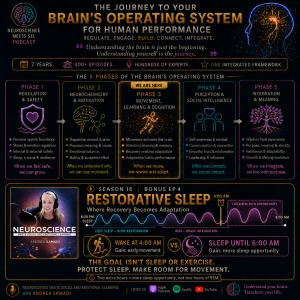
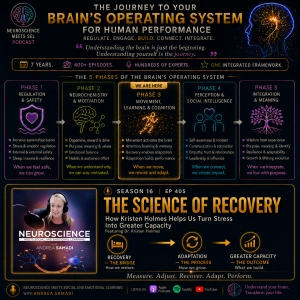
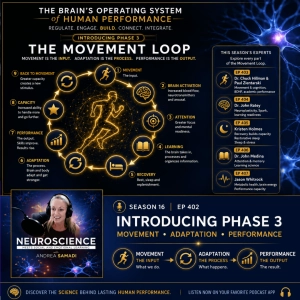
The Brain's Operating System of Human Performance
Before we dive into the Motivation Loop, let's remember what we’ve covered so far.
One of the biggest insights from neuroscience is that high performance doesn't happen in one part of the brain.
It happens through a sequence.
Just like a computer has an operating system, our brains have an operating system for learning, achievement, and human performance.
Over the past several months, we've been building that system one phase at a time.
Phase 1: Regulation & Safety
REGULATE
The first question we asked was:
"Is the nervous system safe enough to learn?"
Before mo