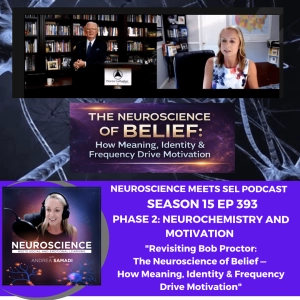
The Neuroscience of Belief: How Meaning, Identity and Frequency, Drive Motivation (Featuring Bob Proctor)
Author: Andrea Samadi
April 19, 2026
Duration: 28:56
Andrea Samadi explores Phase Two of the brain roadmap, showing how belief—shaped by meaning, identity, and daily practice—starts the motivation loop and drives action.
Featuring insights from Bob Proctor, this episode offers practical steps to find your why, train your mind, act from your next-level frequency, and grow into the results you envision.
Welcome back to Season 15 of the Neuroscience Meets Social and Emotional Learning Podcast.
I’m Andrea Samadi, and on this podcast, we bridge the science behind social and emotional learning, emotional intelligence, and practical neuroscience—so we can create measurable improvements in well-being, achievement, productivity, and results.
If you’re new here, welcome.
On today’s EP 393 of the Neuroscience Meets Social and Emotional Learning Podcast, we revisit the work of Bob Proctor to explore something foundational:
👉 The Neuroscience of Belief
Because before motivation…before action…before results…
👉 there is belief.
In this episode, we break down how belief actually works in the brain—and why it’s the starting point of everything we do.
✔ Why motivation doesn’t start with discipline👉 it starts with belief and expectation
✔ How belief shapes your neurochemistry👉 dopamine rises when your brain believes something matters
✔ The Motivation Loop👉 Belief → Chemistry → Action → Feedback → Repeat
✔ Why goals are not about what you get👉 but who you become in the process
✔ The power of alignment👉 when you stop comparing and start following your own path
✔ Understanding “frequency”👉 how your thoughts, emotions, and focus determine what you experience
✔ Why imagination is more than visualization👉 it’s how the brain begins solving for a new future
✔ And why you don’t need the full plan👉 just the next step forward
SEASON 15 ORIENTATION
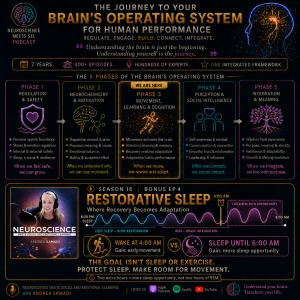
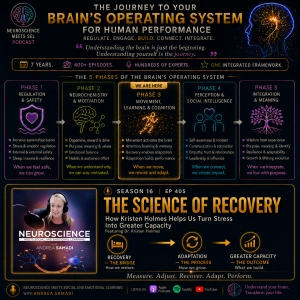
In Season 15, we’ve organized everything as a roadmap of the brain’s foundational systems.
Instead of treating neuroscience, health, mindset, and performance as separate topics—
we’re exploring how they come online in sequence.
Each phase we are covering, builds on the one before it:
Phase 1 — Regulation & Safety• Phase 2 — Neurochemistry & Motivation• Phase 3 — Movement, Learning & Cognition• Phase 4 — Perception, Emotion & Social Intelligence• Phase 5 — Integration, Insight & Meaning
Because peak performance isn’t built by doing more—
👉 it’s built by aligning the systems underneath.
And I want to understand these systems myself.
So thank you for joining me on this journey—
as we learn how to align our brains…to unlock what’s truly possible.
TRANSITIONING FROM PHASE 1 → PHASE 2
In Phase 1, we asked a foundational question:
👉 Is the nervous system safe enough to learn?
Because without safety—
nothing else in the brain fully activates.
But once the brain is regulated…
a new question begins to emerge:
👉 What actually drives us forward?
What determines whether we:
start something• stay with it• or stop altogether
PHASE 2: NEUROCHEMISTRY and MOTIVATION
We started Phase 2 with something simple.
To think about the last time you felt truly motivated.
Not forced…not pushing yourself…
but naturally pulled into something.
👉 What made you start?
Was it discipline?
Or was it something deeper?
…
Because here’s what neuroscience—and the work of many experts—has shown us:
👉 Motivation doesn’t start with action.👉 It starts with belief.
Before you ever take a step—
your brain has already made a decision. If you are thinking:
“This matters.”• “This is worth it.”• “This could REALLY work.”
That’s THE moment that belief is formed—
🧠 your brain begins releasing dopamine in anticipation.
Not because you’ve succeeded…
👉 but because you expect to.
THE MOTIVATION LOOP
This is what we call:
The Motivation Loop.
It works like this:
Belief — meaning and expectation
Neurochemistry — dopamine and drive
Action — effort and behavior
Feedback — reward or disappointment
Repeat… or Burnout
And it all begins with one question:
👉 What do you believe is worth y