TNFlyGirl Debonair Crash: Autopilot/Trim PIO + Icing & Night IMC

TNFlyGirl Debonair Crash: Autopilot/Trim PIO + Icing & Night IMC

Author: Max Trescott | Aviation News Talk Network March 11, 2026 Duration: 36:22

In episode 25 of NTSB News Talk, Max Trescott and Rob Mark break down seven NTSB reports with a common theme: the accident often starts long before the impact.

Brought to you by AVEMCO aircraft insurance.

Support Rob and Max by making a donation at Patreon.com

They begin with an experimental Carbon Cub (N126C) that appears to have struck power lines during very low flight along the Payette River near Montour, Idaho—another reminder that wires are nearly invisible until they aren’t. Next is a Cessna 310R (N252DL) that descended into terrain on an IFR flight after the pilot stopped responding to ATC, pointing toward possible pilot incapacitation amid icing concerns and other red-flag gaps.

The episode then tackles the Beech 35-C33 Debonair crash (N5891J) near Pulaski, Tennessee, where ADS-B data showed worsening pitch oscillations consistent with an autopilot/trim misunderstanding and pilot-induced oscillations. Two more reports highlight night risk: a Zenith CH 701 (N4209W) lost to spatial disorientation after VFR flight into deteriorating conditions, and a Cozy Mk IV (N656TE) that departed Half Moon Bay into night IMC and went into the ocean.

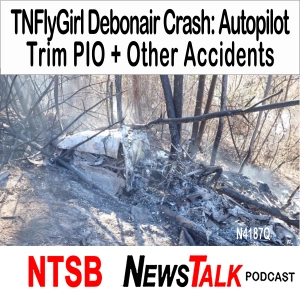
Finally, they cover a Cirrus SR22 (N253BC) overweight takeoff with distraction from alerts, and a Piper Saratoga (N4187Q) engine power loss at night IFR that left the pilot with few runway options.


Ever wonder what really happens after the dust settles on an aviation accident? NTSB News Talk-Aviation Accidents, Safety Investigations & Pilot Lessons pulls back the curtain on the meticulous world of safety investigations, transforming complex reports into actionable knowledge. Hosted by award-winning aviation journalist Rob Mark alongside Max Trescott-a flight instructor with formal accident investigator training-each episode delves into recent findings from the National Transportation Safety Board. Their conversations move beyond the headlines to analyze the chain of events, human factors, and mechanical failures that lead to incidents. This isn't about sensationalism; it's a clear-eyed look at the facts, designed to translate tragedy into tangible lessons for those in the cockpit. Whether you're a seasoned pilot, a flight instructor shaping the next generation, or an enthusiast fascinated by the intricacies of flight safety, this podcast serves as a vital resource. You'll hear detailed breakdowns of specific cases, discussions on broader safety trends, and practical takeaways that can directly inform decision-making and checklists. The dialogue between a journalist's perspective and an instructor's hands-on experience creates a unique and authoritative tone, making technical details accessible and immediately relevant. Tune in for a sobering yet essential exploration of how the aviation community learns, adapts, and strives to make every flight safer.
Author: Language: English Episodes: 29

NTSB News Talk – Aviation Accidents, Safety Investigations & Pilot Lessons
Podcast Episodes
Fatal Pilot Errors: How Common Medications Led to Deadly Crashes [not-audio_url] [/not-audio_url]

Duration: 39:31
Max Trescott and Rob Mark explore one of the most overlooked killers in aviation: common medications that quietly impair pilots and contribute to fatal crashes. While many aviators think over-the-counter or prescription…
NTSB Board Member Michael Graham on Safety Culture, SMS, and GA Risks [not-audio_url] [/not-audio_url]

Duration: 52:42
In this episode of NTSB News Talk, hosts Max Trescott and Rob Mark welcome Michael Graham, a current member of the National Transportation Safety Board (NTSB), for a deep discussion on the agency’s work and the broader s…
NTSB Accident Reports: TBM & King Air Loss of Control [not-audio_url] [/not-audio_url]

Duration: 37:50
In Episode 10 of NTSB News Talk, aviation safety experts Max Trescott and Rob Mark examine recent accident reports that reinforce why loss of control in flight continues to be the number one cause of fatalities in genera…