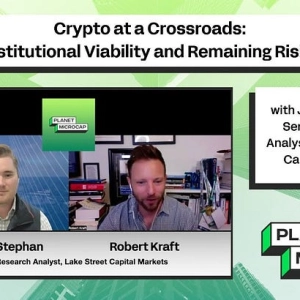
My guest on the show today is Jacob Stephan, Senior Research Analyst at Lake Street Capital Markets. He recently authored a “Crypto Industry” white paper, and I invited him on to break it down. In this episode, Jacob lays out why digital assets have crossed into institutional viability—a “normalization phase” driven by clearer regulation, enterprise-grade infrastructure, and real corporate adoption.
We discuss the internet-style adoption curve (crypto at ~7% global penetration), why regulation is the cornerstone of investability (FIT 21 progress, the new FASB fair-value accounting, and pending clarity in the U.S.), and how stablecoins—“dollars with an API”—are emerging as the killer app with multi-trillion settlement volumes. Jacob walks through concrete examples from Visa, Mastercard, and JPMorgan moving beyond pilots to on-chain settlement, and contrasts stablecoins’ payment utility with Bitcoin’s treasury/“digital gold” role.
We also cover the nuanced risks: centralization at the access layer (custody, cloud, compliance), state-by-state regulatory differences, speculative micro-cap “crypto treasury” raises, and why bipartisan momentum reduces—but doesn’t eliminate—policy risk. Finally, Jacob shares the “picks and shovels” angle—cloud, fintech/payments, and semiconductors—as scalable ways to participate in the build-out without direct token exposure, and why even low single-digit institutional allocations could materially move the asset class.
We discussed a number of crypto currencies in today’s episode. Jacob owns SOL, SUI and BTC, and for full disclosure, I also own BTC.
For more information about Lake Street Capital Markets, please visit: https://www.lakestreetcapitalmarkets.com/
Watch on YouTube:
Summary:
The central thesis is that digital assets have entered a phase of “institutional viability,” driven by regulatory progress, maturing infrastructure, and meaningful corporate adoption. Stephan argues that crypto is now in its “normalization phase,” analogous to the internet in the late 1990s, with global user penetration (~7%) mirroring the internet at its own early tipping point.
The catalyst for this transition is the emergence of clearer U.S. regulation, which provides institutions with legal footing to participate without existential uncertainty. This regulatory shift is reinforced by institutional-grade custody and compliance infrastructure, as well as real corporate use cases—particularly among Visa, Mastercard, PayPal, Tesla, and JP Morgan—who are using blockchain rails for settlement efficiency.
While Bitcoin is increasingly used by certain high-conviction companies as a long-term treasury asset, stablecoins have become crypto’s first major “killer app,” processing over $6 trillion in settlement volume in 2024.
Key risks include centralization at core access points (custody, cloud services), speculative micro-cap token treasury raises, and regulatory uncertainty that remains unresolved. The most compelling investment opportunities are found in “picks and shovels” plays—cloud, fintech, and semiconductor companies powering blockchain infrastructure—offering exposure to sector growth without direct token risk.
1. The “Crypto Normalization” Thesis: An Internet Adoption Analogy
Stephan argues that crypto is entering its first true normalization phase, where it becomes “invisible infrastructure,” much like the internet during its early commercial rollout.
Adoption Curve Parallels
* Internet (late 1990s): 4%–8% global penetration
* Crypto (2024): ~560 million users (~7% of global population)
This matching penetration level suggests crypto is at a similar inflection point, with network effects driving accelerating adoption.
Institutional Legitimacy as the Inflection Point
Large-scale participation from both Wall Street and Silicon Valley—along with improved regulation—has removed the “career risk” institutions previously faced in engaging with digital assets.
Stablecoins as Crypto’s “Killer App”
Just as email was the internet’s first mainstream use case, stablecoins and tokenization are crypto’s first broadly adopted applications—driving real-world settlement, not speculation.
2. Core Drivers of Institutional Viability
Stephan frames institutional adoption around three pillars: regulation, infrastructure, and corporate adoption.
Regulation: The Cornerstone
“The infrastructure made it usable, but regulations are ultimately what made it investable.“
Key U.S. legislative developments:
* FIT 21 Act – Passed House; establishes digital asset regulatory framework
* Genius Act – Signed July 2024, effective 2027
* Clarity Act – Pending in Senate; aims to finalize regulatory designations
This bipartisan progress provides the legal clarity institutions required.
Infrastructure: Institutional-Grade Rails
Custody, compliance, and settlement systems have matured significantly. Major custodians and service providers now meet institutional security and reporting standards.
Corporate Adoption: Validation Through Utility
Major firms are integrating on-chain technology:
* PayPal: Launched PYUSD stablecoin and uses on-chain settlement
* Block: Expanding bitcoin integration
* Tesla: Holds Bitcoin on its treasury
* Visa: USDC settlement network moves $500M+ per month, cutting settlement time from days to minutes
* Mastercard: Global stablecoin settlement platform in 50+ markets
* JP Morgan: Onyx blockchain settles $1B+ per day internally
* BNY Mellon: Offers Bitcoin and USDC custody
These are no longer pilots—these are operating systems for global finance.
Accounting Reform: A Major Unlock
New FASB standards allowing fair-value accounting for digital assets remove the prior “one-way impairment” problem, shifting CFO sentiment from “avoid” to “experiment.”
3. The Evolving U.S. Regulatory Landscape
Regulatory clarity is emerging, not complete.
Federal Landscape
Pending agency rulemaking will determine how laws are practically implemented.
State-Level Variation
* Wyoming: Crypto-friendly bank charters
* New York: Strict consumer-protection BitLicense regime
Stephan sees this as “healthy federalism” that drives competitive refinement.
Low Likelihood of Policy Reversal
Reasons:
* Bipartisan support
* Job creation
* Need for U.S. competitiveness vs. EU (MiCA)
* National interest in dollar-backed stablecoins
4. The Ascendancy of Stablecoins and Tokenized Fiat
Stablecoins are the largest proof point of crypto’s utility today.
Stablecoins = “Dollars with an API”
They enable:
* 24/7 global settlement
* Frictionless movement of money
* Near-instant cross-border transfers
Massive Market Validation
* $6 trillion in settlement volume in 2024
* Driven increasingly by corporate rather than retail use
Distinct Roles
* Stablecoins: Make dollars move faster within the system
* Bitcoin: Stores value outside the system
Institutions increasingly use both.
5. Corporate Integration: From Hedge to Operational Core
Large companies now use blockchain rails to reduce costs and improve settlement efficiency.
Visa, Mastercard, JP Morgan: Real Operational Scale
Examples:
* Visa: $500M+ USDC merchant settlement per month
* Mastercard: Stablecoin infrastructure live in 50+ markets
* JPM Onyx: $1B+ daily settlement flows
Bitcoin as a Treasury Asset
Adopters use Bitcoin as:
* A long-term asymmetric bet
* A hedge against fiat debasement
* A reserve asset for capital-light companies
Short-term volatility is accepted as part of the thesis.
Risks in Micro-Cap Crypto Treasury Raises
Stephan is critical of highly speculative token-based micro-cap capital raises:
* Raises of $100M–$250M in altcoins “reek of speculative bubbles”
* NASDAQ is beginning to crack down
* Some institutional backers see this as an alternative capital mechanism
6. Structural Risks and Challenges
Centralization of the Access Layer
Despite decentralized blockchains, core infrastructure is concentrated among:
* Coinbase
* Fireblocks
* AWS/Google Cloud
Stephan expects a future “regulated federation” of interoperable custodians.
Volatility & Bad Actors
Volatility still limits treasury adoption and speculative actors damage the industry’s reputation.
Political Support Is Conditional
A major fraud incident could still trigger aggressive regulation.
7. Market Outlook and Investment Opportunities
Stephan sees durable growth in underlying infrastructure and utility-based revenue models.
Emerging Revenue Streams
* Block Space as a CommodityDemand for settlement, data availability, and security resembles cloud compute demand.
* Stablecoin RailsFloat + transaction fees = durable revenue for issuers.
Institutional Penetration
He projects low single-digit portfolio allocations from pensions and endowments, but even 1% of global assets is enough to dramatically increase crypto’s total market cap.
Most Compelling “Picks and Shovels” Plays
SectorBeneficiariesRationaleCloud & InfrastructureAmazon (AWS), Microsoft (Azure), Google CloudMajority of blockchain workloads run on cloud platformsPayments & FintechVisa, Mastercard, PayPal, StripeIntegrating on-chain settlement into core systemsSemiconductorsNVIDIA, AMD, Marvell, BroadcomGPUs + networking gear needed for validators and ZK proofs
Planet MicroCap Podcast is on YouTube! All archived episodes and each new episode will be posted on the Planet MicroCap YouTube channel. I’ve provided the link in the description if you’d like to subscribe. You’ll also get the chance to watch all our Video Interviews with management teams, educational panels from the conference, as well as expert commentary from some familiar guests on the podcast.
Subscribe here: http://bit.ly/1Q5Yfym
Click here to rate and review the Planet MicroCap Podcast
The Planet MicroCap Podcast is brought to you by SNN Incorporated, The Official MicroCap News Source, and the Planet MicroCap Review Magazine, the leading magazine in the MicroCap market.
You can Follow the Planet MicroCap Podcast on Twitter @BobbyKKraft
This is a public episode. If you would like to discuss this with other subscribers or get access to bonus episodes, visit
microcapnewsletter.substack.com





![[ARCHIVE] Ep. 41 - The Art of Value Investing with Sanjay Bakshi, Professor and Value Investor (Original air date: March 28, 2017)](/imgp.php?url=https://substackcdn.com/feed/podcast/271436/post/168783808/4079caefee7026df441f09faaacd2d94.jpg)