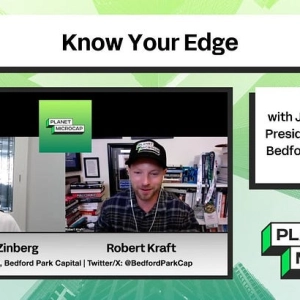
My guest on the show today is Jordan Zinberg, President & CEO of Bedford Park Capital. Jordan leads the Bedford Park Opportunities Fund, a highly concentrated, Canada-focused small and mid-cap equity strategy.
In this episode, Jordan shares how his fund delivered a 58.6% return in 2024, net of fees and expenses, and was named Best One-Year Return at the Canadian Hedge Fund Awards with a 73% return over the 12 months ended June 30, 2024. We also discuss the firm’s annualized return of 18.4% since inception in 2018.
Jordan walks us through the firm’s signature approach—identifying high-growth companies trading at reasonable valuations in a deeply inefficient market. We talk about how he builds conviction through intensive research, how he sizes positions (starting small and pyramiding up), and why bad average-down decisions are rare.
We take a close look at his biggest winners—Propel Holdings, Source Energy Services, and Enterprise Group—and examine how early theses, growth acceleration, and multiple expansion fueled outsized returns in 2024. Jordan emphasizes building your edge, knowing what you own, and structuring your portfolio with conviction and concentration.
For more information about Bedford Park Capital, please visit:
https://bedfordparkcapital.com/
You can follow Jordan Zinberg on Twitter/X @BedfordParkCap: https://x.com/BedfordParkCap
Watch on YouTube:
Summary:
I. Jordan Zinberg's Background and Path to Bedford Park Capital
Early Market Exposure:Zinberg’s first experience with markets came around ages 9–10, collecting and trading baseball cards. He remembers tracking “little arrows up and down the Beckett box,” which gave him his first sense of how markets work.
Teenage Stock Gift:As a teenager, he received stock as a gift. This required him to “look in the paper and look up the stock price,” eventually encountering a stock split and dividend. Each event became a learning opportunity. He calls it “a great gift” that sparked hands-on interest in investing.
Formal Education and Early Career:Zinberg studied business in university, always fascinated by markets. He has now worked in capital markets for over 20 years.
Transition to Small Caps:After seven years at RBC working on large caps, he realized “that was where the money was in the market.” However, he saw how inefficient small-cap markets could be and how much opportunity they offered. That led to a shift in focus.
Learning at a Small Firm:He joined a small fund focused on Canadian small- and mid-cap growth stocks, where he “really learned the craft.” During his nine years there, the fund grew from $13 million to $400 million.
Launching Bedford Park Capital:In 2018, he founded Bedford Park Capital with the goal of applying everything he had learned—and improving upon it—at his own firm.
II. Bedford Park Capital’s Investment Philosophy and Strategy
Exclusive Focus on Canada:Zinberg invests exclusively in Canadian companies, leveraging his “home court advantage.” Canada has over 4,000 public companies, many of which are underfollowed and inefficiently priced.
“It’s still possible for a small firm like ours to go out and pick 15 or 20 good opportunities and get to know them really well—and be able to outperform.”
Core Philosophy: Growth at a Reasonable Price (GARP) + Momentum Overlay
* “The foundation of everything we do at Bedford Park is growth.”
* Looks for companies growing revenue at 20%+ annually.
* Prefers stocks trading at reasonable—not deep discount—valuations.
Factors that lead to attractive mispricings:
* Size: Too small for institutional investors.
* Liquidity: Large funds can’t participate.
* Lack of Coverage: Self-funding companies often have no sell-side analysts.
“Sometimes you have bad companies with a lot of cheerleaders—and great companies hiding in the shadows.”
Zinberg sees many high-growth Canadian stocks trading at single-digit P/E multiples, and adds a momentum overlay, preferring to add to winners, not average down on losers.
Concentrated Portfolio:
* Typically 15–25 names, with the top 10 positions making up ~80% of the fund.
* Believes concentration is a key driver of alpha.
“Nobody should care about my 30th best idea—including me.”
Buying Strategy:
* Starts with small positions (0.5%–1% weight), usually after meeting management.
* Scales up based on performance:
“I’ll generally be adding as the name’s moving higher.”
* Rarely averages down. Instead, reevaluates the thesis after a bad quarter.
Portfolio is divided into:
* 10 core holdings ("starters")
* 10 bench names ("farm team")
Selling Strategy – 3 Triggers:
* Deterioration in Growth: If a company falls below 20% growth for 2–3 quarters, it’s usually a sell.
* Overvaluation Relative to Growth: Looks at growth-to-multiple ratio.
* Better Use of Capital: Will reallocate capital if a more compelling opportunity arises.
Special Situations Playbook:Though not resource-focused, he’ll occasionally buy energy/mining services companies (as industrial proxies) during hot resource markets.
III. Strategy in Action: Propel Holdings (PRL.TO)
* Discovered during the IPO boom (2021) after trusted contacts highlighted it.
* Initially impressed by management and 100% top-line growth. Took a 1% position at $9.75/share.
* Scaled up at $14.
* During the 2022 market collapse, PRL dropped to $6 despite excellent results and strong insider ownership.
* Seeing “3x earnings and a 6% dividend yield,” Zinberg aggressively accumulated shares.
* PRL soared from $6 to $43 by early 2025 and remains the fund’s largest position.
“This was arbitraging the multiple—buying at 3x, and letting it expand to 9–10x.”
IV. Market Sentiment and Positioning (as of July 2025)
* Describes current Canadian microcaps as still undervalued, though not as cheap as Q1 2025.
* Seeing opportunities at 8–10x earnings, which still leaves plenty of upside.
* Recently trimmed the portfolio from 23 to 17 names to allocate more capital to highest-conviction ideas.
V. Investment Process Details
Revisiting Old Ideas:Zinberg is open to revisiting past holdings, especially if new value or opportunity emerges.
Financings vs. Open Market:
* Bedford Park avoids most brokered financings—focuses on self-financing companies.
* Will only participate if it’s a name they already own and want more of.
* Avoids chasing minor discounts just for a small gain:
“We’re trying to make 100%, not 5%.”
No Trend Investing:Does not invest based on macro or thematic trends (e.g., AI, industrials).Instead, maintains a 250–300-name watchlist across sectors, always seeking:
“The best companies that fit our box—high growth and reasonable valuation.”
VI. Lessons Learned & Advice for Aspiring Investors
Positive Lesson – Constellation Software (CSU.TO):
* Discovered in 2009 (~$600M market cap, <10x earnings, 60%+ ROE, no analyst coverage).
* Held from ~$40/share to over $5,000.
“The real magic happens when you hold for the long term—not just grab 30% and move on.”
Mistakes & Pitfalls:
* Avoid: Highly levered companies, poor acquisition integration, customer concentration.
Advice for New Investors:
* Natural Curiosity is Crucial:
“If you don’t love it naturally, give your money to someone who does.”
* Know Your Edge:
“Start with something you understand. Hydrovac workers know hydrovac companies.”
* Beware the Illusion of Ease:Investing via phone apps may feel easy—but expertise and discipline still matter.
“Just because it’s easy to buy doesn’t mean you should.”
On Community:
* The microcap community is collaborative:
“You can’t do this alone. You need people you trust—to bounce ideas and help each other.”
Planet MicroCap Podcast is on YouTube! All archived episodes and each new episode will be posted on the Planet MicroCap YouTube channel. I’ve provided the link in the description if you’d like to subscribe. You’ll also get the chance to watch all our Video Interviews with management teams, educational panels from the conference, as well as expert commentary from some familiar guests on the podcast.
Subscribe here: http://bit.ly/1Q5Yfym
Click here to rate and review the Planet MicroCap Podcast
The Planet MicroCap Podcast is brought to you by SNN Incorporated, The Official MicroCap News Source, and the Planet MicroCap Review Magazine, the leading magazine in the MicroCap market.
You can Follow the Planet MicroCap Podcast on Twitter @BobbyKKraft
This is a public episode. If you would like to discuss this with other subscribers or get access to bonus episodes, visit
microcapnewsletter.substack.com