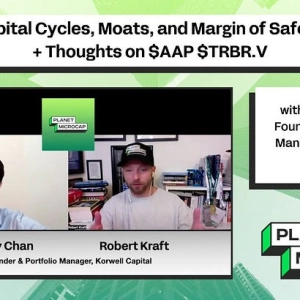
My guest on the show today is Kenny Chan, Founder and Portfolio Manager of Korwell Capital. Kenny is only 23, but he’s built an investment philosophy rooted in the classics — Peter Lynch, Joel Greenblatt, Warren Buffett — and adapted with a modern, high-conviction approach. His north star: “Buy Phil Fisher–like businesses at Graham-like prices.”Kenny walks us through the four categories that define his framework: misunderstood Buffett-like compounders, deep Graham-style value plays, capital-cycle opportunities, and turnarounds. We discuss how he launched Korwell Capital straight out of college, and how investing his own convictions — not academic theory — drives his process.We dig into two examples that bring this to life. First, Advance Auto Parts, where Kenny saw a rare combination of capital-cycle tailwinds, industry consolidation, and a fixable integration problem — creating a classic turnaround at a very cheap price. Second, Trubar, which received a takeover bid on the day of our interview. Kenny breaks down why he viewed the company as a niche brand with a durable moat, why the sale undervalues its long-term potential, and the critical lesson he’s taking away: understand management incentives before you invest.We wrap with Kenny’s advice for aspiring managers — especially the importance of writing publicly, testing your theses, and building a network through the quality of your ideas.We talked about a number of companies in today’s episode, Kenny is a shareholder of Advance Auto Parts and Trubar, and I am not a shareholder in any of the names mentioned.For more information about Kenny Chan and Korwell Capital, please visit: https://korwellcapital.com/
Watch on YouTube:
Summary:
His central thesis is to buy “Phil Fisher–like companies at a Graham-like price,” an idea he executes across four primary investment categories:
* Misunderstood Buffett-like companies
* Graham-like deep value opportunities
* Capital cycle plays
* Turnarounds
The analysis includes detailed case studies illustrating how Chan applies this framework in practice. His investment in Advance Auto Parts demonstrates how capital cycle and turnaround principles can converge within a consolidated, counter-cyclical industry. Meanwhile, the takeover bid for Troubar, a core holding, provides insight into Chan’s thinking around brand-driven moats and the importance of aligning with management incentives for long-term value creation.
The podcast concludes with Chan’s reflections on market inefficiencies and his advice for aspiring fund managers—particularly the importance of publicly testing investment theses to build skill, conviction, and a professional network.
1. Kenny Chan and the Founding of Korwell Capital
1.1 Background and Influences
Kenny Chan’s interest in business began early, inspired by watching his father run a comic book store. This curiosity evolved into a habit of reading business news and, eventually, classic investing literature. His passion was ignited by Peter Lynch’s One Up On Wall Street, which he says “absolutely blew my mind.” He soon immersed himself in the works of Joel Greenblatt, Seth Klarman, Warren Buffett, and other value-investing legends—often reading during daily commutes to school.
Chan attended NYU Stern specifically to pursue a career in value investing, supplementing his academic work with internships in private equity and hedge funds.
1.2 Path to Founding Korwell Capital
After graduation, Chan’s planned private equity role fell through when the fund shut down. He instead joined a small public equity shop. Just months into the role, he approached his boss—who had developed confidence in him—and successfully secured backing to launch Korwell Capital.
Asked about the confidence to start a fund at 23, Chan credits two factors:
* Opportunity – His boss believed in his ability and provided capital.
* Conviction – A strong desire “to be able to research stocks in the way that I believe and ultimately to invest in my own convictions.”
He emphasizes that while his strategy is “not new,” he believes he has “a different perspective of [value investing] insights than most investors.”
2. Korwell Capital’s Investment Framework
2.1 Guiding Philosophy
Chan’s process is built around first-principles thinking:
“A first principles understanding of business to understand a business beyond just its financial statements.”
He cites Li Lu’s concept of “insights”—the handful of fundamental principles Buffett used to outperform his mentors.
His core thesis:
**• “Buy Phil Fisher–like companies at a Graham-like price.”
• “Buy Graham-like companies at a very, very cheap price.”**
This requires deep qualitative understanding to identify stocks temporarily mispriced relative to their true business quality.
2.2 The Four Investment Categories
CategoryDescriptionMisunderstood Buffett-like CompaniesHigh-return-on-capital businesses with strong reinvestment opportunities, available at a cheap price. Very rare.Graham-like OpportunitiesCompanies trading far below tangible book where management is actively unlocking value.Capital Cycle OpportunitiesIdeas derived from studying industry capital flows and cyclicality.TurnaroundsHigh-quality businesses with temporary problems depressing the stock.
3. Core Theses and Case Studies
3.1 Buffett’s Insight: “Shared Economy Scaled”
Chan analyzes Buffett’s early success through the concept later described by Nick Sleep:sacrifice margin per unit to maximize customer value and achieve scale-driven dominance.
Example: GEICO (1976)
GEICO, then a microcap losing 70% of its equity in a year, nearly failed due to straying from its core competency. Buffett saw that the original low-cost model (direct mail to safer government workers) was intact. He invested 25% of Berkshire’s equity portfolio despite the risk.
Chan believes similar situations exist today—great business models temporarily obscured by mismanagement.
3.2 Case Study #1: Advance Auto Parts (AAP)
This illustrates both turnaround and capital cycle dynamics.
Industry Dynamics
• Auto parts retail is counter-cyclical (Peter Lynch insight).• In recessions, people repair cars instead of buying new ones.• Margins for leaders like AutoZone and O’Reilly remain resilient.
Capital Cycle
• Industry consolidated significantly over 20 years.• Thousands of independents absorbed into four major players.• Consolidation drove margin expansion for leaders.
Investment Thesis
• Advance Auto Parts was once the largest player but fell behind due to poor acquisition integration.• New management focused on correcting execution errors created a window:
“A great business with high return on capital potential at a very cheap price.”
3.3 Case Study #2: Trubar (TRU)
On interview day, Trubar—a core Korwell holding—announced a takeover offer.
Original Thesis
A classic Joel Greenblatt–style special situation:
• Troubar was selling non-core cannabis and skincare businesses.• The core protein bar business had been hidden behind poor consolidated financials.• The bar business was doubling revenues with minimal marketing.• Insider ownership was high.
Brand-Driven Moat
Chan argues Trubar’s moat is brand, not assets:
• The category was saturated, but no brand focused specifically on women.• Trubar’s formula (12–16g protein + fiber) matched actual consumer preferences.• Brand loyalty demonstrated real product-market fit.
“A brand is a promise… an incredible barrier to entry.”
Takeover Offer Analysis
• Offer valued Trubar at ~2.2x LTM sales.• Chan called it “very disappointing.”• Selling early forfeits long-term compounding value.• Cites the See’s Candies and Quilmes examples—where sellers left billions on the table.
Lesson Learned
Understand management incentives.Short-term–oriented incentives at the Kingsley Ward family office likely drove an early sale not aligned with maximizing long-term shareholder value.
4. Reflections and Key Quotes
4.1 Market Opportunities
Chan firmly believes markets are inefficient:
“Realizing the kind of companies that are out there with huge dislocations… being able to profit off them.”
4.2 Advice for Aspiring Fund Managers
“Start writing your investment thesis and putting them online. Test your ideas publicly. It’s a great way to build credibility and meet people.”
Publishing his work helped Chan connect with seasoned managers—especially after the rebound in Advance Auto Parts showcased his analytical skill.
4.3 Selected Quotes
• On his mission:
“The most important thing is to research stocks in the way that I believe and invest in my own convictions.”
• On brand as a moat:
“A brand is a promise… something you can’t see in a financial statement.”
• On early exits:
“The real winner is often the acquirer. Selling early means giving up enormous optionality.”
Planet MicroCap Podcast is on YouTube! All archived episodes and each new episode will be posted on the Planet MicroCap YouTube channel. I’ve provided the link in the description if you’d like to subscribe. You’ll also get the chance to watch all our Video Interviews with management teams, educational panels from the conference, as well as expert commentary from some familiar guests on the podcast.
Subscribe here: http://bit.ly/1Q5Yfym
Click here to rate and review the Planet MicroCap Podcast
The Planet MicroCap Podcast is brought to you by SNN Incorporated, The Official MicroCap News Source, and the Planet MicroCap Review Magazine, the leading magazine in the MicroCap market.
You can Follow the Planet MicroCap Podcast on Twitter @BobbyKKraft
This is a public episode. If you would like to discuss this with other subscribers or get access to bonus episodes, visit
microcapnewsletter.substack.com