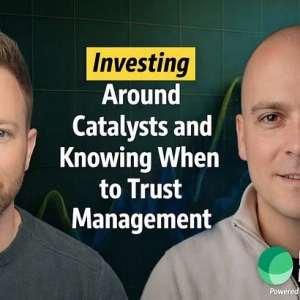
My guest on the show today is Christian Schmidt, a private investor and co-founder of Tracktacle, a financial data and alerts platform that provides real-time alerts on filings and news, plus full-text search across U.S. and Canadian market documents.In this episode, Christian walks us through his unconventional path from banking and e-commerce to becoming a full-time private investor, and how a series of market experiences reshaped his approach to risk, valuation, and opportunity selection. We discuss why he believes private investors have a real edge in microcaps, how he builds positions around clearly defined catalysts, and why doing the valuation work before the news hits is critical to acting with conviction.Christian also shares how painful lessons from turnarounds and management missteps led him to re-prioritize assets and competitive advantage over management narratives — and how those experiences directly inspired the creation of Tracktacle. We dive into how the platform helps investors cut through noise in SEC and SEDAR filings, identify meaningful catalysts faster, and stay on top of microcap developments in real time. We mention a few names on the show today and I'm not a shareholder in any of them.For more information about Tracktacle, please visit: https://www.tracktacle.com/
Watch on YouTube:
Summary:
This podcast covers the investment philosophy, strategic evolution, and entrepreneurial activities of Christian Schmidt, a private investor and co-founder of Tracktacle. Schmidt’s journey began with a bank apprenticeship in Germany, followed by a financially successful but personally unfulfilling career in e-commerce, before a “cathartic” market experience in 2021–2022 catalyzed his transition to full-time private investing in 2023.
His investment approach is catalyst-driven and concentrated in the micro-cap space, where he believes private investors possess a clear analytical edge. A core tenet of his process is completing extensive valuation work before anticipated news or filings, enabling rapid and confident action when catalysts materialize. This strategy is exemplified by his successful investment in Regis Corp.
Recent experiences—particularly with Innovative Food Holdings—have materially reshaped his views on the relative importance of management versus business quality. Schmidt has shifted from a management-centric mindset to a conviction that assets and real competitive advantages ultimately matter more than management, provided management is not acting in bad faith. As a result, he now prioritizes deep asset analysis before engaging with company leadership.
In parallel, Schmidt co-founded Tracktacle, a financial data and alerts platform purpose-built for micro-cap investors. Tracktacle aggregates SEC, SEDAR, and press release data and layers advanced filtering and AI-driven analysis on top, addressing key inefficiencies Schmidt encountered in his own research process.
The Investor’s Journey
From Banking Apprentice to Full-Time Investor
Christian Schmidt, a 35-year-old investor from Rhineland-Palatinate, Germany, took an unconventional route into investing. Initially planning to study medicine, he instead began an apprenticeship at a rural bank while waiting for a university placement. There, a colleague’s fascination with markets “rubbed off” on him, sparked by the simple power of seeing a DAX ETF chart.
Despite this interest, Schmidt found banking unfulfilling. He pursued studies in German and history with the intention of becoming a teacher, while simultaneously working as a self-employed e-commerce consultant. This business became highly profitable—so much so that he abandoned his studies—but he “really hated it from the start.” Over nine years, he invested most of his earnings into stocks and ETFs.
A decisive turning point occurred between 2019 and 2021. The November–January period was extremely demanding in e-commerce, leading to “massive” mental overload. During a sharp market drawdown, his largest position, HelloFresh, declined significantly—an experience he describes as “almost cathartic.” This crystallized a binary choice: pursue investing full-time or revert to passive ETFs and his prior profession.
In 2023, Schmidt chose the former, becoming a full-time private investor managing his own capital through a tax-efficient German LLC.
Intellectual Influences and Strategic Evolution
Schmidt’s investment philosophy evolved from common beginner mistakes into a more flexible, catalyst-focused framework.
Early Missteps
He began by buying stocks promoted in German financial magazines as “the next big thing,” including PayPal, BMW, and Wirecard (which he exited before its collapse). Reflecting on this phase, he notes, “I think most of us started this way.”
Key Influences
* Paul Chishik: Conversations with Chishik were pivotal, helping Schmidt abandon rigid academic valuation frameworks in favor of more practical, situational analysis. He found traditional valuation textbooks excessively complex, requiring “massive spreadsheets” and hours of work.
* Joel Greenblatt’s Class Notes: These materials were “really, really, really helpful,” demonstrating that successful investing extends beyond the standard “quality stocks at a low price” paradigm.
Shift to Micro-Caps
Schmidt ultimately concluded that private investors have a real edge in micro-caps, describing the space as “fishing in a pond without bigger fishes.” With less competition from institutions, he finds it easier to identify compelling ideas.
Core Investment Philosophy and Process
Focus on Catalyst-Driven Micro-Caps
Schmidt’s strategy centers on identifying micro-cap stocks with identifiable catalysts likely to change market perception within two to three quarters.
* Primary Objective: Anticipate positive perception shifts leading to multiple expansion.
* Valuation Philosophy: He de-emphasizes traditional metrics like price-to-book or price-to-sales, focusing instead on underlying cash flow and earnings power.
* As he puts it: “I don’t care that much about price-to-book or price-to-sales.”
The Primacy of Pre-Emptive Research
A defining element of Schmidt’s process is completing valuation work before expected news or filings.
Case Study: Regis Corp.
* Schmidt conducted a full valuation in January when Regis was near bankruptcy or massive dilution.
* When a filing announced that nearly half of the company’s debt was forgiven, he was prepared.
* He immediately recalculated enterprise value, recognizing that halving debt with a small equity base would dramatically increase equity value.
* He began buying shares at $4 during German midday hours while the U.S. West Coast was still asleep.
* The stock rose to $7 as he bought and closed the day at $20.
* He reflects: “If I wouldn’t have done this valuation work in advance, I never would have had the confidence to invest this amount of money at this point in time.”
Constant Vigilance
Schmidt emphasizes that this approach requires full-time commitment, staying alert to new filings and assessing their impact immediately—often via mobile alerts. He believes this strategy is only feasible for investors who can dedicate sustained attention.
Key Lessons and Evolving Perspectives
Reassessing the Role of Management
A negative experience with Innovative Food Holdings (IVFH) fundamentally changed Schmidt’s view on management.
* Prior Belief: Management quality could outweigh business quality.
* IVFH Experience:
* Strong management pedigree (former Kroger and Walmart executives).
* Initial thesis: divest a weak segment to focus on a profitable core.
* Thesis creep followed, shifting toward M&A.
* A severe earnings miss and abandonment of the M&A thesis prompted Schmidt to sell much of his position.
* The CEO was later terminated, and the stock collapsed from $2.30 to $0.30.
Conclusion:“My current conclusion is that assets or real competitive advantage ultimately matter more than management—at least as long as management doesn’t deliberately decide to rip you off.”
He now evaluates assets first and only then engages with management, and he is more skeptical of executives moving from large-cap roles into first-time CEO positions.
The Complexity of Turnarounds
Schmidt has learned that turnarounds often take far longer than expected.
Case Study: Iridex (IRIX)
* Long history of cash burn.
* New internal CEO initiated cost restructuring, including relocating production from Mountain View, CA.
* Two consecutive positive adjusted EBITDA quarters, but progress remains slow.
* A non-sticky shareholder base contributes to volatility.
Lesson: Turnarounds can take “much more than two or three quarters” and can become “energy suckers” requiring significant mental bandwidth.
Tracktacle: A Tool for Micro-Cap Investors
Genesis
The Regis Corp. experience exposed shortcomings in existing research tools. Schmidt relied on “weird tools” with many false positives, while EDGAR searches were noisy and inefficient.
Together with his co-founder Roman (a developer), Schmidt created Tracktacle to solve these issues.
Mission
To deliver signal over noise for micro-cap investors by aggregating filings and enabling precise, real-time analysis.
Observations and Outlook
German vs. North American Investing Cultures
* Dividends vs. Buybacks: German investors and companies prioritize dividends; buybacks are rare.
* CEO Ownership: German CEOs often hold little or no equity, influencing capital allocation behavior.
Personal Investment Outlook
Now fully dependent on portfolio returns, Schmidt emphasizes:
* Downside Protection: Increased focus on risk and capital preservation.
* Strategic Consistency: Commitment to sticking with his core approach and avoiding unnecessary complexity or “weird stuff.”
Planet MicroCap Podcast is on YouTube! All archived episodes and each new episode will be posted on the Planet MicroCap YouTube channel. I’ve provided the link in the description if you’d like to subscribe. You’ll also get the chance to watch all our Video Interviews with management teams, educational panels from the conference, as well as expert commentary from some familiar guests on the podcast.
Subscribe here: http://bit.ly/1Q5Yfym
Click here to rate and review the Planet MicroCap Podcast
You can Follow the Planet MicroCap Podcast on Twitter @BobbyKKraft
This is a public episode. If you would like to discuss this with other subscribers or get access to bonus episodes, visit
microcapnewsletter.substack.com