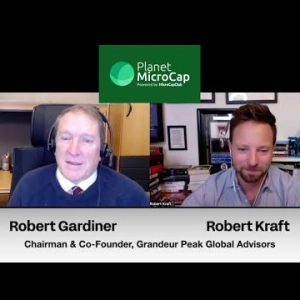
My guest today is Robert Gardiner, Chairman and Co-Founder of Grandeur Peak Global Advisors. Robert has over four decades of experience investing in small and micro-cap companies across global markets, and in this conversation, he shares how his core investment philosophy has remained remarkably consistent over that entire period. His approach is rooted in bottom-up research — identifying high-quality growth businesses early in their lifecycle, partnering with strong management teams, and maintaining strict valuation discipline.A major theme of this episode is why Robert believes the most compelling opportunity in micro-cap investing today is outside the United States. He explains how international micro-cap markets now resemble the U.S. micro-cap environment of the 1990s — a time defined by a large and growing universe of public companies, limited institutional coverage, and meaningful inefficiencies. We discuss why regulatory changes and the rise of private equity have shrunk the opportunity set in the U.S., and why regions like Japan, the UK, and the Nordics now offer what he describes as “mouthwatering” opportunities.Robert also walks through Grandeur Peak’s two-phase investment process — starting with rigorous quantitative screening across a global universe of roughly 35,000 companies, followed by deep qualitative research that emphasizes direct engagement with management and extensive on-the-ground company visits. We talk about why “touching the company” still matters in an era of AI and data abundance, and how global “dot connecting” can make investors better decision-makers, even in domestic portfolios.Finally, Robert shares lessons from a recent three-year sabbatical that prompted meaningful refinements to both process and culture at Grandeur Peak — including the importance of balancing breadth with depth in research, reinforcing buy and sell discipline, and building a firm culture where every team member feels true ownership.This is a wide-ranging conversation that touches on global markets, micro-cap inefficiencies, investment process, leadership, and long-term perspective from someone who has seen multiple cycles firsthand.For more information about Grandeur Peak Global Advisors, please visit: https://grandeurpeakglobal.com/
Watch on YouTube:
Summary:
This podcast synthesizes the investment philosophy, market outlook, and professional insights of Robert Gardiner, Chairman and co-founder of Grandeur Peak Global Advisors. With more than four decades of experience, Gardiner’s approach is grounded in a consistent, bottom-up strategy focused on identifying high-quality, small growth companies at fair prices.
The central thesis is that the most compelling opportunities in micro-cap investing today exist outside the United States. Gardiner argues that international micro-cap markets now resemble the fertile U.S. micro-cap environment of the 1990s—characterized by a broad and growing company universe, limited institutional competition, and attractive valuations—before increased regulation and the rise of private equity constrained opportunity.
Regions such as Japan, the United Kingdom, and the Nordics stand out as particularly rich hunting grounds for underfollowed companies. Grandeur Peak’s investment process combines rigorous quantitative screening across a universe of approximately 35,000 global companies with intensive, on-the-ground qualitative research emphasizing direct engagement with management.
The document also explores key lessons from Gardiner’s recent three-year sabbatical, which prompted renewed emphasis on research depth, process discipline, leadership presence, and firm culture as foundations for long-term investment success.
Robert Gardiner: Career Trajectory and Core Philosophy
An Unconventional Start
Robert Gardiner’s entry into investing was unconventional. At age 16, he began doing “grunt work” for finance professor Sam Stewart, a neighbor, just as personal computers were emerging. What began as an after-school job at Wasatch Advisors, intended to be temporary while Gardiner pursued math and physics, evolved into a lifelong career.
Gardiner credits his success to mentors including Sam Stewart and Jeff Carden, offering this advice to young professionals:
“Work for some really smart good people… that’s the best thing you can do for your career is to learn from them.”
His motivation comes from the intellectual challenge of identifying future market leaders, the competitive nature of investing, and a sense of responsibility for stewarding clients’ “hard-earned money.” After a long tenure at Wasatch, Gardiner co-founded Grandeur Peak Global Advisors in 2011.
Enduring Investment Principles
Gardiner emphasizes that his core strategy has remained unchanged for more than 40 years. It is a common-sense approach focused on finding superior businesses early in their life cycle.
Core Tenets
* Identify great small companies with substantial long-term growth runway
* Seek businesses with durable competitive advantages and sound business models
* Invest alongside capable, trustworthy management teams
* Maintain strict valuation discipline, aiming to pay a fair price or better
As Gardiner notes:
“I’ve literally spent every ounce of my energy… doing that, trying to do that. And it turns out that small and micro is a rich place to do that.”
The State of Micro-Cap Investing
Structural Challenges for Large Asset Managers
Gardiner outlines why large institutions often avoid micro-caps—creating opportunity for specialized investors:
* Position sizing:
“If you want to put even 1% into five billion… that’s a $50 million investment. You can’t put that to work in a $200 million market cap without owning 25% of the company.”
* Illiquidity and patience: Micro-caps require long-term ownership—often five to ten years—making them incompatible with high-turnover strategies.
* Business model mismatch: Micro-cap funds must cap assets, limiting revenue and making them unattractive to large asset managers who prefer scalable products.
The Evolving U.S. Micro-Cap Landscape
Gardiner uses a fishing analogy to describe an ideal investment environment: a lake well-stocked with fish, continuously replenished, and not overfished. While this described the U.S. micro-cap market in the 1990s, conditions have deteriorated.
Factors Shrinking the U.S. Opportunity Set
* Sarbanes-Oxley (post-Enron)Increased regulatory costs and personal liability discouraged small-company IPOs.
* Rise of Private EquityPE offered a more attractive funding alternative, reducing the flow of new public companies.
Gardiner concludes:
“Unfortunately in the US it’s not as true as it was in 1995… there’s still an interesting US micro-cap space, but in my mind it’s not nearly as interesting as internationally.”
The Thesis for International Micro-Cap Investing
Gardiner believes today’s international micro-cap universe mirrors the opportunity-rich U.S. environment of the mid-1990s.
Why International Micro-Caps Are Attractive
* Vast, growing universe: Over 30,000 global small and micro-cap companies, with ongoing IPO activity in less-regulated markets.
* Market inefficiency: Less institutional attention and weaker category awareness create mispricings.
* Favorable sentiment: International small-caps are out of favor with U.S. investors focused on domestic large-caps and private equity.
Gardiner describes current valuations as “mouthwatering.”
Key Regions of Opportunity
Japan
* Corporate governance reforms are driving dividends, buybacks, and M&A.
* Rich universe of under-the-radar micro-caps.
“These companies can double, double again… and that’s exciting.”
Nordics (especially Sweden)
* High density of high-quality small companies with strong growth and reasonable valuations.
“This company can double in the next five or six years and probably double again after that.”
United Kingdom
* Macro headwinds (Brexit, Ukraine war) have depressed valuations despite strong fundamentals.
“The quality of the companies is outstanding… valuations are off the charts interesting.”
The Grandeur Peak Investment Process
Phase 1: Quantitative Screening
Gardiner, a math major, believes “the numbers tell a story.”
* Universe of ~35,000 public companies screened down to ~2,800 best-in-class growth names
* Metrics include rising ROA, strong growth, and reasonable valuation (P/E, EV/EBITDA, Market Cap/Revenue)
* AI and LLMs are increasingly used to screen qualitative factors such as market share and competitive advantage
Phase 2: Qualitative Deep Dive & “Company Touch”
Quantitative insights are followed by intensive qualitative research.
* Direct engagement: Calls and in-person meetings with management
* Boots on the ground: Site visits provide cultural, political, and macro context
* High-touch approach: Grandeur Peak prides itself on the volume of global company visits
Gardiner emphasizes:
“Something AI will never be able to do is sit in front of a CEO and hear them articulate their strategy.”
Case Study: O’Reilly Automotive
Gardiner discovered O’Reilly shortly after its IPO by screening Missouri-based companies, driving three hours to meet the CEO on a Saturday. The investment became a 20–30x return at Wasatch.
Global “Dot Connecting”
Gardiner believes a global mandate improves investing everywhere—even domestically.
“Wherever the best company is… if it’s not in the US, buy it there.”
Understanding global competitors, trends, and business models leads to better decision-making across portfolios.
Leadership, Culture, and Lessons from a Sabbatical
After a three-year religious sabbatical, Gardiner returned with fresh perspective.
Process Refinements
* Depth over breadthGlobal reach had stretched research resources too thin. Grandeur Peak is reducing holdings to deepen conviction.
* Restoring disciplineOveremphasis on valuation led to holding “value traps” that lost momentum. The firm is rebalancing its focus across quality, momentum, and valuation.
Cultural Imperatives
* Leadership presence: Gardiner recognized the need to be more present for his team and recommitted to leadership.
* Shared ownership:
“I want this firm to feel like everybody here feels like it’s their company.”
This reflection was not a step toward retirement. Gardiner concluded:
“I’m hoping that I die in my 90s from a heart attack, reading an annual report… that I’m still doing this for another couple decades.”
Planet MicroCap Podcast is on YouTube! All archived episodes and each new episode will be posted on the Planet MicroCap YouTube channel. I’ve provided the link in the description if you’d like to subscribe. You’ll also get the chance to watch all our Video Interviews with management teams, educational panels from the conference, as well as expert commentary from some familiar guests on the podcast.
Subscribe here: http://bit.ly/1Q5Yfym
Click here to rate and review the Planet MicroCap Podcast
You can Follow the Planet MicroCap Podcast on Twitter @BobbyKKraft
This is a public episode. If you would like to discuss this with other subscribers or get access to bonus episodes, visit
microcapnewsletter.substack.com