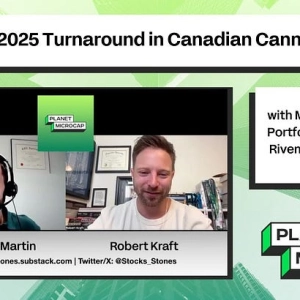
My guest on the show today is Mathieu Martin, Portfolio Manager at Rivemont MicroCap Fund. I've known Mathieu a long time, and he's a regular guest on the show. He's a generalist microcap investor who recently started exploring a sector many investors have written off entirely: Canadian cannabis. After years of avoiding the space due to its speculative excesses, Mathieu has been seeing the potential for a turnaround — with cleaner balance sheets, improving fundamentals, and profitable operators finally emerging.
In this episode, we talk about what’s changed in the Canadian cannabis landscape — from rationalized supply and reduced competition, to international export markets and stronger brand differentiation. Mathieu shares how he uncovered opportunities like High Tide, why some vertically integrated players like Cannara Biotech and Rubicon stand out, and how excise tax reform or expanded retail footprints could serve as powerful catalysts for the sector.
We also dig into why most investors are still stuck on the legacy LPs from the 2017–2019 bubble — and what they’re missing. Mathieu explains the importance of reading cash flow statements over flashy revenue growth, highlights accounting red flags, and discusses how to navigate this highly regulated, capital-intensive market with discipline.
If you’ve written off cannabis or simply haven’t revisited the Canadian names in years, this conversation might just change your mind, and for full disclosure, we discussed a number of companies on today's episode, and I'm not a shareholder in any of them.
For more information about the Rivemont MicroCap Fund and the Stocks & Stones Newsletter, please visit: https://stocksandstones.substack.com/
You can Follow Mathieu Martin on Twitter/X @Stocks_Stones: https://x.com/Stocks_Stones
Watch on YouTube:
Summary:
I. Overview of the Canadian Cannabis Market Shift
The Canadian cannabis market is undergoing a significant turnaround after years of stagnation following the speculative bubble from 2017 to 2019. Matthew Martin, who had previously avoided the sector due to its speculative nature, has recently become interested as fundamentals have improved and profitable operators have started to emerge.
Historical Context:From 2017 to 2019, Canadian cannabis experienced a massive bull market, which led to excessive speculation. This resulted in a prolonged bust period lasting nearly five years.
Renewed Interest:Martin’s interest was reignited in 2023 after an analyst introduced him to High Tide, a cannabis retailer with impressive metrics. Since then, he sees the space “starting to turn around,” with “upcoming winners… starting to emerge.”
II. Key Drivers of the Canadian Cannabis Market Turnaround
Several factors are driving the renewed momentum and investment opportunity in Canadian cannabis:
Rationalized Supply Side
* Past Oversupply:During the initial boom, producers built “several times more cultivation capacity than the market demand,” driving wholesale prices down.
* Punitive Excise Tax:A fixed excise tax of $1 per gram was originally meant to be 10% of a $10/gram price. As prices dropped to $3–4/gram, this became a 25–40% tax on topline sales, severely hurting margins and pushing many producers out of business.
* Bankruptcies and Exits:More than 60 bankruptcies over the past 3–4 years have helped rationalize supply.
* Undersupply:Martin notes a “consensus that the Canadian market is now under-supplied,” contributing to rising wholesale prices.
Emergence of International Markets
* Export Demand:New international markets (Germany, Israel, Australia) lack domestic cultivation and rely on imports. Canada is now the world’s largest exporter of cannabis.
* Profitability of Exports:Export sales are “way more profitable” than domestic sales, as Canadian LPs don’t pay excise tax on exports.
* Shift in Strategy:Some LPs are doubling down on Canada, while others are pulling product from Canadian shelves and prioritizing exports, reducing domestic supply.
Focus on Quality and Consistency
* Differentiation:Cannabis is no longer a commodity. Martin emphasizes the importance of flower quality, THC levels, and flavor profile.
* Brand Loyalty:Repeat purchasing is growing as consumers begin to recognize and prefer consistent, high-quality brands.
* Quality Assurance:Newer cultivators prioritize quality assurance as a core focus and differentiator.
III. Investment Focus and Competitive Advantages
Martin’s investment strategy in cannabis targets profitable, fast-growing companies with strong balance sheets and durable competitive advantages.
High Tide (Retail):
Martin’s entry point into cannabis. High Tide employs a “Costco model,” offering a premium membership for discounted cannabis and accessories. This makes them the “lowest-cost retailer” and capable of “running their competitors out of business.”
Licensed Producers (Cultivation):
Initially seen as a commoditized segment, Martin now sees differentiation in quality. He seeks LPs that are “growing 30–40% year-over-year” and are already profitable.
Vertical Integration:
Martin favors companies that control cultivation, processing, packaging, and branding.
* Canara: Fully vertically integrated.
* Rubicon: Fairly integrated, continuing to internalize more processes.
Barriers to Entry:
* Regulatory Hurdles:The industry is highly regulated, making market entry difficult and time-consuming (2+ years to establish distribution).
* Capital Intensity:Building large-scale greenhouses requires significant upfront capital, and very little new capital is entering the space today.
IV. Industry Challenges and Misperceptions
Despite positive trends, the sector still faces challenges and is often misunderstood.
Legacy LP Struggles:
Investors still associate the space with legacy names like Canopy Growth, Aurora, and Tilray—firms that continue to struggle with profitability, high debt loads, and shrinking market share.
Market Misunderstanding:
There’s little awareness of emerging players like Canara and Rubicon that are gaining share, growing revenues, producing high-quality products, and doing so profitably.
Accounting Red Flags:
Martin emphasizes cash flow analysis over reported earnings. For example, Simply Solventless Concentrate showed rising revenue and net income, but consistently negative cash flow due to inventory build-up. Revenues were booked in cannabis rather than cash, inflating inventory and leading to restatements.
* Investor Tip:“Look at the cash flow statement,” examine inventory, and favor companies with “a year or more of clean, audited financials.”
V. Potential Catalysts for Future Growth
Several developments could significantly boost the Canadian cannabis investment thesis:
Industry-Specific Catalysts
* Higher THC Limits on Edibles:Canada’s current limits are relatively low. Raising them could expand the addressable market.
* Excise Tax Reform:Reducing the “punitive” excise tax would make the industry more profitable.
* Quebec Expansion:Quebec has one of the lowest cannabis store densities in Canada. A more open retail footprint could “double the size” of its market.
Capital Market Catalysts
* M&A Activity:A major acquisition by a tobacco or alcohol company could “wake people up” to the space’s potential.
* Fundamental Execution:If profitable players continue to grow, “their fundamentals will become impossible to ignore.”
VI. Consumption Trends and Market Outlook
Illegal to Legal Market Transition:
Since legalization, the legal market has steadily grown, now representing “75–80% of total cannabis sales in Canada.” This growth has come almost entirely from capturing market share from the illicit market.
Recession Resistance:
Martin sees cannabis as similar to tobacco and alcohol—“fairly recession resistant” with stable demand even in downturns.
Ongoing Consumption Growth:
Martin expects mid-single-digit annual growth. Younger generations drinking less alcohol may act as a “tailwind” for cannabis consumption.
Canada vs. U.S. Consumption (via ChatGPT):
Canada has “higher overall prevalence” of cannabis use, but usage intensity is higher in the U.S., where a “larger share of users consume daily or near daily.”
VII. Broader Microcap Market Trends
Beyond cannabis, Martin notes several important dynamics in the broader Canadian microcap market:
M&A Slowdown:
The previously “hot” M&A environment of 2023–2024 has cooled. Monthly deal volume is down from 5–8 to just 1–3 transactions.
Reduced Opportunities:
Many quality names have gone private, leaving “a big hole in the portfolio” and making it “hard to replace these opportunities.”
Valuation Uplift (Non-M&A):
M&A helped rerate certain names to higher valuations, meaning not all needed to go private. As a result, “the space isn’t as discounted as it once was.”
LIFE Financings:
The new “LIFE financing” exemption makes it easier for microcaps to raise capital. It provides a low-cost, immediately tradable alternative to a prospectus offering, reducing cost of capital and increasing flexibility for microcap companies.
Planet MicroCap Podcast is on YouTube! All archived episodes and each new episode will be posted on the Planet MicroCap YouTube channel. I’ve provided the link in the description if you’d like to subscribe. You’ll also get the chance to watch all our Video Interviews with management teams, educational panels from the conference, as well as expert commentary from some familiar guests on the podcast.
Subscribe here: http://bit.ly/1Q5Yfym
Click here to rate and review the Planet MicroCap Podcast
The Planet MicroCap Podcast is brought to you by SNN Incorporated, The Official MicroCap News Source, and the Planet MicroCap Review Magazine, the leading magazine in the MicroCap market.
You can Follow the Planet MicroCap Podcast on Twitter @BobbyKKraft
This is a public episode. If you would like to discuss this with other subscribers or get access to bonus episodes, visit
microcapnewsletter.substack.com








![[ARCHIVE] Ep. 41 - The Art of Value Investing with Sanjay Bakshi, Professor and Value Investor (Original air date: March 28, 2017)](/imgp.php?url=https://substackcdn.com/feed/podcast/271436/post/168783808/4079caefee7026df441f09faaacd2d94.jpg)
