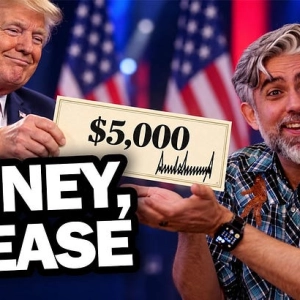
The Trump administration is backing away from a planned $1.8 billion anti-weaponization fund after a revolt from Republicans on Capitol Hill. The fund, tied to a settlement and intended to be administered by the Justice Department, had drawn criticism as a potential slush fund that could benefit Trump allies prosecuted under the Biden administration. White House officials told GOP leaders they were retreating from the proposal, at least for now.
What stands out to me is that this was never something Trump could simply do by executive order. It would have had to move through Congress, and right now he is running short on political leverage. Collins, Murkowski, and McConnell have already shown they’re willing to break with the administration. Add in senators like Tom Tillis, John Cornyn, and Bill Cassidy, who have their own political considerations, and suddenly there are a lot of Republican votes that need convincing. If every other priority is tied to this fund, it becomes a problem. The White House has signaled retreat…. for now.
Politics Politics Politics is a reader-supported publication. To receive new posts and support my work, consider becoming a free or paid subscriber.
Meanwhile, Florida Attorney General James Uthmeier has sued OpenAI and CEO Sam Altman, alleging that ChatGPT is an unsafe product, particularly for children, and that the company misled the public about its risks. The lawsuit argues that AI contributes to harms including addiction, suicide, and even mass shootings. What makes this interesting is that there are no clean ideological fault lines on AI. In Florida, AI is increasingly being treated as just another version of Big Tech, grouped together with the companies conservatives believe have censored or de-platformed them. Simultaneously, politicians in states like Michigan are celebrating AI investments, data centers, and the jobs that come with them, even as it might leave Gretchen Whitmer on the outside looking in for 2028. As AI becomes a larger part of the economy, states are going to play a much bigger role in determining how it develops.
But our biggest story remains Iran. Over the last few days, a targeted IRGC commander killing, an attack on a U.S. airbase in Kuwait, and reports that Iran is ending ceasefire talks have all pushed events away from diplomacy and toward escalation. Iran is threatening to fully shut down the Strait of Hormuz and other export routes. The president of Iran has reportedly tendered his resignation, while the IRGC appears to be tightening its grip on power. At the same time, Hezbollah has reportedly signaled a willingness to accept a ceasefire with Israel, though neither American nor Israeli officials seem convinced it would hold.
Everything now revolves around leverage. The Strait of Hormuz is Iran’s last major bargaining chip. If it reopens without major concessions, Tehran loses a significant source of pressure. If Iran gives up its nuclear ambitions or loses the ability to project power through regional proxies, the regime risks undermining the very justification it has used for decades. Meanwhile, global oil markets are hanging on every development. Hopes of a diplomatic breakthrough have helped keep prices contained, but each new escalation raises the possibility that the conflict widens and energy markets absorb the shock.
One small but important development is that internet access appears to be returning inside Iran after months of restrictions. That means more information is beginning to flow out of the country at a moment when the political situation appears increasingly unstable. Whether this ends in negotiations, further military action, or a deeper internal power struggle unfortunately remains wrapped in the fog of war.
Chapters
00:00:00 - Intro
00:03:07 - Interview with Evan Scrimshaw
00:39:19 - Trump Slush Fund
00:42:13 - AI Lawsuit
00:46:34 - Iran
00:50:10 - Interview with Charlie Feldman
01:30:42 - Wrap-up
This is a public episode. If you'd like to discuss this with other subscribers or get access to bonus episodes, visit
www.politicspoliticspolitics.com/subscribe