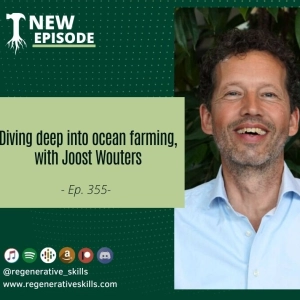
Diving deep into ocean farming, with Joost Wouters

Diving deep into ocean farming, with Joost Wouters

Author: Oliver Goshey September 6, 2024 Duration: 45:29
Today I want to continue with a deeper dive into the topic of water, literally, by going to the furthest point downstream, where terrestrial water enters the ocean.  Marine ecosystems are much less understood by the general public for a variety of reasons, but our actions on land have a direct effect on the health of our oceans too. Luckily there are incredible teams of people looking to address these issues with promising new solutions and over the next couple of episodes I’ll be highlighting a few of them.  To get things started I spoke to Joost Wouters, an entrepreneur, speaker, author and the ‘Sea’EO of the Seaweed Company. I got to know Joost first as a co-instructor with me on the Ecosystem restoration design course through Gaia Education. I was fascinated with his presentation and the compelling data on the potential regenerative effects that seaweed and kelp can have in bringing back the health of coastal areas. In his role with the Seaweed Company, he and his team aim to implement CO2-reducing seaweed-based business models at large scale. It turns out that seaweed is the fastest growing biomass in the world. Seaweed farming itself, if done responsibly, has the power to address many of the ecological challenges we face today, without the use of land, fertilizer, or freshwater. It reduces ocean acidification, promotes marine biodiversity, and even absorbs vast quantities of CO2 from the atmosphere. Seaweed can also create highly valuable end products. It is a nutritious food source for both people and animals and can be used as an environmentally friendly alternative to petroleum-based fertilisers and plastics. At the moment it’s a unique untapped resource, and the goal of the Seaweed Company is to unlock the potential of this wondrous resource to benefit both people and the planet. In this episode Joost starts by explaining some of the urgent issues facing marine environments and how seaweed farming can help to address them. We go over the advantages that growing seaweed has over terrestrial agriculture, the high value products that can be made from different types of seaweed, the many pilot projects around the world that his company has helped to start and much more.  Towards the end we also examine the roadblocks that are holding this solution back from being more widely adopted and how those of you listening can learn more and get involved.  I’ve personally been learning a lot about marine ecosystems through these interviews and truly hope that a greater awareness will begin to be built around just how essential the health of our oceans is to the health of all life, even to ecosystems that are far inland and away from any saltwater. I’m really excited for this and the next few episodes for this reason.
What does it mean to live a regenerative life, and how do we actually do it? That's the central question explored in Regenerative Skills, hosted by Oliver Goshey. This isn't just about theory; it's a practical dialogue focused on stewardship of the natural world and fostering strong, resilient communities. Every week, Oliver brings conversations with a diverse range of global experts right to your ears, translating their knowledge into actionable steps you can integrate into your daily habits. You'll hear tangible strategies for everything from soil health and sustainable food systems to building local networks and re-skilling ourselves for a better future. The aim is to move beyond sustainability toward active regeneration, providing the tools and perspectives needed to make a tangible difference right where you are. Tune into this educational podcast for a grounded, hopeful, and deeply informative journey. Together, these discussions build a comprehensive guide for anyone looking to heal their relationship with the environment and their neighbors, proving that positive change is woven from countless small, intentional actions.
Author: Language: en-us Episodes: 100

Regenerative Skills
Podcast Episodes
Academia and Farming: The disconnect and potential [not-audio_url] [/not-audio_url]

Duration: 1:20:51
In today’s deep dive episode we’re taking on the behemoth of a topic that is the broken system and relationship between academic institutions and farmers on the ground. For a long time there was traditional and experient…
From Waste to Wealth: Closing Loops on the Farm [not-audio_url] [/not-audio_url]

Duration: 59:00
In this panel session, we’re exploring one of the most practical and underused opportunities in regenerative farming and rural life: learning to see waste streams as life streams. Across farms and villages, huge amounts…
Measuring Regeneration: Beyond data and metrics [not-audio_url] [/not-audio_url]

Duration: 1:01:45
Welcome back everyone to the second of the Deep Dive episodes. In this new format the intention is to bring complexity back into the conversations around regenerative agriculture. Myself and many of my peers have been ob…
Who gets to say what "regeneration" means? [not-audio_url] [/not-audio_url]

Duration: 39:41
Welcome to episode two of season ten of the Regenerative Skills podcast. As I mentioned last time, the show is changing this year: we’re moving to two episodes a month, and I’ll be alternating between two formats. The fi…
Farming Without Burning Out: Boundaries, Joy, and Mental Resilience [not-audio_url] [/not-audio_url]

Duration: 58:38
To start off the year, I wanted to explore a topic that often gets swept under the rug. Mental well-being, or the lack of it, in farming communities has reached epedemic levels. Farmers in Europe face a nasty mix of chro…
Climate Resilience on European Farms: Adaptation and New Potential [not-audio_url] [/not-audio_url]

Duration: 56:45
Welcome back to another episode in our panel discussion series. In this edition we’ll be focusing on the challenges and opportunities of climate adaptation with examples of farmers in different key and representative zon…