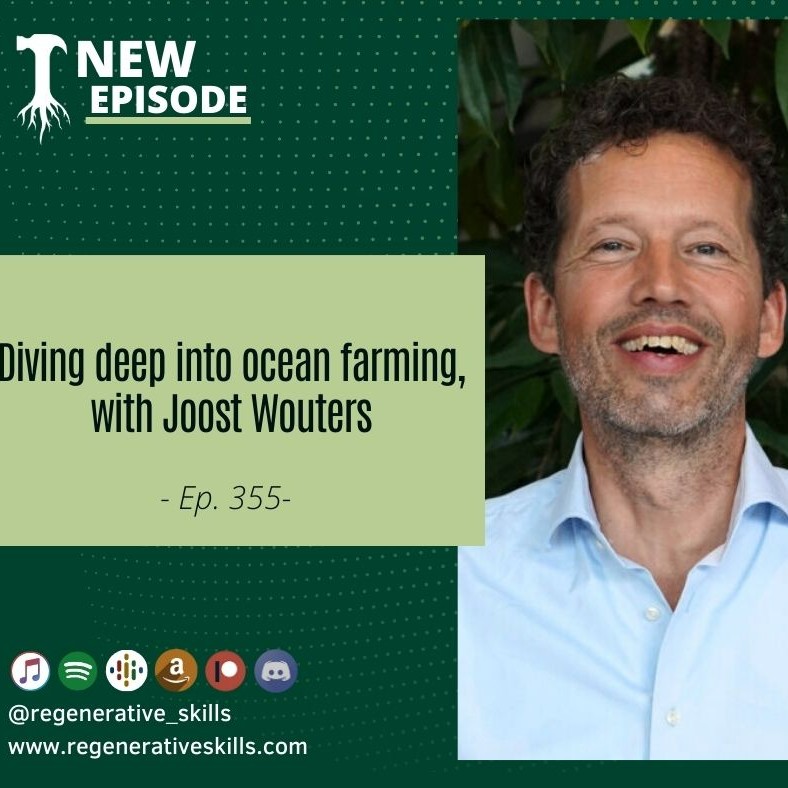
Diving deep into ocean farming, with Joost Wouters

Diving deep into ocean farming, with Joost Wouters

Author: Oliver Goshey September 6, 2024 Duration: 45:29
Today I want to continue with a deeper dive into the topic of water, literally, by going to the furthest point downstream, where terrestrial water enters the ocean.  Marine ecosystems are much less understood by the general public for a variety of reasons, but our actions on land have a direct effect on the health of our oceans too. Luckily there are incredible teams of people looking to address these issues with promising new solutions and over the next couple of episodes I’ll be highlighting a few of them.  To get things started I spoke to Joost Wouters, an entrepreneur, speaker, author and the ‘Sea’EO of the Seaweed Company. I got to know Joost first as a co-instructor with me on the Ecosystem restoration design course through Gaia Education. I was fascinated with his presentation and the compelling data on the potential regenerative effects that seaweed and kelp can have in bringing back the health of coastal areas. In his role with the Seaweed Company, he and his team aim to implement CO2-reducing seaweed-based business models at large scale. It turns out that seaweed is the fastest growing biomass in the world. Seaweed farming itself, if done responsibly, has the power to address many of the ecological challenges we face today, without the use of land, fertilizer, or freshwater. It reduces ocean acidification, promotes marine biodiversity, and even absorbs vast quantities of CO2 from the atmosphere. Seaweed can also create highly valuable end products. It is a nutritious food source for both people and animals and can be used as an environmentally friendly alternative to petroleum-based fertilisers and plastics. At the moment it’s a unique untapped resource, and the goal of the Seaweed Company is to unlock the potential of this wondrous resource to benefit both people and the planet. In this episode Joost starts by explaining some of the urgent issues facing marine environments and how seaweed farming can help to address them. We go over the advantages that growing seaweed has over terrestrial agriculture, the high value products that can be made from different types of seaweed, the many pilot projects around the world that his company has helped to start and much more.  Towards the end we also examine the roadblocks that are holding this solution back from being more widely adopted and how those of you listening can learn more and get involved.  I’ve personally been learning a lot about marine ecosystems through these interviews and truly hope that a greater awareness will begin to be built around just how essential the health of our oceans is to the health of all life, even to ecosystems that are far inland and away from any saltwater. I’m really excited for this and the next few episodes for this reason.
What does it mean to live a regenerative life, and how do we actually do it? That's the central question explored in Regenerative Skills, hosted by Oliver Goshey. This isn't just about theory; it's a practical dialogue focused on stewardship of the natural world and fostering strong, resilient communities. Every week, Oliver brings conversations with a diverse range of global experts right to your ears, translating their knowledge into actionable steps you can integrate into your daily habits. You'll hear tangible strategies for everything from soil health and sustainable food systems to building local networks and re-skilling ourselves for a better future. The aim is to move beyond sustainability toward active regeneration, providing the tools and perspectives needed to make a tangible difference right where you are. Tune into this educational podcast for a grounded, hopeful, and deeply informative journey. Together, these discussions build a comprehensive guide for anyone looking to heal their relationship with the environment and their neighbors, proving that positive change is woven from countless small, intentional actions.
Author: Language: en-us Episodes: 100

Regenerative Skills
Podcast Episodes
Crossing milestones and charting a new path forward: [not-audio_url] [/not-audio_url]

Duration: 32:42
400 episodes down and some big changes coming. It's been almost 9 full years since I started this little show and I'm amazed at the journey that it's accompanied me on, from my apprenticeship in bamboo building in Guatem…
Community Resilience: Farms as Anchors of Local Culture and Community [not-audio_url] [/not-audio_url]

Duration: 54:24
Welcome back everyone and welcome back to the monthly panel sessions. In this session that I hosted with Climate Farmers, we dive into the lives of three passionate farmers, Julia, Anne, and Mateo, who are not only dedic…
Why we need to rebug the planet, with Vicki Hird: redux [not-audio_url] [/not-audio_url]

Duration: 53:08
Though there are only a handful of bugs and invertebrates that humans consider edible, productive, or beautiful, they are an essential element in any healthy ecosystem.All too often the ones that we don’t derive beauty f…
The edible ecosystem solution, with Zach Loeks: redux [not-audio_url] [/not-audio_url]

Duration: 25:40
have you ever wondered what the difference between a garden and an edible ecosystem is? Do you want to know how you can create one in you own yard? In this episode with author Zach Loeks from the Ecosystem Solutions Inst…
Building regenerative community in Bulgaria, with Bobby Dimitrov [not-audio_url] [/not-audio_url]

Duration: 1:14:51
Building on the series with my friend Alex in Urugay on the challenges and opportunities of regeneration in areas of the world that are more economically and resource limited, Alex was able to connect with our mutual fri…
The Role of Livestock in Regenerative Systems: Panel Session [not-audio_url] [/not-audio_url]

Duration: 1:23:20
Welcome back to another panel session.This month our topic of focus was the role of livestock in regenerative farms.This is a contentious issue for many people either strongly entrenched in the idea that animals should b…
