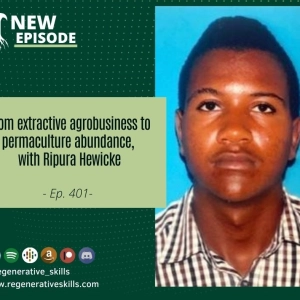
From extractive agrobusiness to permaculture abundance, with Ripura Hewicke

From extractive agrobusiness to permaculture abundance, with Ripura Hewicke

Author: Oliver Goshey November 28, 2025 Duration: 1:17:02
In our tour of Sub Saharran Africa, Alex followed a recommendation from Thiang’o to talk with Ripura Hewick. Ripura is based in Namibia, and manages a dryland farm for the non-profit Steps for Children.   Ripura started as a traditional Agrobusiness management student University of Science and Technology (NUST) graduate with a Bachelors of Agriculture  but left conventional agriculture, disappointed in the business. After a hiatus he returned to as a farm manager of a permaculture project connected to one of Steps for Children’s schools.    In this interview, Ripura describes the unlearning and relearning process he had to go through to figure out how to successfully build a community integrated market garden, that provides nutrition, education and seedlings for the local community.

What does it mean to live a regenerative life, and how do we actually do it? That's the central question explored in Regenerative Skills, hosted by Oliver Goshey. This isn't just about theory; it's a practical dialogue focused on stewardship of the natural world and fostering strong, resilient communities. Every week, Oliver brings conversations with a diverse range of global experts right to your ears, translating their knowledge into actionable steps you can integrate into your daily habits. You'll hear tangible strategies for everything from soil health and sustainable food systems to building local networks and re-skilling ourselves for a better future. The aim is to move beyond sustainability toward active regeneration, providing the tools and perspectives needed to make a tangible difference right where you are. Tune into this educational podcast for a grounded, hopeful, and deeply informative journey. Together, these discussions build a comprehensive guide for anyone looking to heal their relationship with the environment and their neighbors, proving that positive change is woven from countless small, intentional actions.
Author: Language: en-us Episodes: 100

Regenerative Skills
Podcast Episodes
Community Resilience: Farms as Anchors of Local Culture and Community [not-audio_url] [/not-audio_url]

Duration: 54:24
Welcome back everyone and welcome back to the monthly panel sessions. In this session that I hosted with Climate Farmers, we dive into the lives of three passionate farmers, Julia, Anne, and Mateo, who are not only dedic…
Why we need to rebug the planet, with Vicki Hird: redux [not-audio_url] [/not-audio_url]

Duration: 53:08
Though there are only a handful of bugs and invertebrates that humans consider edible, productive, or beautiful, they are an essential element in any healthy ecosystem.All too often the ones that we don’t derive beauty f…
The edible ecosystem solution, with Zach Loeks: redux [not-audio_url] [/not-audio_url]

Duration: 25:40
have you ever wondered what the difference between a garden and an edible ecosystem is? Do you want to know how you can create one in you own yard? In this episode with author Zach Loeks from the Ecosystem Solutions Inst…
Building regenerative community in Bulgaria, with Bobby Dimitrov [not-audio_url] [/not-audio_url]

Duration: 1:14:51
Building on the series with my friend Alex in Urugay on the challenges and opportunities of regeneration in areas of the world that are more economically and resource limited, Alex was able to connect with our mutual fri…
The Role of Livestock in Regenerative Systems: Panel Session [not-audio_url] [/not-audio_url]

Duration: 1:23:20
Welcome back to another panel session.This month our topic of focus was the role of livestock in regenerative farms.This is a contentious issue for many people either strongly entrenched in the idea that animals should b…
How co-op groceries are taking on “the giants,” with Jon Steinman [not-audio_url] [/not-audio_url]

Duration: 1:12:20
For a long time now, our food system has been a primary indicator for so many markers of health in our society, from the way that our food is produced, what kinds of food we eat, how we cook, how it affects our health an…