This is a guest conversation episode of Ship It Weekly, separate from the weekly news recaps.
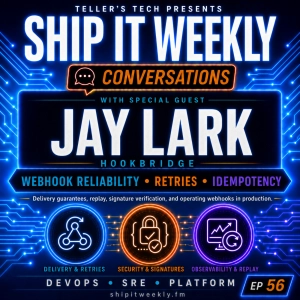
In this Ship It Conversations episode, I talk with Jay Lark of Hookbridge about webhook reliability, retries, idempotency, replay, security, local development, and what happens when a simple HTTP POST becomes production infrastructure.
Jay is a Principal DevOps Engineer and the founder of Hookbridge, a service focused on making webhook delivery more reliable and easier to operate.
We start with the basic model: one service sends an HTTP POST to another when something happens. The happy path is easy. The problems begin when an endpoint is unavailable, responds too slowly, receives duplicate events, or gets them out of order.
Jay explains what “at least once delivery” means and why receivers must expect duplicates. We talk about idempotency, event IDs, retry behavior, availability during deployments, and why returning a 200 does not prove downstream processing succeeded.
We also dig into observability and security. Teams need enough visibility to know whether a webhook arrived, whether signature verification passed, what response was returned, and where processing failed. Jay breaks down HMAC signatures, timestamps, replay protection, and why a valid signature still does not replace normal business-logic validation.
Local development is another source of friction. External providers cannot send events directly to localhost, so developers often rely on temporary tunnels, staging deployments, copied payloads, or mocks. Jay explains how Hookbridge uses a fixed URL and local client to forward real webhook traffic to a developer’s machine.
We also talk about n8n, self-hosted OpenClaw systems, Hookbridge pull endpoints, and when polling may be simpler or safer than exposing another inbound endpoint.
The big takeaway: design the failure path before a webhook becomes business-critical. Verify the sender, expect duplicate and out-of-order events, build enough visibility to debug failures, and have a replay strategy before the first incident.
Highlights
• Why webhooks are harder than “just an HTTP POST”
• What at-least-once delivery means for receivers
• Why idempotency, retries, and event ordering matter
• What teams need for webhook observability and debugging
• Where HMAC signatures, timestamps, and replay protection fit
• Why local webhook development is still awkward
• When polling or pull-based delivery may be a better fit
• When teams should stop building webhook infrastructure themselves
Links
Hookbridge: https://hookbridge.io
Hookbridge local development CLI: https://www.hookbridge.io/cli.html
Hookbridge pull endpoints: https://www.hookbridge.io/pull.html
Jay Lark on LinkedIn: https://www.linkedin.com/in/jay-lark-ba7a3b5/
OpenClaw: https://openclaw.ai
More episodes and show notes: https://shipitweekly.fm
On Call Brief: https://oncallbrief.com