Christine Rosen: The Extinction of Experience

Christine Rosen: The Extinction of Experience

Author: Helen and Dave Edwards August 21, 2025 Duration: 55:26

In this conversation, we explore the shifts in human experience with Christine Rosen, senior fellow at the American Enterprise Institute and author of "The Extinction of Experience: Being Human in a Disembodied World." As a member of the "hybrid generation" of Gen X, Christine (like us) brings the perspective of having lived through the transition from an analog to a digital world and witnessed firsthand what we've gained and lost in the process.

Christine frames our current moment through the lens of what naturalist Robert Michael Pyle called "the extinction of experience"—the idea that when something disappears from our environment, subsequent generations don't even know to mourn its absence. Drawing on over 20 years of studying technology's impact on human behavior, she argues that we're experiencing a mass migration from direct to mediated experience, often without recognizing the qualitative differences between them.

Key themes we explore:

  • The Archaeology of Lost Skills: How the abandonment of handwriting reveals the broader pattern of discarding embodied cognition—the physical practices that shape how we think, remember, and process the world around us
  • Mediation as Default: Why our increasing reliance on screens to understand experience is fundamentally different from direct engagement, and how this shift affects our ability to read emotions, tolerate friction, and navigate uncomfortable social situations
  • The Machine Logic of Relationships: How technology companies treat our emotions "like the law used to treat wives as property"—as something to be controlled, optimized, and made efficient rather than experienced in their full complexity
  • Embodied Resistance: Why skills like cursive handwriting, face-to-face conversation, and the ability to sit with uncomfortable emotions aren't nostalgic indulgences but essential human capacities that require active preservation
  • The Keyboard Metaphor: How our technological interfaces—with their control buttons, delete keys, and escape commands—are reshaping our expectations for human relationships and emotional experiences


Christine challenges the Silicon Valley orthodoxy that frames every technological advancement as inevitable progress, instead advocating for what she calls "defending the human." This isn't a Luddite rejection of technology but a call for conscious choice about what we preserve, what we abandon, and what we allow machines to optimize out of existence.

The conversation reveals how seemingly small decisions—choosing to handwrite a letter, putting phones in the center of the table during dinner, or learning to read cursive—become acts of resistance against a broader cultural shift toward treating humans as inefficient machines in need of optimization. As Christine observes, we're creating a world where the people designing our technological future live with "human nannies and human tutors and human massage therapists" while prescribing AI substitutes for everyone else.

What emerges is both a warning and a manifesto: that preserving human experience requires actively choosing friction, inefficiency, and the irreducible messiness of being embodied creatures in a physical world. Christine's work serves as an essential field guide for navigating the tension between technological capability and human flourishing—showing us how to embrace useful innovations while defending the experiences that make us most fully human.

About Christine Rosen: Christine Rosen is a senior fellow at the American Enterprise Institute, where she focuses on the intersection of technology, culture, and society. Previously the managing editor of The New Republic and founding editor of The Hedgehog Review, her writing has appeared in The Atlantic, The New York Times, The Wall Street Journal, and numerous other publications. "The Extinction of Experience" represents over two decades of research into how digital technologies are reshaping human behavior and social relationships.
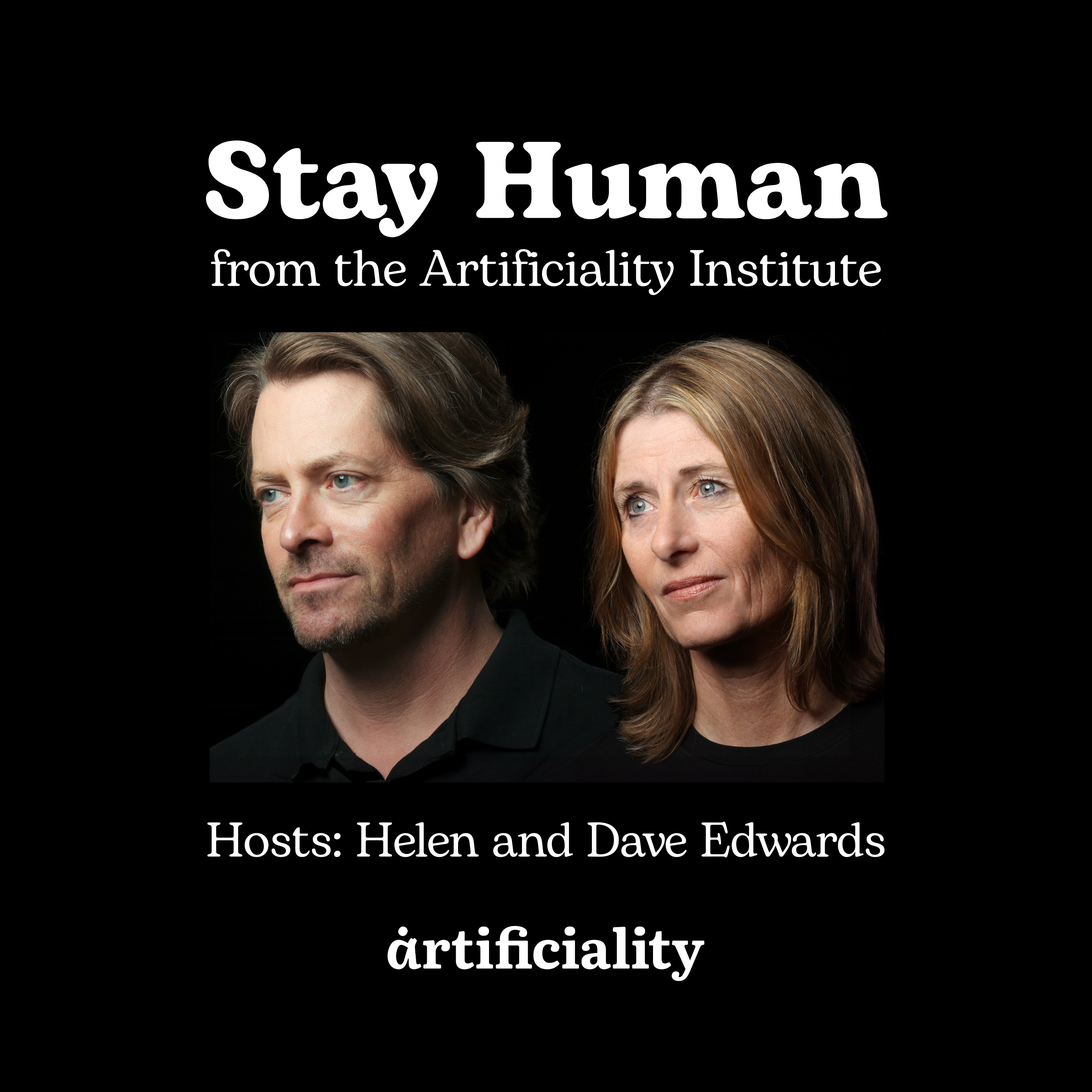

Hosted by Helen and Dave Edwards, Stay Human, from the Artificiality Institute is a conversation that lives in the messy, human space between our tools and our selves. Each episode digs into the subtle ways artificial intelligence is reshaping our daily decisions, our creative impulses, and even our sense of identity. This isn't a technical manual or a series of futuristic predictions; it's a grounded exploration of how we maintain our agency in a world increasingly mediated by algorithms. The podcast operates from a core belief: that our engagement with AI should be about more than just safety or efficiency-it needs to be meaningful and worthwhile. You'll hear discussions rooted in story-based research, where complex ideas about cognition and ethics are unpacked through relatable narratives and real-world examples. The goal is to provide a framework for thoughtful choice, helping each of us consciously design the relationship we want with the machines in our lives. Tuning in offers a chance to step back from the hype and consider how we can actively remain the authors of our own minds, preserving what makes us uniquely human even as the technology evolves. It's an essential listen for anyone curious about the personal and philosophical dimensions of our digital age.
Author: Language: en-us Episodes: 100

Stay Human, from the Artificiality Institute
Podcast Episodes
Julia Rhodes Davis: Advancing Racial Equity [not-audio_url] [/not-audio_url]

Duration: 47:39
In this episode, we speak with Julia Rhodes Davis, a Senior Advisor at Data & Society, about her recent report "Advancing Racial Equity Through Technology Policy" published by the AI Now Institute. This comprehensive rep…
Alicia Juarrero: Context Changes Everything [not-audio_url] [/not-audio_url]

Duration: 1:04:50
Grounding her work in the problem of causation, Alicia Juarrero challenges previously held beliefs that only forceful impacts are causes. Constraints, she claims, bring about effects as well, and they enable the emergenc…
Jai Vipra: Computational Power and AI [not-audio_url] [/not-audio_url]

Duration: 41:17
Jai Vipra is a research fellow at the AI Now Institute where she focuses on competition issues in frontier AI models. She recently published the report Computational Power and AI which focuses on compute as a core depend…
Wendy Wong: We, the Data, and Human Rights [not-audio_url] [/not-audio_url]

Duration: 58:40
Wendy Wong is a professor of political science and principal’s research chair at the University of British Columbia where she researches and teaches about the governance of emerging technologies, human rights, and civil…
Chris Summerfield: Natural General Intelligence [not-audio_url] [/not-audio_url]

Duration: 56:53
Chris Summerfield is a Professor of Cognitive Science at the University of Oxford. His work is concerned with understanding how humans learn and make decisions. He is interested in how humans acquire new concepts or patt…
Michael Bungay Stanier: How to Work with (Almost) Anyone [not-audio_url] [/not-audio_url]

Duration: 58:02
Michael Bungay Stanier has an extraordinary talent for distilling the complexity of human relationships into easy to remember and follow frameworks—doing so with just the right amount of Australian humor and plenty of vu…
Synthesis & Generative AI [not-audio_url] [/not-audio_url]

Duration: 33:21
An exploration of how we might conceptualize the design of AGI within the context of human left and right brains. The tension between AI and human functioning highlights unique cooperation. AI uses language, abstraction,…
Jonathan Coulton: Generative AI, songwriting, and creativity [not-audio_url] [/not-audio_url]

Duration: 1:01:37
If you’ve read our show notes, you’ll know that our music was written and performed by Jonathan Coulton. I’ve known Jonathan for more than 30 years, dating back to when we sang together in college. But that’s a story for…
Is it possible for AI to be meaningful? [not-audio_url] [/not-audio_url]

Duration: 36:30
An exploration of the intersection of AI, meaning, and human relationships. In this episode, we dive deep into the role of AI in our lives and how it can influence our perception of meaning. We explore how AI, and specif…
Existential risk of AI [not-audio_url] [/not-audio_url]

Duration: 32:37
ChatGPT, Dall-e, Midjourney, Bard, and Bing are here. Many others are coming. At every dinner conversation, classroom lesson, and business meeting people are talking about AI. There are some big questions that now everyo…
