Christine Rosen: The Extinction of Experience

Christine Rosen: The Extinction of Experience

Author: Helen and Dave Edwards August 21, 2025 Duration: 55:26

In this conversation, we explore the shifts in human experience with Christine Rosen, senior fellow at the American Enterprise Institute and author of "The Extinction of Experience: Being Human in a Disembodied World." As a member of the "hybrid generation" of Gen X, Christine (like us) brings the perspective of having lived through the transition from an analog to a digital world and witnessed firsthand what we've gained and lost in the process.

Christine frames our current moment through the lens of what naturalist Robert Michael Pyle called "the extinction of experience"—the idea that when something disappears from our environment, subsequent generations don't even know to mourn its absence. Drawing on over 20 years of studying technology's impact on human behavior, she argues that we're experiencing a mass migration from direct to mediated experience, often without recognizing the qualitative differences between them.

Key themes we explore:

  • The Archaeology of Lost Skills: How the abandonment of handwriting reveals the broader pattern of discarding embodied cognition—the physical practices that shape how we think, remember, and process the world around us
  • Mediation as Default: Why our increasing reliance on screens to understand experience is fundamentally different from direct engagement, and how this shift affects our ability to read emotions, tolerate friction, and navigate uncomfortable social situations
  • The Machine Logic of Relationships: How technology companies treat our emotions "like the law used to treat wives as property"—as something to be controlled, optimized, and made efficient rather than experienced in their full complexity
  • Embodied Resistance: Why skills like cursive handwriting, face-to-face conversation, and the ability to sit with uncomfortable emotions aren't nostalgic indulgences but essential human capacities that require active preservation
  • The Keyboard Metaphor: How our technological interfaces—with their control buttons, delete keys, and escape commands—are reshaping our expectations for human relationships and emotional experiences


Christine challenges the Silicon Valley orthodoxy that frames every technological advancement as inevitable progress, instead advocating for what she calls "defending the human." This isn't a Luddite rejection of technology but a call for conscious choice about what we preserve, what we abandon, and what we allow machines to optimize out of existence.

The conversation reveals how seemingly small decisions—choosing to handwrite a letter, putting phones in the center of the table during dinner, or learning to read cursive—become acts of resistance against a broader cultural shift toward treating humans as inefficient machines in need of optimization. As Christine observes, we're creating a world where the people designing our technological future live with "human nannies and human tutors and human massage therapists" while prescribing AI substitutes for everyone else.

What emerges is both a warning and a manifesto: that preserving human experience requires actively choosing friction, inefficiency, and the irreducible messiness of being embodied creatures in a physical world. Christine's work serves as an essential field guide for navigating the tension between technological capability and human flourishing—showing us how to embrace useful innovations while defending the experiences that make us most fully human.

About Christine Rosen: Christine Rosen is a senior fellow at the American Enterprise Institute, where she focuses on the intersection of technology, culture, and society. Previously the managing editor of The New Republic and founding editor of The Hedgehog Review, her writing has appeared in The Atlantic, The New York Times, The Wall Street Journal, and numerous other publications. "The Extinction of Experience" represents over two decades of research into how digital technologies are reshaping human behavior and social relationships.
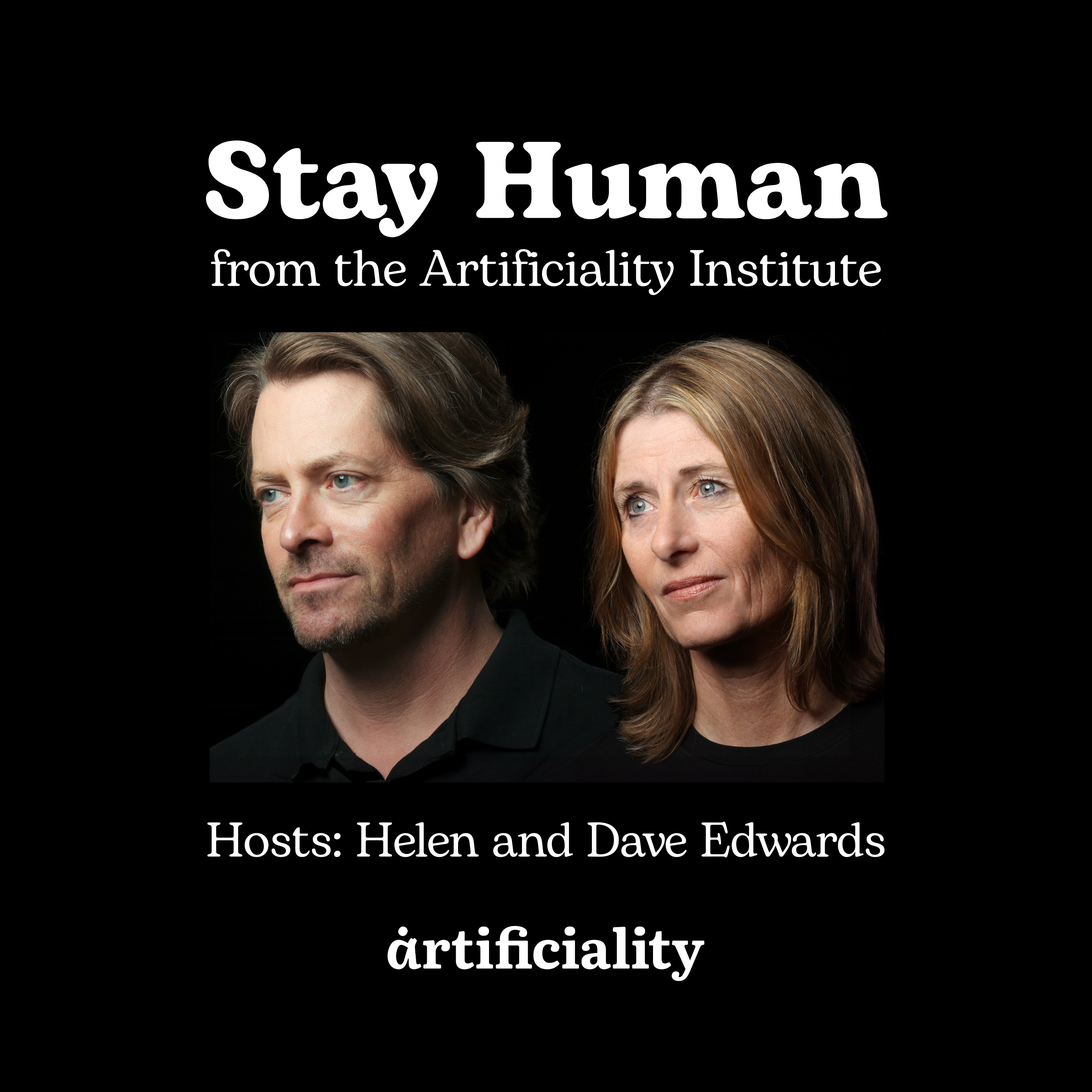

Hosted by Helen and Dave Edwards, Stay Human, from the Artificiality Institute is a conversation that lives in the messy, human space between our tools and our selves. Each episode digs into the subtle ways artificial intelligence is reshaping our daily decisions, our creative impulses, and even our sense of identity. This isn't a technical manual or a series of futuristic predictions; it's a grounded exploration of how we maintain our agency in a world increasingly mediated by algorithms. The podcast operates from a core belief: that our engagement with AI should be about more than just safety or efficiency-it needs to be meaningful and worthwhile. You'll hear discussions rooted in story-based research, where complex ideas about cognition and ethics are unpacked through relatable narratives and real-world examples. The goal is to provide a framework for thoughtful choice, helping each of us consciously design the relationship we want with the machines in our lives. Tuning in offers a chance to step back from the hype and consider how we can actively remain the authors of our own minds, preserving what makes us uniquely human even as the technology evolves. It's an essential listen for anyone curious about the personal and philosophical dimensions of our digital age.
Author: Language: en-us Episodes: 100

Stay Human, from the Artificiality Institute
Podcast Episodes
Values & Generative AI [not-audio_url] [/not-audio_url]

Duration: 25:05
As Silicon Valley lunges towards creating AI that is considered superior to humans (at times called Artificial General Intelligence or Super-intelligent AI), it does so with the premise that it is possible to encode valu…
Culture & Generative AI [not-audio_url] [/not-audio_url]

Duration: 32:29
Culture plays a vital role in connecting individuals and communities, enabling us to leverage our unique talents, share knowledge, and solve problems together. However, the rise of an intelligentsia of machine soothsayer…
Mind for our Minds: Introduction [not-audio_url] [/not-audio_url]

Duration: 26:28
This episode is the first in our summer series based on our thesis for designing AI to be a Mind for our Minds. We recently presented this idea for the first time at our favorite event of the year hosted by The House of…
C. Thi Nguyen: Metrification [not-audio_url] [/not-audio_url]

Duration: 1:07:38
AI is based on data. And data is frequently collected with the intent to be quantified, understood, and used across context. That’s why we have things like grade point averages that translate across subject matters and e…
Harpreet Sareen: Cyborg Botany [not-audio_url] [/not-audio_url]

Duration: 48:44
We are deeply interested in the intersection of the digital and material worlds, both living and not living. Most of our interviews are focused on the intersection of humans and machines—how does the digital world affect…
Arvind Jain: Glean, Enterprise Search, and Generative AI [not-audio_url] [/not-audio_url]

Duration: 48:03
Anyone working in a large organization has likely asked this question: Why is it that I can seemingly find anything on the internet but I can’t seem to find anything inside my organization? It is counter-intuitive that i…
Lukas Egger: Generative AI, a view from SAP [not-audio_url] [/not-audio_url]

Duration: 46:35
The world has been upended by the introduction of generative AI. We think this could be the largest advance in technology—ever. All of our clients are trying to figure out what to do, how to de-risk the introduction of t…
Katie Davis: Technology's Child [not-audio_url] [/not-audio_url]

Duration: 52:32
Is technology good or bad for children? How should parents think about technology in their children’s lives? Are there different answers depending on the age of the child and their stage of development? What can we apply…
Andrew Blum: The Weather Machine [not-audio_url] [/not-audio_url]

Duration: 52:58
Weather forecasting is fascinating. It involves making predictions in the complex, natural world, using a global infrastructure for people who have varying needs and desires. Some just want to know if we should carry an…
Juan Noguera: Generative AI in Industrial Design [not-audio_url] [/not-audio_url]

Duration: 39:26
We’ve heard a lot about how generative AI may negatively impact careers in design. But we wonder how might generative AI have a positive impact on designers? How might generative AI be used as a tool that helps designers…