Shostakovich Symphony No. 8

Shostakovich Symphony No. 8

Author: Joshua Weilerstein December 12, 2024 Duration: 1:08:33

Here are two statements by Dmitri Shostakovich about the same piece, the 8th symphony that we are talking about today:

Statement No. 1, Shostakovich's published comments about the symphony when it was first performed in 1943: The 8th Symphony reflects my…elevated creative mood, influenced by the joyful news of the Red Army's victories….
"The Eighth Symphony contains tragic and dramatic inner conflicts. But on the whole it is optimistic and life-asserting. The first movement is a long adagio, with a dramatically tense climax. The second movement is a march, with scherzo elements, and the third is a dynamic march. The fourth movement, in spite of its march form, is sad in mood. The fifth and final movement is bright and gay, like a pastoral, with dance elements and folk motifs.
"The philosophical conception of my new work can be summed up in these words: life is beautiful. All that is dark and evil rots away, and beauty triumphs."

Statement No. 2, from the disputed book Testimony, published in the 1970s: 'And then the war came and the sorrow became a common one. We could talk about it, we could cry openly, cry for our lost ones. People stopped fearing tears. Before the war there probably wasn't a single family who hadn't lost someone, a father, a brother, or if not a relative, then a close friend. Everyone had someone to cry over, but you had to cry silently, under the blanket, so no one would see. Everyone feared everyone else, and the sorrow oppressed and suffocated us. It suffocated me too. I had to write about it. I had to write a Requiem for all those who died, who had suffered. I had to describe the horrible extermination machine and express protest against it. The Seventh and Eighth Symphonies are my Requiems.

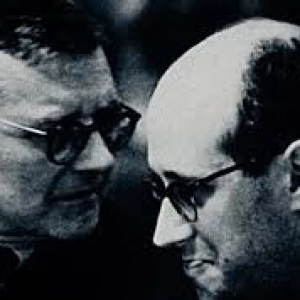
I don't know of a more profound example of Shostakovich's doublespeak, or of his ability to make diametrically opposing statements about the meaning behind his music.  Shostakovich's 8th symphony premiered at the height of World War II, and it was not a hit, unlike his 7th symphony which had swept the world with its seeming patriotic fervor and its devastating condemnation of the Nazis. Shostakovich's 8th is a very different piece, darker, edgier, less catchy, less simple, and certainly less optimistic. It was panned in the Soviet Union by the official critics and was effectively banned from performance in teh Soviet Union from 1948 until the late 1950s. It was also not particularly popular outside of the Soviet Union, as the 7th's popularity and accessibility dwarfed the 8th, though this equation has now flipped, with the 8th symphony now probably becoming slightly more often played than the 7th. As always with Shostakovich, he mixes tradition with his own Shostakovich-ian innovations. The symphony has a Sonata Form first movement, but that movement is longer than the following three movements combined. It has a darkness to light theme from C Minor to C Major, like in Beethoven's 5th and Mahler's 2nd, but whether the ending is optimistic is subject to furious debate. It has not 1 but 2 scherzos, but they are among the least funny scherzos ever written, and it has a slow movement that is surprisingly un-emotional. The requiem Shostakovich speaks of seems to happen slowly over the course of this 1 hour symphony. It is perhaps Shostakovich's most ambiguous mature symphony, and it is also thought of as one of his greatest masterpieces. Today on this Patreon Sponsored episode, we'll dive into this remarkable work, trying to create a framework to understand this huge and demanding symphony. Join us!


There’s a particular kind of curiosity that draws people to classical music, but the sheer scale of the repertoire can feel overwhelming. Sticky Notes: The Classical Music Podcast, hosted by conductor Joshua Weilerstein, meets that curiosity right where it is. Think of it as a series of open conversations about the music itself, designed to be equally engaging for someone hearing a symphony for the first time and for a lifelong devotee. Episodes might feature a thoughtful interview with a performing artist, offering a glimpse behind the curtain, or they could focus entirely on a single piece, peeling back its layers to explore why it resonates. Weilerstein guides these explorations with clarity and enthusiasm, moving seamlessly from foundational concepts to more nuanced details about different musical eras. The entire premise of this podcast is built on a genuine belief that this music belongs to all of us. It’s about replacing any sense of intimidation with connection and understanding. While past seasons are gradually being re-released, each episode stands as its own invitation to listen more deeply.
Author: Language: English Episodes: 50

Sticky Notes: The Classical Music Podcast
Podcast Episodes
Shostakovich Cello Concerto No. 1 [not-audio_url] [/not-audio_url]

Duration: 50:05
It's hard to overstate the depth of the connection between Dmitri Shostakovich and the legendary cellist Mstistlav Rostropovich. Shostakovich and Rostropovich were extremely close friends, and Shostakovich wrote and dedi…
Ravel, Ravel, Ravel, w/Boris Giltburg and G. Henle Verlag! [not-audio_url] [/not-audio_url]

Duration: 59:12
Magician, Swiss Watchmaker, Aloof, Elegant, Precise, Soulful, Childlike, Naive, Warm: these are all words that have been used to describe Maurice Ravel, a man of elegant contradictions. But perhaps these contradictions a…
Amy Beach, "Gaelic" Symphony [not-audio_url] [/not-audio_url]

Duration: 1:00:56
Amy Beach is a name that might not be familiar to you. She was born in 1867 and died in 1944, and her life was one of the most fascinating and varied in musical history. She was a child prodigy, became a successful piani…
Smetana: Ma Vlast [not-audio_url] [/not-audio_url]

Duration: 1:05:54
Nationalism, patriotism, cultural identity, a sense of home; these are concepts and ideas whose popularity have ebbed and flowed throughout history. Nationalism has been seen as a natural expression of cultural identity…
Berg Violin Concerto [not-audio_url] [/not-audio_url]

Duration: 48:49
In the early 1930s, at the height of the atonal and twelve tone movement in music, the American violinist Louis Krasner commissioned a concerto from the Viennese Composer Alban Berg. Berg declined at first, saying that h…
Beethoven String Quartet, Op. 135 [not-audio_url] [/not-audio_url]

Duration: 57:42
There is nothing like hearing a Late Beethoven String Quartet for the first time. Beethoven's late string quartets, Op. 127, Op. 130, Op. 131, Op. 132, and Op. 135, are among the 5 greatest pieces of music ever written f…
Berlioz Symphonie Fantastique LIVE w/ The Aalborg Symphony [not-audio_url] [/not-audio_url]

Duration: 1:12:20
I'm so happy to share this live episode of Sticky Notes that I did with the Aalborg Symphony Orchestra in Denmark back in October! This episode covered Berlioz's remarkable Symphonie Fantastique - the ultimate symphonic…
Literary Works in Classical Music [not-audio_url] [/not-audio_url]

Duration: 46:31
My Patreon sponsor for this episode, Adrian, set me a challenge: The influence of literary works on classical compositions, exploring pieces inspired by poetry, novels, or plays. He also asked me to do something else, an…