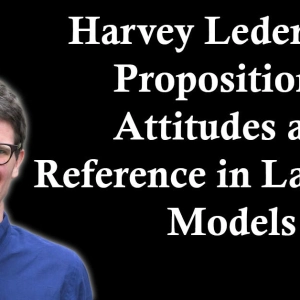
Harvey Lederman: Propositional Attitudes and Reference in Language Models

Harvey Lederman: Propositional Attitudes and Reference in Language Models

Author: Daniel Bashir January 11, 2024 Duration: 2:10:34

In episode 106 of The Gradient Podcast, Daniel Bashir speaks to Professor Harvey Lederman.

Professor Lederman is a professor of philosophy at UT Austin. He has broad interests in contemporary philosophy and in the history of philosophy: his areas of specialty include philosophical logic, the Ming dynasty philosopher Wang Yangming, epistemology, and philosophy of language. He has recently been working on incomplete preferences, on trying in the philosophy of language, and on Wang Yangming’s moral metaphysics.

Have suggestions for future podcast guests (or other feedback)? Let us know here or reach us at editor@thegradient.pub

Subscribe to The Gradient Podcast:  Apple Podcasts  | Spotify | Pocket Casts | RSSFollow The Gradient on Twitter

Outline:

* (00:00) Intro

* (02:15) Harvey’s background

* (05:30) Higher-order metaphysics and propositional attitudes

* (06:25) Motivations

* (12:25) Setup: syntactic types and ontological categories

* (25:11) What makes higher-order languages meaningful and not vague?

* (25:57) Higher-order languages corresponding to the world

* (30:52) Extreme vagueness

* (35:32) Desirable features of languages and important questions in philosophy

* (36:42) Higher-order identity

* (40:32) Intuitions about mental content, language, context-sensitivity

* (50:42) Perspectivism

* (51:32) Co-referring names, identity statements

* (55:42) The paper’s approach, “know” as context-sensitive

* (57:24) Propositional attitude psychology and mentalese generalizations

* (59:57) The “good standing” of theorizing about propositional attitudes

* (1:02:22) Mentalese

* (1:03:32) “Does knowledge imply belief?” — when a question does not have good standing

* (1:06:17) Sense, Reference, and Substitution

* (1:07:07) Fregeans and the principle of Substitution

* (1:12:12) Follow-up work to this paper

* (1:13:39) Do Language Models Produce Reference Like Libraries or Like Librarians?

* (1:15:02) Bibliotechnism

* (1:19:08) Inscriptions and reference, what it takes for something to refer

* (1:22:37) Derivative and basic reference

* (1:24:47) Intuition: n-gram models and reference

* (1:28:22) Meaningfulness in sentences produced by n-gram models

* (1:30:40) Bibliotechnism and LLMs, disanalogies to n-grams

* (1:33:17) On other recent work (vector grounding, do LMs refer?, etc.)

* (1:40:12) Causal connections and reference, how bibliotechnism makes good on the meanings of sentences

* (1:45:46) RLHF, sensitivity to truth and meaningfulness

* (1:48:47) Intelligibility

* (1:50:52) When LLMs produce novel reference

* (1:53:37) Novel reference vs. find-replace

* (1:56:00) Directionality example

* (1:58:22) Human intentions and derivative reference

* (2:00:47) Between bibliotechnism and agency

* (2:05:32) Where do invented names / novel reference come from?

* (2:07:17) Further questions

* (2:10:04) Outro

Links:

* Harvey’s homepage and Twitter

* Papers discussed

* Higher-order metaphysics and propositional attitudes

* Perspectivism

* Sense, Reference, and Substitution

* Are Language Models More Like Libraries or Like Librarians? Bibliotechnism, the Novel Reference Problem, and the Attitudes of LLMs


Get full access to The Gradient at thegradientpub.substack.com/subscribe

Hosted by Daniel Bashir, The Gradient: Perspectives on AI moves beyond surface-level headlines to explore the intricate machinery and human ideas shaping artificial intelligence. Each episode is built on a foundation of deep research, leading to conversations that are both technically substantive and broadly accessible. You'll hear from researchers, engineers, and philosophers who are actively building and critiquing our technological future, discussing not just how AI systems work, but the larger implications of their integration into society. This isn't about speculative hype; it's a grounded examination of real progress, persistent challenges, and ethical considerations from those on the front lines. The discussions peel back layers on topics like model architecture, policy, and the fundamental science behind the algorithms becoming part of our daily lives. For anyone curious about the substance behind the buzz-whether you have a technical background or are simply keen to understand a defining technology of our age-this podcast offers a crucial and thoughtful resource. Tune in for a consistently detailed and nuanced take that treats artificial intelligence with the complexity it deserves.
Author: Language: English Episodes: 100

The Gradient: Perspectives on AI
Podcast Episodes
C. Thi Nguyen: Values, Legibility, and Gamification [not-audio_url] [/not-audio_url]

Duration: 1:30:13
Episode 127I spoke with Christopher Thi Nguyen about:* How we lose control of our values* The tradeoffs of legibility, aggregation, and simplification* Gamification and its risksEnjoy—and let me know what you think!C. Th…
Vivek Natarajan: Towards Biomedical AI [not-audio_url] [/not-audio_url]

Duration: 1:55:03
Episode 126I spoke with Vivek Natarajan about:* Improving access to medical knowledge with AI* How an LLM for medicine should behave* Aspects of training Med-PaLM and AMIE* How to facilitate appropriate amounts of trust…
Thomas Mullaney: A Global History of the Information Age [not-audio_url] [/not-audio_url]

Duration: 1:43:45
Episode 125False universalism freaks me out. It doesn’t freak me out as a first principle because of epistemic violence; it freaks me out because it works. I spoke with Professor Thomas Mullaney about:* Telling stories a…
Seth Lazar: Normative Philosophy of Computing [not-audio_url] [/not-audio_url]

Duration: 1:50:17
Episode 124You may think you’re doing a priori reasoning, but actually you’re just over-generalizing from your current experience of technology.I spoke with Professor Seth Lazar about:* Why managing near-term and long-te…
Suhail Doshi: The Future of Computer Vision [not-audio_url] [/not-audio_url]

Duration: 1:08:07
Episode 123I spoke with Suhail Doshi about:* Why benchmarks aren’t prepared for tomorrow’s AI models* How he thinks about artists in a world with advanced AI tools* Building a unified computer vision model that can gener…
Azeem Azhar: The Exponential View [not-audio_url] [/not-audio_url]

Duration: 1:46:25
Episode 122I spoke with Azeem Azhar about:* The speed of progress in AI* Historical context for some of the terminology we use and how we think about technology* What we might want our future to look likeAzeem is an entr…
David Thorstad: Bounded Rationality and the Case Against Longtermism [not-audio_url] [/not-audio_url]

Duration: 2:19:02
Episode 122I spoke with Professor David Thorstad about:* The practical difficulties of doing interdisciplinary work* Why theories of human rationality should account for boundedness, heuristics, and other cognitive limit…
Michael Sipser: Problems in the Theory of Computation [not-audio_url] [/not-audio_url]

Duration: 1:28:21
In episode 119 of The Gradient Podcast, Daniel Bashir speaks to Professor Michael Sipser.Professor Sipser is the Donner Professor of Mathematics and member of the Computer Science and Artificial Intelligence Laboratory a…