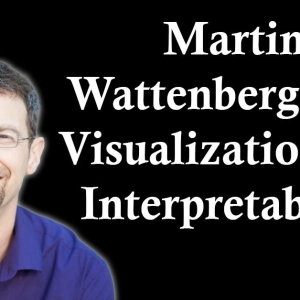
In episode 99 of The Gradient Podcast, Daniel Bashir speaks to Professor Martin Wattenberg.
Professor Wattenberg is a professor at Harvard and part-time member of Google Research’s People + AI Research (PAIR) initiative, which he co-founded. His work, with long-time collaborator Fernanda Viégas, focuses on making AI technology broadly accessible and reflective of human values. At Google, Professor Wattenberg, his team, and Professor Viégas have created end-user visualizations for products such as Search, YouTube, and Google Analytics. Note: Professor Wattenberg is recruiting PhD students through Harvard SEAS—info here.
Have suggestions for future podcast guests (or other feedback)? Let us know here or reach us at editor@thegradient.pub
Subscribe to The Gradient Podcast: Apple Podcasts | Spotify | Pocket Casts | RSSFollow The Gradient on Twitter
Outline:
* (00:00) Intro
* (03:30) Prof. Wattenberg’s background
* (04:40) Financial journalism at SmartMoney
* (05:35) Contact with the academic visualization world, IBM
* (07:30) Transition into visualizing ML
* (08:25) Skepticism of neural networks in the 1980s
* (09:45) Work at IBM
* (10:00) Multiple scales in information graphics, organization of information
* (13:55) How much information should a graphic display to whom?
* (17:00) Progressive disclosure of complexity in interface design
* (18:45) Visualization as a rhetorical process
* (20:45) Conversation Thumbnails for Large-Scale Discussions
* (21:35) Evolution of conversation interfaces—Slack, etc.
* (24:20) Path dependence — mutual influences between user behaviors and technology, takeaways for ML interface design
* (26:30) Baby Names and Social Data Analysis — patterns of interest in baby names
* (29:50) History Flow
* (30:05) Why investigate editing dynamics on Wikipedia?
* (32:06) Implications of editing patterns for design and governance
* (33:25) The value of visualizations in this work, issues with Wikipedia editing
* (34:45) Community moderation, bureaucracy
* (36:20) Consensus and guidelines
* (37:10) “Neutral” point of view as an organizing principle
* (38:30) Takeaways
* PAIR
* (39:15) Tools for model understanding and “understanding” ML systems
* (41:10) Intro to PAIR (at Google)
* (42:00) Unpacking the word “understanding” and use cases
* (43:00) Historical comparisons for AI development
* (44:55) The birth of TensorFlow.js
* (47:52) Democratization of ML
* (48:45) Visualizing translation — uncovering and telling a story behind the findings
* (52:10) Shared representations in LLMs and their facility at translation-like tasks
* (53:50) TCAV
* (55:30) Explainability and trust
* (59:10) Writing code with LMs and metaphors for using
* More recent research
* (1:01:05) The System Model and the User Model: Exploring AI Dashboard Design
* (1:10:05) OthelloGPT and world models, causality
* (1:14:10) Dashboards and interaction design—interfaces and core capabilities
* (1:18:07) Reactions to existing LLM interfaces
* (1:21:30) Visualizing and Measuring the Geometry of BERT
* (1:26:55) Note/Correction: The “Atlas of Meaning” Prof. Wattenberg mentions is called Context Atlas
* (1:28:20) Language model tasks and internal representations/geometry
* (1:29:30) LLMs as “next word predictors” — explaining systems to people
* (1:31:15) The Shape of Song
* (1:31:55) What does music look like?
* (1:35:00) Levels of abstraction, emergent complexity in music and language models
* (1:37:00) What Prof. Wattenberg hopes to see in ML and interaction design
* (1:41:18) Outro
Links:
* Professor Wattenberg’s homepage and Twitter
* Harvard SEAS application info — Professor Wattenberg is recruiting students!
* Research
* Earlier work
* A Fuzzy Commitment Scheme
* Stacked Graphs—Geometry & Aesthetics
* A Multi-Scale Model of Perceptual Organization in Information Graphics
* Conversation Thumbnails for Large-Scale Discussions
* Baby Names and Social Data Analysis
* History Flow (paper)
* At Harvard and Google / PAIR
* Tools for Model Understanding: Facets, SmoothGrad, Attacking discrimination with smarter ML
* TensorFlow.js
* Visualizing translation
* TCAV
* Other ML papers:
* The System Model and the User Model: Exploring AI Dashboard Design (recent speculative essay)
* Emergent World Representations: Exploring a Sequence Model Trained on a Synthetic Task
* Visualizing and Measuring the Geometry of BERT
* Artwork
* The Shape of Song
Get full access to The Gradient at
thegradientpub.substack.com/subscribe