Sasha Rush: Building Better NLP Systems

Sasha Rush: Building Better NLP Systems

Author: Daniel Bashir February 29, 2024 Duration: 54:03

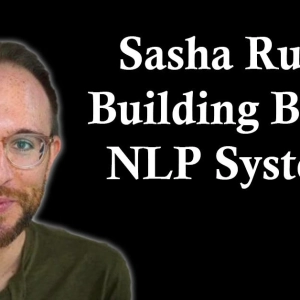
In episode 113 of The Gradient Podcast, Daniel Bashir speaks to Professor Sasha Rush.

Professor Rush is an Associate Professor at Cornell University and a Researcher at HuggingFace. His research aims to develop natural language processing systems that are safe, fast, and controllable. His group is interested primarily in tasks that involve text generation, and they study data-driven probabilistic methods that combine deep-learning based models with probabilistic controls. He is also interested in open-source NLP and deep learning, and develops projects to make deep learning systems safer, clearer, and easier to use.

Have suggestions for future podcast guests (or other feedback)? Let us know here or reach us at editor@thegradient.pub

Subscribe to The Gradient Podcast:  Apple Podcasts  | Spotify | Pocket Casts | RSSFollow The Gradient on Twitter

Outline:

* (00:00) Intro

* (01:47) Professor Rush’s background

* (03:23) Professor Rush’s reflections on prior work—importance of learning and inference

* (04:58) How much engineering matters in deep learning, the Rush vs. Frankle Bet

* (07:12) On encouraging and incubating good research

* (10:50) Features of good research environments

* (12:36) 5% bets in Professor Rush’s research: State-Space Models (SSMs) as an alternative to Transformers

* (15:58) SSMs vs. Transformers

* (18:53) Probabilistic Context-Free Grammars—are (P)CFGs worth paying attention to?

* (20:53) Sequence-level knowledge distillation: approximating sequence-level distributions

* (25:08) Pruning and knowledge distillation — orthogonality of efficiency techniques

* (26:33) Broader thoughts on efficiency

* (28:31) Works on prompting

* (28:58) Prompting and In-Context Learning

* (30:05) Thoughts on mechanistic interpretability

* (31:25) Multitask prompted training enables zero-shot task generalization

* (33:48) How many data points is a prompt worth?

* (35:13) Directions for controllability in LLMs

* (39:11) Controllability and safety

* (41:23) Open-source work, deep learning libraries

* (42:08) A story about Professor Rush’s post-doc at FAIR

* (43:51) The impact of PyTorch

* (46:08) More thoughts on deep learning libraries

* (48:48) Levels of abstraction, PyTorch as an interface to motivate research

* (50:23) Empiricism and research commitments

* (53:32) Outro

Links:

* Research

* Early work / PhD

* Dual Decomposition and LP Relaxations

* Vine Pruning for Efficient Multi-Pass Dependency Parsing

* Improved Parsing and POS Tagging Using Inter-Sentence Dependency Constraints

* Research — interpretable and controllable natural language generation

* Compound Probabilistic Context-Free Grammars for Grammar Induction

* Multitask prompted training enables zero-shot task generalization

* Research — deep generative models

* A Neural Attention Model for Abstractive Sentence Summarization

* Learning Neural Templates for Text Generation

* How many data points is a prompt worth?

* Research — efficient algorithms and hardware for speech, translation, dialogue

* Sequence-Level Knowledge Distillation

* Open-source work

* NamedTensor

* Torch Struct


Get full access to The Gradient at thegradientpub.substack.com/subscribe

Hosted by Daniel Bashir, The Gradient: Perspectives on AI moves beyond surface-level headlines to explore the intricate machinery and human ideas shaping artificial intelligence. Each episode is built on a foundation of deep research, leading to conversations that are both technically substantive and broadly accessible. You'll hear from researchers, engineers, and philosophers who are actively building and critiquing our technological future, discussing not just how AI systems work, but the larger implications of their integration into society. This isn't about speculative hype; it's a grounded examination of real progress, persistent challenges, and ethical considerations from those on the front lines. The discussions peel back layers on topics like model architecture, policy, and the fundamental science behind the algorithms becoming part of our daily lives. For anyone curious about the substance behind the buzz-whether you have a technical background or are simply keen to understand a defining technology of our age-this podcast offers a crucial and thoughtful resource. Tune in for a consistently detailed and nuanced take that treats artificial intelligence with the complexity it deserves.
Author: Language: English Episodes: 100

The Gradient: Perspectives on AI
Podcast Episodes
Andrew Lee: How AI will Shape the Future of Email [not-audio_url] [/not-audio_url]

Duration: 1:03:40
In episode 118 of The Gradient Podcast, Daniel Bashir speaks to Andrew Lee.Andrew is co-founder and CEO of Shortwave, a company dedicated to building a better product experience for email, particularly by leveraging AI.…
Joss Fong: Videomaking, AI, and Science Communication [not-audio_url] [/not-audio_url]

Duration: 1:23:59
Episode 117“You get more of what you engage with. Everyone who complains about coverage should understand that every click, every quote tweet, every argument is registered by these publications as engagement. If what you…
Kate Park: Data Engines for Vision and Language [not-audio_url] [/not-audio_url]

Duration: 41:34
In episode 116 of The Gradient Podcast, Daniel Bashir speaks to Kate Park. Kate is the Director of Product at Scale AI. Prior to joining Scale, Kate worked on Tesla Autopilot as the AI team’s first and lead product manag…
Ben Wellington: ML for Finance and Storytelling through Data [not-audio_url] [/not-audio_url]

Duration: 1:07:40
In episode 115 of The Gradient Podcast, Daniel Bashir speaks to Ben Wellington.Ben is the Deputy Head of Feature Forecasting at Two Sigma, a financial sciences company. Ben has been at Two Sigma for more than 15 years, a…
Venkatesh Rao: Protocols, Intelligence, and Scaling [not-audio_url] [/not-audio_url]

Duration: 2:18:35
“There is this move from generality in a relative sense of ‘we are not as specialized as insects’ to generality in the sense of omnipotent, omniscient, godlike capabilities. And I think there's something very dangerous t…
Nicholas Thompson: AI and Journalism [not-audio_url] [/not-audio_url]

Duration: 59:43
In episode 111 of The Gradient Podcast, Daniel Bashir speaks to Nicholas Thompson.Nicholas is the CEO of The Atlantic. Previously, he served as editor-in-chief of Wired and editor of Newyorker.com. Nick also cofounded At…
Russ Maschmeyer: Spatial Commerce and AI in Retail [not-audio_url] [/not-audio_url]

Duration: 55:41
In episode 109 of The Gradient Podcast, Daniel Bashir speaks to Russ Maschmeyer.Russ is the Product Lead for AI and Spatial Commerce at Shopify. At Shopify, he leads a team that looks at how AI can better empower entrepr…