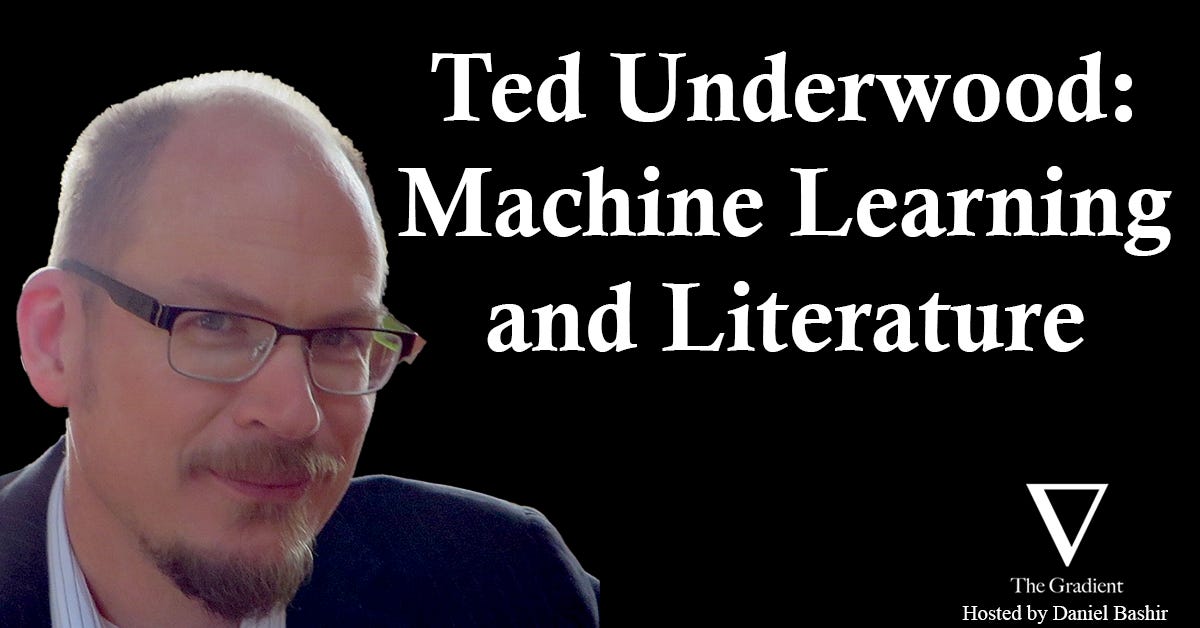
In episode 71 of The Gradient Podcast, Daniel Bashir speaks to Ted Underwood.
Ted is a professor in the School of Information Sciences with an appointment in the Department of English at the University of Illinois at Urbana Champaign. Trained in English literary history, he turned his research focus to applying machine learning to large digital collections. His work explores literary patterns that become visible across long timelines when we consider many works at once—often, his work involves correcting and enriching digital collections to make them more amenable to interesting literary research.
Have suggestions for future podcast guests (or other feedback)? Let us know here or reach us at editor@thegradient.pub
Subscribe to The Gradient Podcast: Apple Podcasts | Spotify | Pocket Casts | RSSFollow The Gradient on Twitter
Outline:
* (00:00) Intro
* (01:42) Ted’s background / origin story
* (04:35) Context in interpreting statistics, “you need a model,” the need for data about human responses to literature and how that manifested in Ted’s work
* (07:25) The recognition that we can model literary prestige/genre because of ML
* (08:30) Distant reading and the import of statistics over large digital libraries
* (12:00) Literary prestige
* (12:45) How predictable is fiction? Scales of predictability in texts
* (13:55) Degrees of autocorrelation in biography and fiction and the structure of narrative, how LMs might offer more sophisticated analysis
* (15:15) Braided suspense / suspense at different scales of a story
* (17:05) The Literary Uses of High-Dimensional Space: how “big data” came to impact the humanities, skepticism from humanists and responses, what you can do with word count
* (20:50) Why we could use more time to digest statistical ML—how acceleration in AI advances might impact pedagogy
* (22:30) The value in explicit models
* (23:30) Poetic “revolutions” and literary prestige
* (25:53) Distant vs. close reading in poetry—follow-up work for “The Longue Durée”
* (28:20) Sophistication of NLP and approaching the human experience
* (29:20) What about poetry renders it prestigious?
* (32:20) Individualism/liberalism and evolution of poetic taste
* (33:20) Why there is resistance to quantitative approaches to literature
* (34:00) Fiction in other languages
* (37:33) The Life Cycles of Genres
* (38:00) The concept of “genre”
* (41:00) Inflationary/deflationary views on natural kinds and genre
* (44:20) Genre as a social and not a linguistic phenomenon
* (46:10) Will causal models impact the humanities?
* (48:30) (Ir)reducibility of cultural influences on authors
* (50:00) Machine Learning and Human Perspective
* (50:20) Fluent and perspectival categories—Miriam Posner on “the radical, unrealized potential of digital humanities.”
* (52:52) How ML’s vices can become virtues for humanists
* (56:05) Can We Map Culture? and The Historical Significance of Textual Distances
* (56:50) Are cultures and other social phenomena related to one another in a way we can “map”?
* (59:00) Is cultural distance Euclidean?
* (59:45) The KL Divergence’s use for humanists
* (1:03:32) We don’t already understand the broad outlines of literary history
* (1:06:55) Science Fiction Hasn’t Prepared us to Imagine Machine Learning
* (1:08:45) The latent space of language and what intelligence could mean
* (1:09:30) LLMs as models of culture
* (1:10:00) What it is to be a human in “the age of AI” and Ezra Klein’s framing
* (1:12:45) Mapping the Latent Spaces of Culture
* (1:13:10) Ted on Stochastic Parrots
* (1:15:55) The risk of AI enabling hermetically sealed cultures
* (1:17:55) “Postcards from an unmapped latent space,” more on AI systems’ limitations as virtues
* (1:20:40) Obligatory GPT-4 section
* (1:21:00) Using GPT-4 to estimate passage of time in fiction
* (1:23:39) Is deep learning more interpretable than statistical NLP?
* (1:25:17) The “self-reports” of language models: should we trust them?
* (1:26:50) University dependence on tech giants, open-source models
* (1:31:55) Reclaiming Ground for the Humanities
* (1:32:25) What scientists, alone, can contribute to the humanities
* (1:34:45) On the future of the humanities
* (1:35:55) How computing can enable humanists as humanists
* (1:37:05) Human self-understanding as a collaborative project
* (1:39:30) Is anything ineffable? On what AI systems can “grasp”
* (1:43:12) Outro
Links:
* Ted’s blog and Twitter
* Research
* The literary uses of high-dimensional space
* The Longue Durée of literary prestige
* The Historical Significance of Textual Distances
* Machine Learning and Human Perspective
* The life cycles of genres
* Can We Map Culture?
* Cohort Succession Explains Most Change in Literary Culture
* Other Writing
* Reclaiming Ground for the Humanities
* We don’t already understand the broad outlines of literary history
* Science fiction hasn’t prepared us to imagine machine learning.
* How predictable is fiction?
* Mapping the latent spaces of culture
* Using GPT-4 to measure the passage of time in fiction
Get full access to The Gradient at
thegradientpub.substack.com/subscribe