
Having a career as a pro handyman can be surprisingly lucrative.
For example, I currently average over $149 per hour doing basic home repairs and often make over $200 per hour.
And I’m not special. Many of my students make more than this and easily generate a six-figure income each year.
How do we do it?
I explain how in this step-by-step guide here, but for now, let’s focus on how much an average handyman makes each year to get a good idea of how much you can make as a handyman.
Contents
Average handyman salaries
I hunted for relevant stats regarding handyman salaries. Here are the important ones I dug up:
According to Zip Recruiter:
- The annual salary for a pro handyman in the U.S. ranges from $29,000 to $75,500.
- The national average annual income for a handyman is $53,009 ($25/hour).
- 71% of handymen make between $42,000 and $63,500.
Here are a few handyman-type careers and their annual median pay in 2022, according to the U.S. Bureau of Labor and Statistics:
- Construction laborers and helpers: $39,520
- General maintenance and repair workers: $44,980
- Carpenters: $51,390
- Plumbers: $60,090
- Electricians: $60,240
- Construction managers: $101,480
- Construction and building inspectors: $64,480
Figure 1: National Average Salary For Handyman-Type Jobs
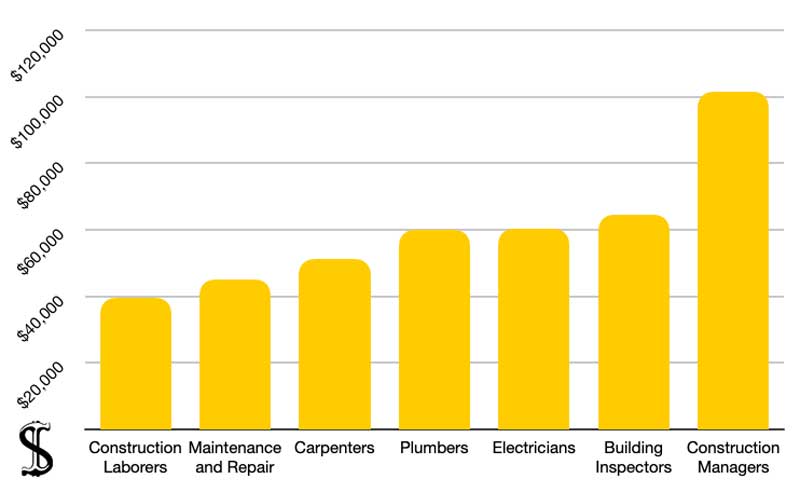
Again, these numbers are the median. Some handyman workers make more, and others make less. A highly skilled handyman with a decade of experience will make more than someone less experienced or knowledgeable.
Location plays a significant role in how much you can make as well. To get a better estimate of potential income in your specific area, check out a website like Zip Recruiter.
As you can see from the numbers above, employed handymen tend to make more than construction helpers, but neither is rolling in cash.
Plumbers and electricians make quite a bit more, but if you want to make six figures in this industry as an employee, your best bet is to land a job as a construction manager.
Now, let’s look at how much you can make with a handyman business because this is much more fun and interesting.
How much can you make as a self-employed handyman?
The average self-employed handyman can earn between $53,000 and $120,000 annually (after expenses). This is for a handyman working solo with no employees.
So, if you’re wondering if the handyman business is profitable, the answer is YES.
Operating a handyman business can be pretty lucrative if you set up your business correctly and provide excellent service.
Take a look at this table, which I’ve created to estimate your potential income as a self-employed handyman based on how much you charge and how many billable hours you work each week.
Table 1: Estimated Self-Employed Handyman Income
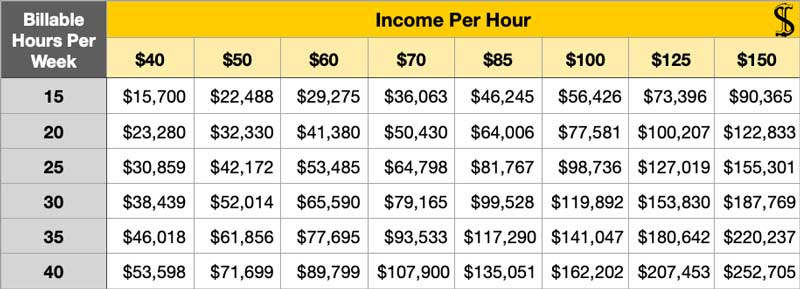
Table 1 is based on the following assumptions: $7,622 yearly fixed overhead expenses, $6.50 per billable hour for variable costs (gas, vehicle, supplies, and tools), self-employment taxes of 7.65% already paid from net earnings, 49 weeks per year worked.
This table represents actual income. Typical handyman business expenses (insurance, licensing, tools, marketing, etc.) and self-employment taxes are already factored into the equation. This means it provides a near apples-to-apples comparison with an employee’s salary.
As you can see from the table, two main variables will affect your yearly income as a pro handyman:
- Your rates (how much you generate per billable hour, regardless of whether you charge by the hour).
- The number of billable hours worked per week.
Of course, other things will also affect your income, such as expense variations, but these tend to be similar for most self-employed handyman businesses. Since I’ve been nerding out about the handyman business for nearly a decade, I can estimate typical expenses with enough precision to be valid.
How much can you expect to make, given your unique circumstances?
To answer this question, you’ll need to estimate your rates and how many hours you will bill for, on average, each week.
Here’s one way to figure that out.
Estimating your self-employed Handyman rates
As I demonstrated in my article about setting handyman hourly rates, pro handymen in the U.S. average between $40 and $139 per hour, with the majority charging $60 to $90 per hour.
That’s a decent range, and what you can charge will depend on where you live, the services you provide, and how good you are at what you do (just like for employees).
However, as a business owner, your income will also be affected by your business skills. If you learn how to market your business effectively, sell your services, and manage yourself and your expenses well, it will dramatically impact your profits and income.
But, assuming you become average at those business skills, it’s safe to assume you can get between $60 and $85 per billable hour for your time (and much more if you master the business skills).
Adjust a bit higher if you live in a major metropolitan area and a bit lower in a rural area.
Estimating your billable hours
As a self-employed handyman, you won’t be paid for every hour that you work.
Unlike an employee, you’ll have to answer the phone, follow up with customers, manage your bookkeeping, shop for tools and supplies, market your services, and do other admin tasks that you will not be paid for (at least not directly).
So, unless you want to work 60+ hours per week, you won’t bill for 40 hours per week. A reasonable estimate for a typical handyman is to work somewhere between 25 and 35 billable hours per week. That allows time for driving to and from jobs, following up, and other day-to-day tasks.
Of course, this also assumes you can keep your schedule full in the first place.
So, if you look at the table above and then match your estimated hourly rate with the number of billable hours you will be working, you can get a pretty good idea of your income.
Assuming 25 billable hours per week at $60 per hour, you will make about $53,000 in a year.
Figure 2: Estimated self-employed handyman’s annual income
(If working 30 billable hours per week on average)
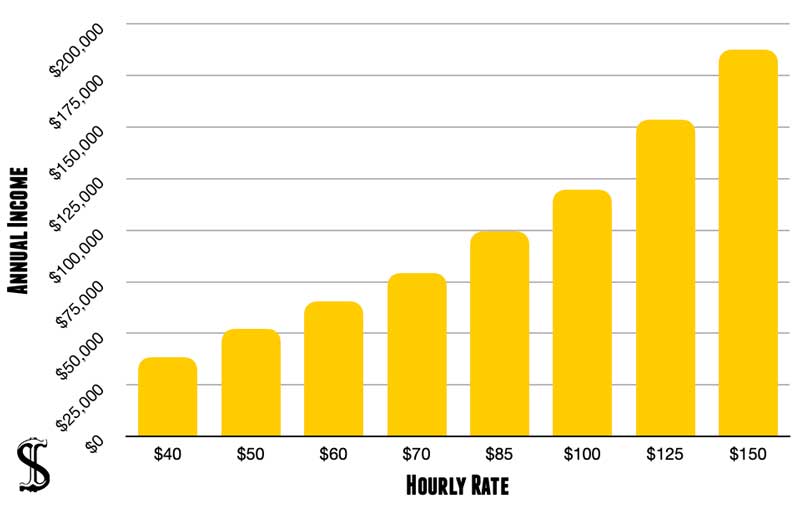
If you can average ~30 billable hours per week at a rate of $85 per hour or more, you can make $100,000. Not too bad!
Get a job or start a business? Which is better for a handyman?
If you only look at income potential, this is a no-brainer. Starting a handyman business is by far the better option. As an employee with lots of experience, you are only looking at an income ceiling of $80,000, and that’s if you live in the right place with the right employer. The same skills and experience could earn you well over $100K as a self-employed handyman.
Being self-employed has other benefits as well. You have more control over your schedule. You have more control over which customers you work for and what kind of jobs you take on. If you build your business well, you are creating a valuable asset. And owning your own business is more secure than being an employee.
But there are downsides to being self-employed. You have to manage your marketing, pricing, and yourself. This can be stressful, and if you don’t manage your business well, you can make a lot less than you would as an employee.
It also takes time to get your business up and running (time that you aren’t paid for).
As an employee, you have the benefit of making money right away. Every hour that you work, you are guaranteed to receive compensation. You don’t have to decide how much to charge or where to invest your marketing dollars. You just get to show up and fix stuff. Being an employee is often less stressful.
However, you don’t have control over your schedule as an employee. You must work when, where, and for whom you are told. You may have to take on jobs that you hate doing. And, of course, your income potential is significantly lower.
Starting a business is a clear choice for me, and the benefits far outweigh the downsides.
But if you are looking for on-the-job training, a faster route to payday, or a more consistent income, and you don’t mind following orders, then getting a job may be a better choice.
What about the cost of health insurance for self-employed handymen?
Many self-employed pros are covered under their spouse’s health benefits.
But what if you aren’t?
Are you better off getting a job with benefits than starting a business?
Probably not. Let’s take a look at some numbers.
According to ehealthinsurance.com:
- The average monthly premium for an individual in 2021 was $484 ($5,808 per year).
- The average monthly premium for a family was $1230 ($14,760 per year).
Paying health insurance is a huge bummer, but it’s probably not expensive enough to force you to get a job. Let’s take a look at the numbers.
Above, I demonstrated that the average self-employed handyman could expect to make between $53,000 and $120,000. If we factor in health insurance, here’s how things change.
Estimated self-employed handyman income after paying for health insurance:
- $47,000 to $111,000 if paying for individual coverage.
- $38,000 to $102,000 if paying for a family health insurance premium.
Now, remember from above that 71% of handyman employees earn between $42,000 and $63,000. Comparing those to the self-employed rates, you can still make significantly more as a self-employed handyman, even while paying for your own health insurance.
But not all handyman employers offer insurance benefits, and those that do probably pay their employees slightly lower salaries. So again, the winner from a financial perspective is clear – you can make much more money as a self-employed handyman.
Conclusions
The handyman business can be quite profitable, especially if you are willing to work hard and focus some time and effort on learning essential business skills.
An effective self-employed handyman can earn significantly more than they could as an employee. If you are a self-driven person with the confidence that you can solve problems, starting your own handyman business is your best bet.
And lastly, as a self-employed handyman, it’s worth it to invest time and money to learn how to raise your rates or schedule jobs more efficiently. Doing so will have a significant impact on your income.

Now, listen to the podcast version of this article, which includes extra content with deeper insights. Listen right here or on your favorite podcast app!
HS026 – How much money can you make as a pro handyman?
The post How much can you make as a pro handyman? appeared first on Handyman Startup.