Spatial Injustice: School Closures as a Form of Educational Redlining

Spatial Injustice: School Closures as a Form of Educational Redlining

Author: Andrew Lefkowits, Val Brown, Courtney Mykytyn March 25, 2026 Duration: 1:01:03
What happens when we stop thinking about schools as buildings—and start seeing them as the ecosystems that hold our communities together? In this episode, we sit with Dr. Mara Tieken to explore school closures not as isolated decisions, but as part of a broader pattern of spatial injustice—where resources, opportunities, and care are unevenly distributed based on where we live. Together, we wrestle with a hard truth: school closures are often framed as inevitable… but what if they’re actually the result of choices—policies, priorities, and patterns of disinvestment—that we can question? We grapple with several key ideas: Schools are more than buildings—they are social, cultural, and economic anchors in our communities Closures disproportionately impact Black, Brown, and low-income communities The most common justifications (cost savings, academic improvement, “efficiency”) often don’t hold up under scrutiny What gets labeled as a “failing school” is often a school that has been failed—by policy, funding, and systemic neglect School closures don’t just disrupt students—they create lasting grief, loss, and disconnection across generations This conversation also reminds us that we are not powerless. Across the country, communities are: Organizing and building multiracial, cross-class coalitions Questioning the data and narratives used to justify closures Running for school board, advocating for policy change, and showing up for each other’s schools—not just our own We are left wondering, what would it look like to treat every school as our school? Not just when it’s under threat—but all the time. Because if public schools are foundational to our democracy, then caring for them can’t be an individual act. It has to be collective. LINKS: Dr. Tieken's Hechinger Report Op-Ed - Shuttering public schools is a strategy that rarely saves much money and often leads to test score declines - https://hechingerreport.org/opinion-shuttering-public-schools-is-a-strategy-that-rarely-saves-much-money-and-often-leads-to-test-score-declines/ And from The Washington Monthly - Don't Fall for the School Closure Temptation - https://washingtonmonthly.com/2025/10/10/dont-fall-for-the-school-closure-temptation/ Rural Schools Open - Dr. Tieken's guide to fighting school closures and doing it well, when needed - https://ruralschoolsopen.org/ Dr. Eve L Ewing - Ghosts in the Schoolyard - https://bookshop.org/a/18658/9780226526164 And Dr. Ewing on our show - S11E12: Schools and Race: Eve Ewing on the Construction of American Racism - https://integratedschools.org/podcast/s11e12-schools-and-race-eve-ewing-on-the-construction-of-american-racism/ Send us a voice memo: speakpipe.com/integratedschools Check out our Bookshop.org storefront to support local bookstores, and send a portion of the proceeds back to us. - https://bookshop.org/shop/IntegratedSchools Join our Patreon to support this work, and connect with us and other listeners to discuss these issues even further. - https://www.patreon.com/integratedschools Subscribe to our YouTube Channel for video versions of our episodes. - https://www.youtube.com/@integratedschools Let us know what you think of this episode, suggest future topics, or share your story with us – IntegratedSchools on Facebook, @integratedschools on Instagram and TikTok, or email us podcast@integratedschools.org. The Integrated Schools Podcast was created by Courtney Mykytyn and Andrew Lefkowits. This episode was produced by Andrew Lefkowits and Val Brown. It was edited, and mixed by Andrew Lefkowits. Music by Kevin Casey. Advertising Inquiries: https://redcircle.com/brands Privacy & Opt-Out: https://redcircle.com/privacy

It’s easy to talk about school integration in the abstract, but what does it actually look like on the ground for families navigating these choices every day? The Integrated Schools Podcast moves beyond theory into the messy, personal realities of race, parenting, and educational equity. Hosted by Andrew Lefkowits, a White dad from Denver, and Val Brown, a Black mom from North Carolina, along with co-author Courtney Mykytyn, this podcast centers conversations that deliberately sit with discomfort and complexity. Each episode brings in voices from across the spectrum-parents making tough school decisions, educators in the trenches, researchers, and community organizers-to explore why our schools remain so segregated and what it truly means to work toward integration. You’ll hear candid stories about navigating predominantly white spaces, confronting personal bias, and the small, daily actions that either challenge or uphold systemic inequities. This isn’t a podcast offering easy answers; instead, it provides a necessary space to listen, reflect, and engage with the nuanced layers of a deeply entrenched issue. The dialogue here is built on the belief that honest, sometimes difficult talk is a prerequisite for meaningful change, both in our schools and in ourselves.
Author: Language: English Episodes: 50

The Integrated Schools Podcast
Podcast Episodes
Calling In with Loretta Ross [not-audio_url] [/not-audio_url]

Duration: 1:02:54
We’re joined by MacArthur “Genius” and legendary activist Dr. Loretta Ross for a conversation that left us grounded, challenged, and deeply moved. From her early work in reproductive justice and anti-violence movements,…
A Big Tent: Parent Voice for Public Educatiion [not-audio_url] [/not-audio_url]

Duration: 55:46
In this episode, we’re stretching the boundaries of our “big tent”—the messy, hopeful space where we try to build a public education system worthy of all our kids. We sat down with Ms. Keri Rodrigues, President and co-fo…
Using Stories to Inspire Change [not-audio_url] [/not-audio_url]

Duration: 59:12
What happens when over 600 educators, students, organizers, and advocates gather in community to center racial equity and storytelling? We found out at this year’s Color of Education Summit in Raleigh, North Carolina. In…
Raising Antiracist Kids [not-audio_url] [/not-audio_url]

Duration: 47:23
We’re sharing a special crossover: Dr. Val and Andrew join Tabitha St. Bernard-Jacobs and Adam Jacobs, co-hosts of the Raising Antiracist Kids podcast, to talk about parents as partners in building antiracist school comm…
Identity and Purpose with Byron Sanders [not-audio_url] [/not-audio_url]

Duration: 1:04:16
What does it mean to truly know who you are—and how might that knowing shape what you give back to the world? In this episode, we’re joined by Byron Sanders—educator, CEO, community leader, and newly elected Dallas ISD s…
Season 12 Kick Off: What Now? [not-audio_url] [/not-audio_url]

Duration: 31:58
As we launch Season 12 of the podcast, Dr. Val and Andrew reflect on the start of the school year. With big personal transitions, and the country in a state of deep uncertainty, we ask, what now? How can we acknowledge t…
Eve Ewing Revisited [not-audio_url] [/not-audio_url]

Duration: 1:08:27
Original Sins: The (Mis)education of Black and Native Children and the Construction of American Racism is the Integrated Schools Book Club http://integratedschools.org/book-club/ pick for the fall. So we thought we'd rev…
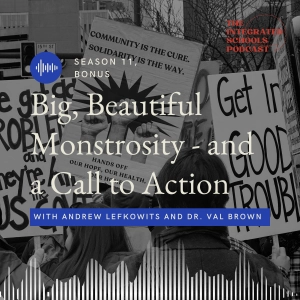
Big, Beautiful Monstrosity - and a Call to Action [not-audio_url] [/not-audio_url]

Duration: 7:45
The president just signed a truly monstrous piece of legislation into law. Much has been written about the impacts on health, climate and the debt, but there is a lesser known evil lurking in this bill - a national schoo…
Reflections on Season 11 [not-audio_url] [/not-audio_url]

Duration: 30:17
As Season 11 comes to a close, we wanted to spend some time reflecting on the lessons we've learned from this season and what we hope for in Season 12. We'll be off for the summer with a few possible bonus episodes, and…
The Intersection of Private Decisions and Public Responsibility [not-audio_url] [/not-audio_url]

Duration: 54:30
“Having my children in public school was something that I wanted to do with people in my community. It was a commitment that we were making together. And then when I saw folks leaving, it felt like a betrayal.” – Stephan…