Synergizing Dialogue, Inquiry, and Cognitive Science for Powerful Knowledge Pedagogy

Synergizing Dialogue, Inquiry, and Cognitive Science for Powerful Knowledge Pedagogy

Author: ThoughtStretchers Education July 24, 2026 Duration: 56:29

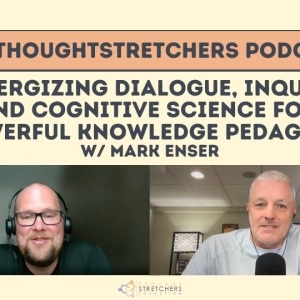
Drew Perkins talks with Mark Enser about his Substack piece titled, A Pedagogy for Powerful Knowledge | Why dialogue, enquiry and cognitive science aren't competing answers.  This episode addresses questions like: "How to combine cognitive science with inquiry-based learning", "Differences between classroom discussion and dialogic teaching", "Why inquiry requires high-level scaffolding", and "How to avoid algorithmic teaching in the classroom".

Links & Resources Mentioned In This Episode

Have some feedback you'd like to share? You can email me at drew@thoughtstretchers.org.

If you enjoyed this episode, please share it and please leave a review on Apple Podcasts or wherever you're listening.

Some Key Takeaways

  • The "Future Three" Pedagogical Model: Education should move away from abstract, student-led theories toward a "Future Three" approach that prioritizes objective knowledge transmission as the foundation for deeper inquiry.1
    Synthesizing Pedagogy: Powerful knowledge is not achieved by picking one method; it requires a synergy of cognitive science (for stability), dialogic teaching (for deeper truth-seeking), and structured inquiry.
  • Dialogue vs. Discussion: Discussion is often superficial and biologically primary. True dialogue is a trained skill requiring support and Socratic guidance to help students critique models and search for truth.
  • Structuring Inquiry: Inquiry is not "minimal guidance." Effective inquiry must be highly scaffolded, using conceptual questions as "maps" that provide a clear purpose for the learning journey and guide students through the application of foundational knowledge.
  • Avoiding "Cargo Cult" Pedagogy: Teachers must prioritize intent over rote, algorithmic application of cognitive science. Methods like retrieval practice should require deeper cognitive effort rather than being used as a checklist of simple recall techniques.
  • Progression for Novices: While integrating all three pillars is the goal, cognitive science practices are often the most stable starting point for novice teachers, as they are easier to structure into playbooks and carry the least risk of unproductive outcomes.

Episode Highlights & Timecodes

  • [00:03:04] Mark Enser's Background: From 20 years as a geography teacher to an Ofsted inspector and freelance consultant.
  • [00:12:02] Pedagogical Evolution: The shift from a "Future Two" mindset (student-led) to a "Future Three" model (prioritizing objective knowledge).
  • [00:18:15] The Core Thesis: Why "powerful knowledge" requires a synergy of cognitive science, dialogic teaching, and structured inquiry.
  • [00:20:31] Discussion vs. Dialogue: Distinguishing between the social behavior of discussion and the trained, guided skill of dialogue.
  • [00:26:12] The Search for Truth: Using the dialectic in education to critique models rather than just memorizing facts.
  • [00:33:53] Inquiry vs. Discovery Learning: Why effective inquiry requires high-level scaffolding rather than "minimal guidance."
  • [00:38:04] Inquiry as a Framing Tool: Using conceptual questions as "maps" to provide purpose and bound the curriculum.
  • [00:46:23] Avoiding "Cargo Cult" Cognitive Science: Moving beyond rote algorithms and checklists to prioritize true teacher intent.
  • [00:51:26] Advice for Novice Teachers: Prioritizing cognitive science as a stable baseline before layering in more complex dialogic and inquiry-based strategies.

Hosted by ThoughtStretchers Education, The ThoughtStretchers Podcast is built on the belief that the best teaching emerges from genuine dialogue and challenging questions. This isn't about quick tips or superficial trends. Instead, each episode engages in the kind of dialectic conversations that push beyond comfortable assumptions, examining the foundational ideas and complex issues that shape modern learning environments. You'll hear deep, often meandering discussions that probe the "why" behind educational practices, fostering a space for intellectual rigor rarely found in typical professional development. Tuning into this podcast feels like sitting in on a thoughtful, sometimes provocative, roundtable where curiosity is the primary curriculum. It’s for educators who find energy in debate and refinement of thought, who believe that strengthening their own intellectual framework is the first step toward nurturing it in others. The dialogue here is designed to stretch your perspective on pedagogy, curriculum, and the very purpose of education, making it a sustained exercise in professional growth. If you’re looking to engage with education on a more philosophical and principled level, these conversations offer a compelling and substantive resource.
Author: Language: en-us Episodes: 50

The ThoughtStretchers Podcast
Podcast Episodes
Is The 'What & How' We Teach Math All Wrong? [not-audio_url] [/not-audio_url]

Duration: 1:08:38
Drew Perkins welcomes back Ted Dintersmith to discuss the urgent need to move away from an education system obsessed with standardized testing and toward one that empowers students to do real, meaningful work. In his new…
Biologically Primary vs. Secondary Learning With David Geary [not-audio_url] [/not-audio_url]

Duration: 57:25
Drew Perkins talks with David Geary, a cognitive developmental and evolutionary psychologist and Curator's Professor in the Department of Psychological Sciences at the University of Missouri. They dive into the foundatio…
School Choice, Competition vs. Spending [not-audio_url] [/not-audio_url]

Duration: 1:17:32
Drew Perkins welcomes Patrick Graff, Senior Fellow at the American Federation for Children, to discuss his recent research analyzing 15 years of Florida's tax-credit scholarship program. Graff presents a compelling case…
Moving From Formative Assessment To Action [not-audio_url] [/not-audio_url]

Duration: 1:12:37
Drew Perkins talks with Valentina Devid to explore why the term "formative assessment" often fails in practice and how shifting the focus to Formative Action can lead to more sustainable, durable learning. Valentina shar…
Engineering the Aha, What's Missing From Inquiry [not-audio_url] [/not-audio_url]

Duration: 1:13:04
Drew Perkins talks with Brendan Lee, a primary school teacher, host of the Knowledge for Teachers Podcast, and advocate for evidence-informed pedagogy. Brendan shares his transition from an initial belief in unguided pro…
John Sweller On The Foundations And Future Of Cognitive Load Theory [not-audio_url] [/not-audio_url]

Duration: 1:20:10
Drew Perkins speaks with John Sweller, Emeritus Professor of Educational Psychology at the University of New South Wales, and Oliver Caviglioli, information designer and former special school principal, about the foundat…
Modern Learning And The Paradox Of Edtech [not-audio_url] [/not-audio_url]

Duration: 1:13:08
Drew Perkins talks with Brian Lamb, founder of Swivl, about the "Paradox of Edtech" and how modern digital interfaces are changing the way we learn. They discuss the shift from being "data-driven" to "data-informed," the…
10 Months At Sea, A School For Global Leadership [not-audio_url] [/not-audio_url]

Duration: 57:24
Drew Perkins welcomes Emily Waugh and Gabriela Delgado de Fina, both Assistant Heads of School for the A+ World Academy. They discuss the academy's unique educational model: a 10-month voyage for 72 students aboard the S…
Failure Factory, A Warning For Public Schools [not-audio_url] [/not-audio_url]

Duration: 53:17
Drew Perkins talks with investigative reporter Chris Papst about his book, Failure Factory: How Baltimore City Public Schools Deprive Taxpayers and Students of a Future . Papst, a reporter for Project Baltimore, shares h…
AI, Inquiry, And The Future Of Thinking [not-audio_url] [/not-audio_url]

Duration: 1:06:23
Drew Perkins welcomes Carole Geneix, Director of Teaching and Learning at Washington International School, to the podcast to discuss the evolving landscape of Artificial Intelligence in education. As schools grapple with…