Synergizing Dialogue, Inquiry, and Cognitive Science for Powerful Knowledge Pedagogy

Synergizing Dialogue, Inquiry, and Cognitive Science for Powerful Knowledge Pedagogy

Author: ThoughtStretchers Education July 24, 2026 Duration: 56:29

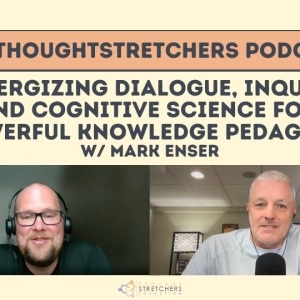
Drew Perkins talks with Mark Enser about his Substack piece titled, A Pedagogy for Powerful Knowledge | Why dialogue, enquiry and cognitive science aren't competing answers.  This episode addresses questions like: "How to combine cognitive science with inquiry-based learning", "Differences between classroom discussion and dialogic teaching", "Why inquiry requires high-level scaffolding", and "How to avoid algorithmic teaching in the classroom".

Links & Resources Mentioned In This Episode

Have some feedback you'd like to share? You can email me at drew@thoughtstretchers.org.

If you enjoyed this episode, please share it and please leave a review on Apple Podcasts or wherever you're listening.

Some Key Takeaways

  • The "Future Three" Pedagogical Model: Education should move away from abstract, student-led theories toward a "Future Three" approach that prioritizes objective knowledge transmission as the foundation for deeper inquiry.1
    Synthesizing Pedagogy: Powerful knowledge is not achieved by picking one method; it requires a synergy of cognitive science (for stability), dialogic teaching (for deeper truth-seeking), and structured inquiry.
  • Dialogue vs. Discussion: Discussion is often superficial and biologically primary. True dialogue is a trained skill requiring support and Socratic guidance to help students critique models and search for truth.
  • Structuring Inquiry: Inquiry is not "minimal guidance." Effective inquiry must be highly scaffolded, using conceptual questions as "maps" that provide a clear purpose for the learning journey and guide students through the application of foundational knowledge.
  • Avoiding "Cargo Cult" Pedagogy: Teachers must prioritize intent over rote, algorithmic application of cognitive science. Methods like retrieval practice should require deeper cognitive effort rather than being used as a checklist of simple recall techniques.
  • Progression for Novices: While integrating all three pillars is the goal, cognitive science practices are often the most stable starting point for novice teachers, as they are easier to structure into playbooks and carry the least risk of unproductive outcomes.

Episode Highlights & Timecodes

  • [00:03:04] Mark Enser's Background: From 20 years as a geography teacher to an Ofsted inspector and freelance consultant.
  • [00:12:02] Pedagogical Evolution: The shift from a "Future Two" mindset (student-led) to a "Future Three" model (prioritizing objective knowledge).
  • [00:18:15] The Core Thesis: Why "powerful knowledge" requires a synergy of cognitive science, dialogic teaching, and structured inquiry.
  • [00:20:31] Discussion vs. Dialogue: Distinguishing between the social behavior of discussion and the trained, guided skill of dialogue.
  • [00:26:12] The Search for Truth: Using the dialectic in education to critique models rather than just memorizing facts.
  • [00:33:53] Inquiry vs. Discovery Learning: Why effective inquiry requires high-level scaffolding rather than "minimal guidance."
  • [00:38:04] Inquiry as a Framing Tool: Using conceptual questions as "maps" to provide purpose and bound the curriculum.
  • [00:46:23] Avoiding "Cargo Cult" Cognitive Science: Moving beyond rote algorithms and checklists to prioritize true teacher intent.
  • [00:51:26] Advice for Novice Teachers: Prioritizing cognitive science as a stable baseline before layering in more complex dialogic and inquiry-based strategies.

Hosted by ThoughtStretchers Education, The ThoughtStretchers Podcast is built on the belief that the best teaching emerges from genuine dialogue and challenging questions. This isn't about quick tips or superficial trends. Instead, each episode engages in the kind of dialectic conversations that push beyond comfortable assumptions, examining the foundational ideas and complex issues that shape modern learning environments. You'll hear deep, often meandering discussions that probe the "why" behind educational practices, fostering a space for intellectual rigor rarely found in typical professional development. Tuning into this podcast feels like sitting in on a thoughtful, sometimes provocative, roundtable where curiosity is the primary curriculum. It’s for educators who find energy in debate and refinement of thought, who believe that strengthening their own intellectual framework is the first step toward nurturing it in others. The dialogue here is designed to stretch your perspective on pedagogy, curriculum, and the very purpose of education, making it a sustained exercise in professional growth. If you’re looking to engage with education on a more philosophical and principled level, these conversations offer a compelling and substantive resource.
Author: Language: en-us Episodes: 50

The ThoughtStretchers Podcast
Podcast Episodes
Beyond Explicit Instruction, The Importance of Elaboration [not-audio_url] [/not-audio_url]

Duration: 59:52
Drew Perkins welcomes education writer and author Natalie Wexler to the podcast to discuss her latest work and the evolving conversation around explicit instruction and the "Science of Reading." While the movement has su…
Why Classroom Technology Harms Learning (with Jared Cooney Horvath) [not-audio_url] [/not-audio_url]

Duration: 49:23
Drew Perkins welcomes neuroscientist and acclaimed author Jared Cooney Horvath to dissect his new book, The Digital Delusion, which provides a rigorous, evidence-based critique of edtech. Links & Resources Mentioned In T…
How Free Speech Builds a Better Brain With Barbara Oakley [not-audio_url] [/not-audio_url]

Duration: 56:26
In this episode of the ThoughtStretchers podcast, host Drew Perkins talks with Dr. Barbara Oakley, distinguished professor of engineering and co-instructor of the celebrated Learning How to Learn course, to discuss her c…
Knowledge-Rich Inquiry With 4QM Teaching [not-audio_url] [/not-audio_url]

Duration: 1:10:13
Drew Perkins welcomes Gary Schiffman and Jon Bassett of 4QM Teaching to the podcast to discuss their new US History curriculum and the principles behind their innovative Four Question Method. Links & Resources Mentioned…
Memorizing History Facts, So What? [not-audio_url] [/not-audio_url]

Duration: 1:30:07
Is the core of teaching history about memorizing history facts, or is it about critical thinking? And what is the role of knowledge-rich inquiry in the history classroom? Drew Perkins is joined by history educators Laure…
Are Leveled Readers Hurting Student Growth? [not-audio_url] [/not-audio_url]

Duration: 1:11:10
Drew Perkins is joined by guest co-host, fourth-grade teacher Melinda Karshner, for a critical conversation with Timothy Shanahan, Distinguished Professor Emeritus at the University of Illinois at Chicago and former Dire…
Change Starts Here with Shane Leaning [not-audio_url] [/not-audio_url]

Duration: 1:11:26
Drew Perkins talks with Shane Leaning about his new book, Change Starts Here: What If Everything Your School Needed Was Right in Front of You? Links & Resources Mentioned In This Episode Watch on YouTube
Digital Literacy, Civics, And Surveillance [not-audio_url] [/not-audio_url]

Duration: 1:00:59
Drew Perkins talks with Heidi Boghosian about her book, Cyber Citizens: Saving Democracy with Digital Literacy. Links & Resources Mentioned In This Episode
A Critical Look at Educational Research [not-audio_url] [/not-audio_url]

Duration: 1:23:46
Drew Perkins talks with George Lilley, a veteran teacher from Australia, about his critiques of the work of John Hattie, and the Science of Learning. Links & Resources Mentioned In This Episode
NASSP Leadership, Policy, And Student Well-Being [not-audio_url] [/not-audio_url]

Duration: 1:13:44
Drew Perkins talks with return guest, Ronn Nozoe, CEO of the National Association of Secondary School Principals (NASSP). Links & Resources Mentioned In This Episode