
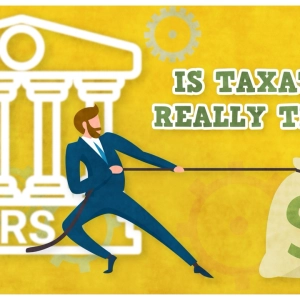
683. What Is the Deal with Taxes? Where Do Taxes Come From and Are They Really Necessary?

683. What Is the Deal with Taxes? Where Do Taxes Come From and Are They Really Necessary?

Author: Connor Boyack April 16, 2026 Duration: 15:06

While taxes are often described as the "price we pay for society," their history, purpose, and impact raise deeper questions about freedom, property, and government power.

From ancient civilizations to modern governments, taxation has always been a central part of political systems. Many people accept taxes as unavoidable — even necessary — but few stop to ask where taxes come from or whether they are truly justified.

In this episode of The Way the World Works, we explore the origins of taxation, how it has been used throughout history, and why it remains one of the most debated issues in economics and politics. We break down the idea that taxes are the "price of civilization," compare taxation to forced taking of property, and examine how taxes fund everything from infrastructure to war. We also look at alternative ways communities can organize and support shared needs without relying on coercion.

If taking someone's property is wrong, what makes taxation different?

What You'll Learn in This Episode:

  • Where taxes come from and how long they've existed
  • Why taxation is often compared to forced taking of property
  • How taxes are used to fund government programs and wars
  • Why people accept taxes as "necessary"
  • How voluntary cooperation can provide alternatives

Timestamps:

0:00 Why We Talk About Taxes
1:30 "Death and Taxes" Explained
3:30 What Is Taxation, Really?
6:00 Historical Roots of Taxes
9:00 Property Rights and Government Power
12:00 Taxes and War Spending
15:00 Alternatives to Taxation

👍 Like this video if you believe it's important to question how government uses money
🔔 Subscribe for more values-based conversations about economics and freedom
💬 Comment below: Do you think taxes are necessary?

Shop Resources:

📘 Learn more about government power and bad economic ideas in
The Tuttle Twins Guide to the World's Worst Ideas
https://www.tuttletwins.com/products/the-tuttle-twins-guide-to-the-worlds-worst-ideas

📚 Get Tuttle Twins books and homeschool resources:
https://tuttletwins.com

Tags:

#Taxes #Economics #GovernmentSpending #PropertyRights #FreeMarkets #Liberty #PublicPolicy #ValuesEducation


Looking for a way to navigate today’s complex world with your kids? The Way the World Works: A Tuttle Twins Podcast for Families, hosted by Connor Boyack, is here to help. This podcast extends the conversation from the popular book series into your daily life, offering a resource for parents and children to learn together. Each episode dives into current events and enduring ideas, breaking them down into understandable concepts that spark family discussion. The goal is to move beyond the noise and confusion, providing tools for critical thinking and clearer understanding. You’ll hear explorations of history, economics, and personal freedom, all framed in an engaging, age-appropriate manner. This isn’t about dry lectures; it’s about equipping your family with principles to analyze the world around them. Tune in to this podcast for regular episodes that blend education with real-world application, fostering curiosity and meaningful dialogue at home. It’s a natural next step for fans of the Tuttle Twins and a welcoming starting point for any family seeking to build a foundation of knowledge and shared values.
Author: Language: English Episodes: 50

The Way the World Works: A Tuttle Twins Podcast for Families
Podcast Episodes
702. The Acts That Sparked the American Revolution [not-audio_url] [/not-audio_url]

Duration: 17:16
One law that actually made sugar cheaper ended up setting off a ten-year chain reaction that cost Britain its American colonies. Before the American Revolution, Britain passed a series of laws that slowly pushed the colo…
701. How Americans Learned to Celebrate Independence [not-audio_url] [/not-audio_url]

Duration: 10:33
Did the Founders really imagine fireworks, parades, and hot dogs — or did they expect us to celebrate the 4th of July a different way? John Adams made one very specific prediction in 1776, and he was only two days off. W…
700. The Liberty Tree: One of America's First Symbol of Freedom [not-audio_url] [/not-audio_url]

Duration: 12:34
In 1775, before he wrote Common Sense, Thomas Paine wrote a poem about a tree — and that tree was already shaping the American Revolution. The story of the American Revolution is usually told through famous documents and…
699. Who Was Joseph Plumb Martin? [not-audio_url] [/not-audio_url]

Duration: 12:04
Joseph Plumb Martin was just a 15-year-old farm boy when he signed up to fight in the American Revolution — and the memoir he wrote at age 70 gives us one of the only firsthand glimpses of what war was actually like for…
698. The Civilian Spies Who Helped America Win the Revolution [not-audio_url] [/not-audio_url]

Duration: 13:15
Two ordinary civilians — a New York tailor and an enslaved man from Virginia — used their everyday roles to outsmart the British and change the course of the American Revolution. In this episode of The Way the World Work…
697. Why Was Moral Character So Important to the Founding Fathers? [not-audio_url] [/not-audio_url]

Duration: 12:31
America's founders believed a free society could only survive if its people practiced self-control, integrity, personal responsibility, and virtue. The Founding Fathers didn't believe freedom meant doing whatever you wan…
