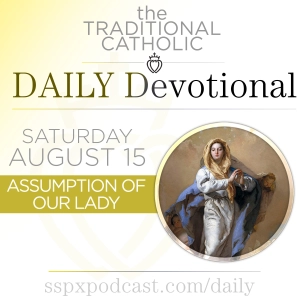
It's the Feast of
Assumption of the Blessed Virgin,
1st Class, with the color of
White. In this episode: the meditation: "Listening to God", today's news from the Church: "Bishop de Sivry Visits a Camp of the Eucharistic Crusade", and today's thought from the Archbishop Marcel Lefebvre.
Have feedback or questions about the DD or our other shows?
podcast@sspx.org
Sources Used Today:
- "Listening to God" — From Trinity Sunday to the Assumption
- "Bishop de Sivry Visits a Camp of the Eucharistic Crusade" (FSSPX.news)
- The Spiritual Life — Archbishop Marcel Lefebvre (Angelus Press)
Please support our new project, the Archbishop Lefebvre Biography Audiobook:
The History of the Feast of the Assumption of Mary
The Feast of the Assumption may feel like one of those celebrations that has simply always been on the Catholic calendar. And in a sense, it almost has. Christians were celebrating the end of Our Lady's earthly life many centuries before the Church formally defined the Assumption as a dogma.
The earliest celebrations developed in the Christian East. By the fifth and sixth centuries, August 15 was associated with a feast commemorating Mary's death, or "Dormition," meaning her falling asleep. The emperor Maurice helped establish August 15 throughout the Byzantine Empire, and the feast gradually became one of the great celebrations of Eastern Christianity.
But here's where the history gets interesting.
Christians possessed tombs and relics associated with countless Apostles and martyrs. Yet there was no universally accepted shrine claiming to possess the body of the Blessed Virgin. Ancient traditions instead spoke of Mary's tomb being found empty after her death, because God had taken her body into heaven.
Those traditions spread westward.
By the seventh century, the feast was being celebrated in Rome. Pope Sergius I included it among the great Marian feasts marked by a solemn procession through the city. Over time, Western Christians increasingly called it the Assumption, emphasizing that Mary had been taken body and soul into heavenly glory.
Medieval Europe absolutely embraced the feast.
August 15 became one of the great holidays of the Christian year. Churches were dedicated to the Assumption, towns held processions, and artists filled churches with images of Mary being carried heavenward by angels. In many agricultural regions, the feast became connected with the blessing of herbs, flowers, and the first fruits of the harvest. The custom survives especially in parts of Germany, Austria, Poland, and central Europe, where elaborate bundles of herbs are still brought to church for blessing.
France developed an especially interesting connection. In 1638, King Louis XIII solemnly consecrated France to the Blessed Virgin and ordered special observances of the Assumption each August 15. For generations afterward, great Marian processions on that day became part of French Catholic life.
Then, in 1950, something happened that was actually quite unusual.
Pope Pius XII formally defined the Assumption as a dogma of the Catholic faith in Munificentissimus Deus, declaring that Mary, "having completed the course of her earthly life," was assumed body and soul into heavenly glory.
The definition was new.
The belief wasn't.
By that point, Christians had already been celebrating Mary's Assumption for well over a thousand years.
And that may be the most fascinating part of the feast. August 15 shows us how Catholic tradition often works. The Church prayed, celebrated, preached, painted, processed, and believed this mystery for century after century before finally defining formally what generations of Christians had already professed.
Our Lady assumed into Heaven, Queen of angels and saints, pray for us.
- - - - - -
Explore more:
What is the SSPX Podcast?
The SSPX Podcast is produced by Angelus Press, which has as its mission the fortification of traditional Catholics so that they can defend the Faith, and reaching out to those who have not yet found Tradition.
What is the SSPX?
The main goal of the Society of Saint Pius X is to preserve the Catholic Faith in its fullness and purity, to teach its truths, and to diffuse its virtues, especially through the Roman Catholic priesthood.
Authentic spiritual life, the sacraments, and the traditional liturgy are its primary means of bringing this life of grace to souls.
Although the traditional Latin Mass is the most visible and public expression of the work of the Society, we are committed to defending Catholic Tradition in its entirety: all of Catholic doctrine and morals as the Church has always defended them. What people need is the Catholic Faith, without compromise, with all the truth and beauty which accompanies it.
https://sspx.org