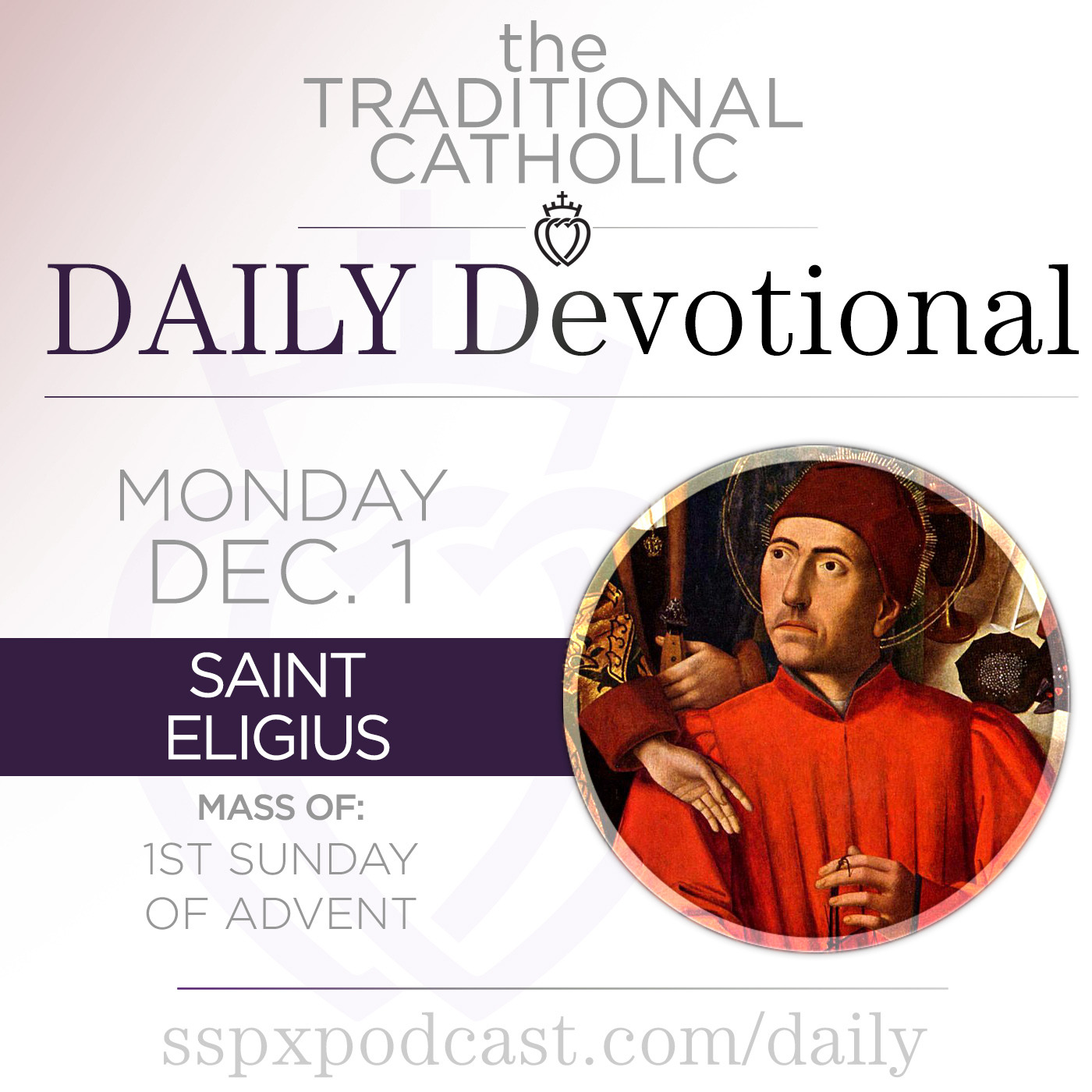
It’s the Feast of Advent Feria, St. Eligius, 3rd Class, with the color of Violet. In this episode: the meditation: “The Season of the Seed”, today’s news from the Church: “Brazil: Nearly 500 Confirmations Conferred by Bishop Fellay”, a preview of the Sermon: “It Is Now the Hour to Rise from Sleep”, and today’s thought from the Archbishop.
Have feedback or questions about the DD or our other shows? podcast@sspx.org
Sources Used Today:
- “The Season of the Seed” – The Reed of God by Caryll Houselander
- “Brazil: Nearly 500 Confirmations Conferred by Bishop Fellay” (FSSPX.news)
- “It Is Now the Hour to Rise from Sleep” (SSPX Sermons)
- The Spiritual Life – Archbishop Lefebvre (Angelus Press)
Saint Eligius — or Saint Eloy, as he’s known in much of Europe — is one of those saints whose life glitters with a mix of holiness, craftsmanship, and old-world charm. Born around 588 near Limoges, he was trained as a goldsmith and quickly became famous for both his skill and his honesty. One early story captures his character perfectly: a king commissioned him to make an ornate saddle from a piece of gold. Eligius crafted two saddles from the amount instead of one — and returned the extra. The king was so astonished by his integrity that he made Eligius master of the mint, then eventually his personal counselor.
Eligius never let success harden his heart. He used his wealth to ransom captives, feed the poor, and bury the dead — the kind of hidden works that made him beloved long before he ever became a bishop. Eventually he was ordained and appointed Bishop of Noyon-Tournai, where he spent the rest of his life evangelizing the rural countryside, preaching simply and patiently to communities that were still half-pagan. His sermons survived for centuries because they reveal a spiritual father who knew his people’s struggles: superstitions, fear of the unknown, and the tug of old customs. He answered all of it with cheerful firmness and deep compassion.
But where Eligius really shines is in the traditions that blossomed after his death. His feast on December 1 became one of the most joy-filled days of medieval winter. Blacksmiths, metalworkers, carpenters, jewelers, and farriers — anyone who worked with their hands — claimed him as their patron. In France and Belgium, guilds held festive processions with decorated horses, tools, lanterns, and music. Apprentices were blessed with Eligius medals, and craftsmen placed their tools before the altar for the priest to sprinkle with holy water. It was a yearly reminder that honest labor is a path to holiness.
In horse-breeding regions, Saint Eligius was the protector of animals, especially horses and draft beasts. Farmers led their horses to church for a blessing on his feast, sometimes braiding their manes with ribbons for the occasion. In some towns, grooms circled the church three times with their horses, praying for a safe winter and successful year of work.
He also became a beloved patron of travelers, metal detectors (long before the technology existed, due to his fame as a metalsmith), and even coin collectors — a playful nod to his years at the royal mint. And in many parts of Europe, his name was invoked against misfortunes involving tools, machinery, and livestock.
What makes Saint Eligius so enduring is the way he sanctified ordinary life. He reminds us that skill, honesty, beauty, and kindness are all forms of service to God — that a well-made tool or an honest day’s labor can be an offering as pleasing to heaven as any song of praise.
Saint Eligius, patron of craftsmen and workers, pray for us!
- - - - - -
- - - - - -
Explore more:
What is the SSPX Podcast?
The SSPX Podcast is produced by Angelus Press, which has as its mission the fortification of traditional Catholics so that they can defend the Faith, and reaching out to those who have not yet found Tradition.
What is the SSPX?
The main goal of the Society of Saint Pius X is to preserve the Catholic Faith in its fullness and purity, to teach its truths, and to diffuse its virtues, especially through the Roman Catholic priesthood.
Authentic spiritual life, the sacraments, and the traditional liturgy are its primary means of bringing this life of grace to souls.
Although the traditional Latin Mass is the most visible and public expression of the work of the Society, we are committed to defending Catholic Tradition in its entirety: all of Catholic doctrine and morals as the Church has always defended them. What people need is the Catholic Faith, without compromise, with all the truth and beauty which accompanies it.
https://sspx.org