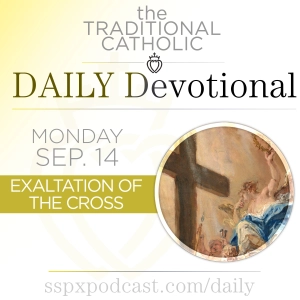
It's the Feast of
Exaltation of the Holy Cross,
2nd Class, with the color of
Red. In this episode: the meditation: "The Sanctification of Sunday", today's news from the Church: "Could the SSPX still wait for Rome?", a preview of the Sermon: "Trusting Providence", and today's thought from the Archbishop Marcel Lefebvre.
Have feedback or questions about the DD or our other shows?
podcast@sspx.org
Sources Used Today:
- "The Sanctification of Sunday" — From the Assumption to Advent
- "Could the SSPX still wait for Rome?" (FSSPX.news)
- "Trusting Providence" (SSPX Sermons)
- The Spiritual Life — Archbishop Marcel Lefebvre (Angelus Press)
Please support our new project, the Archbishop Lefebvre Biography Audiobook:
The Feast of the Exaltation of the Holy Cross has one of the most interesting histories on the Catholic calendar because it celebrates not simply Christ's Crucifixion, but the strange journey of the Cross itself through history.
The story begins with Helena, mother of Emperor Constantine. Around the year 326, Helena traveled to Jerusalem looking for the places associated with the Passion of Christ. According to ancient tradition, excavations near Calvary uncovered three crosses.
That created an obvious problem.
Which one was Christ's?
Tradition says the True Cross was identified through a miraculous healing when a sick woman touched it. Other versions tell of a dead man being restored to life. Whatever the precise details, devotion to the Cross in Jerusalem developed very early.
Constantine soon ordered a magnificent church built over Calvary and Christ's tomb. The complex was dedicated in September of 335 and eventually became the Church of the Holy Sepulchre.
The following day, September 14, the relic of the True Cross was solemnly displayed, or "exalted," before the people so everyone could venerate it.
That's where our feast gets its name.
But the Cross wasn't finished traveling.
In 614, Persian armies captured Jerusalem, destroyed churches, and carried away the relic of the True Cross as war booty.
Imagine the shock.
One of Christianity's holiest relics was now in the hands of an invading army.
Years later, the Byzantine emperor Heraclius defeated the Persians and recovered the Cross. In 629, he solemnly returned it to Jerusalem.
Then comes one of the feast's most memorable traditions.
Heraclius supposedly approached Calvary wearing his imperial robes, jeweled crown, and all the splendor of an emperor. But when he tried to carry the Cross forward, he couldn't move.
The Patriarch of Jerusalem pointed out the obvious contrast.
Christ had carried that Cross wearing a crown of thorns.
Heraclius was carrying it dressed like a king.
So the emperor removed his crown, exchanged his rich garments for simple clothing, took up the Cross again, and this time carried it forward.
Whether every detail happened exactly that way or not, medieval Christians loved the story because it captures the entire meaning of the feast.
The Cross was once an instrument designed to humiliate criminals.
Christianity turned it into a throne.
That's why Catholics place crosses above altars, wear them around their necks, and raise them over churches. We don't honor suffering for its own sake. We honor the Cross because Christ took the thing meant to destroy Him and made it the instrument of our salvation.
We adore Thee, O Christ, and we bless Thee, because by Thy Holy Cross Thou hast redeemed the world.
- - - - - -
Explore more:
What is the SSPX Podcast?
The SSPX Podcast is produced by Angelus Press, which has as its mission the fortification of traditional Catholics so that they can defend the Faith, and reaching out to those who have not yet found Tradition.
What is the SSPX?
The main goal of the Society of Saint Pius X is to preserve the Catholic Faith in its fullness and purity, to teach its truths, and to diffuse its virtues, especially through the Roman Catholic priesthood.
Authentic spiritual life, the sacraments, and the traditional liturgy are its primary means of bringing this life of grace to souls.
Although the traditional Latin Mass is the most visible and public expression of the work of the Society, we are committed to defending Catholic Tradition in its entirety: all of Catholic doctrine and morals as the Church has always defended them. What people need is the Catholic Faith, without compromise, with all the truth and beauty which accompanies it.
https://sspx.org