It's the Feast of
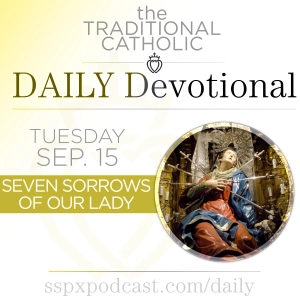
Seven Sorrows of Our Lady,
1st Class, with the color of
White. In this episode: the meditation: "Attendance at Mass", a preview of this week's episode of The SSPX Podcast: "Audiobook Chapter 17 "I Adhere to Eternal Rome"", and today's thought from the Archbishop Marcel Lefebvre.
Have feedback or questions about the DD or our other shows?
podcast@sspx.org
Sources Used Today:
- "Attendance at Mass" — From the Assumption to Advent
- The SSPX Podcast: "Audiobook Chapter 17 "I Adhere to Eternal Rome"" (SSPX Podcast)
- The Spiritual Life — Archbishop Marcel Lefebvre (Angelus Press)
Please support our new project, the Archbishop Lefebvre Biography Audiobook:
The Feast of Our Lady of Sorrows asks us to look at the life of Christ from a perspective we don't always stop to consider: what was all of this like for His Mother?
Catholics have meditated on Mary's suffering since the earliest centuries, especially her presence at Calvary. Simeon had foretold it when Jesus was still an infant: "Thy own soul a sword shall pierce." Medieval Christians eventually began identifying particular moments when that sword seemed especially sharp.
These became the Seven Sorrows of Mary: Simeon's prophecy, the Flight into Egypt, losing the Child Jesus in Jerusalem, meeting Christ on the road to Calvary, standing beneath the Cross, receiving His dead body, and watching Him placed in the tomb.
And devotion to them became enormous.
By the Middle Ages, Christians were meditating on Mary's sorrows through prayers, artwork, processions, and hymns. The most famous is the Stabat Mater, traditionally attributed to the thirteenth-century Franciscan Jacopone da Todi. Its opening image is simple and devastating: Mary standing beside the Cross while her Son dies.
The Servite Order made this devotion especially their own. Founded in Florence in the thirteenth century by the Seven Holy Founders, the Servites spread devotion to the Seven Sorrows throughout Europe. The familiar image of Mary's heart pierced by seven swords comes directly from this tradition.
Interestingly, the Church eventually had two feasts honoring Mary's sorrows.
One developed on the Friday of Passion Week, focusing particularly on Mary's compassion during the Passion. The other was celebrated by the Servites in September. In 1814, after returning to Rome following his captivity under Napoleon, Pope Pius VII extended the September feast to the universal Church in thanksgiving. Pope Pius X later fixed it on September 15, immediately after the Exaltation of the Holy Cross.
That placement is almost perfect.
September 14: look at the Cross.
September 15: look at the Mother standing beneath it.
The feast also inspired some striking traditions, particularly in Mediterranean countries. In Spain, Italy, Malta, and parts of Latin America, statues of the Sorrowful Mother are carried through streets dressed in dark robes, sometimes beneath elaborate canopies. During Holy Week, confraternities still carry enormous images of the Dolorosa, surrounded by candles and flowers, while crowds watch in silence.
Our Lady of Sorrows isn't really about asking which of Mary's sufferings was worst.
It's about remembering that she stayed.
At Bethlehem, she held Christ when almost no one knew Him.
At Calvary, she remained when almost everyone had left.
Our Lady of Sorrows, Mother who stood faithfully beneath the Cross, pray for us.
- - - - - -
Explore more:
What is the SSPX Podcast?
The SSPX Podcast is produced by Angelus Press, which has as its mission the fortification of traditional Catholics so that they can defend the Faith, and reaching out to those who have not yet found Tradition.
What is the SSPX?
The main goal of the Society of Saint Pius X is to preserve the Catholic Faith in its fullness and purity, to teach its truths, and to diffuse its virtues, especially through the Roman Catholic priesthood.
Authentic spiritual life, the sacraments, and the traditional liturgy are its primary means of bringing this life of grace to souls.
Although the traditional Latin Mass is the most visible and public expression of the work of the Society, we are committed to defending Catholic Tradition in its entirety: all of Catholic doctrine and morals as the Church has always defended them. What people need is the Catholic Faith, without compromise, with all the truth and beauty which accompanies it.
https://sspx.org