It's the Feast of
Sts. Cornelius and Cyprian,
3rd Class, with the color of
Red. In this episode: the meditation: "Sanctification of the Family Through Mass", today's news from the Church: "Small but Important Victory in the Euthanasia Law in France", and today's thought from the Archbishop Marcel Lefebvre.
Have feedback or questions about the DD or our other shows?
podcast@sspx.org
Sources Used Today:
- "Sanctification of the Family Through Mass" — From the Assumption to Advent
- "Small but Important Victory in the Euthanasia Law in France" (FSSPX.news)
- The Spiritual Life — Archbishop Marcel Lefebvre (Angelus Press)
Please support our new project, the Archbishop Lefebvre Biography Audiobook:
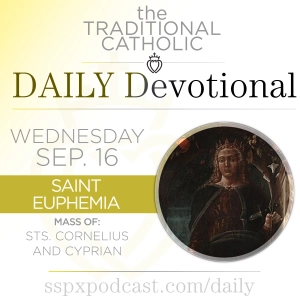
Saint Euphemia is one of those early martyrs whose story didn't end with her martyrdom. More than a century after her death, her tomb became connected with one of the most important councils in Church history.
Euphemia lived in Chalcedon, across the water from Constantinople, around the beginning of the fourth century. She came from a Christian family and was still a young woman when Emperor Diocletian's great persecution reached the city.
According to the ancient accounts, the governor ordered everyone to participate in sacrifices to the pagan god Ares.
Euphemia refused.
She was arrested with other Christians and subjected to a series of tortures intended to make her abandon the faith. The traditional account describes the rack, fire, and eventually the arena, where she was exposed to wild animals. She died around the year 303.
Christians buried her with honor in Chalcedon, and a great basilica eventually rose over her tomb.
And that's where the story gets especially interesting.
In 451, nearly 150 years after Euphemia's death, hundreds of bishops gathered in Chalcedon to settle an enormous controversy over the Person of Christ. The question was how Christians should speak correctly about Christ being both truly God and truly man.
The meetings took place in the basilica dedicated to Euphemia.
According to a beloved Eastern Christian tradition, the disagreement became so intense that representatives placed competing statements of faith inside Euphemia's tomb and sealed it.
Then everyone prayed.
When the tomb was reopened, tradition says the orthodox profession was found in Euphemia's hand, while the rejected statement lay at her feet.
Whether we treat that account as miraculous history or later devotional tradition, it tells us how closely Christians associated Euphemia with the Council of Chalcedon. She became not merely a martyr of the early persecutions, but a symbol of the Church's defense of the truth about Christ.
Her relics also had quite a journey.
After Persian invasions threatened Chalcedon, they were eventually brought across the Bosporus to Constantinople. During the later Iconoclast persecutions, tradition says her relics were thrown into the sea, recovered, and eventually restored.
They can still be venerated today in the Church of Saint George in Istanbul, the cathedral of the Ecumenical Patriarchate.
That's an extraordinary journey for a young woman killed more than seventeen centuries ago.
Euphemia never wrote a theological book.
She never attended a council.
She simply refused to deny Christ.
Yet generations later, bishops debating exactly who Christ is gathered around her tomb to do it.
Saint Euphemia, great martyr and witness to the true faith of Christ, pray for us.
- - - - - -
Explore more:
What is the SSPX Podcast?
The SSPX Podcast is produced by Angelus Press, which has as its mission the fortification of traditional Catholics so that they can defend the Faith, and reaching out to those who have not yet found Tradition.
What is the SSPX?
The main goal of the Society of Saint Pius X is to preserve the Catholic Faith in its fullness and purity, to teach its truths, and to diffuse its virtues, especially through the Roman Catholic priesthood.
Authentic spiritual life, the sacraments, and the traditional liturgy are its primary means of bringing this life of grace to souls.
Although the traditional Latin Mass is the most visible and public expression of the work of the Society, we are committed to defending Catholic Tradition in its entirety: all of Catholic doctrine and morals as the Church has always defended them. What people need is the Catholic Faith, without compromise, with all the truth and beauty which accompanies it.
https://sspx.org