It's a
Feria / 1st Fri,
4th Class, with the color of
Green. In this episode: the meditation: "Trust In Providence", today's news from the Church: "What "Communion"?", a preview of this week's episode of The SSPX Podcast: "The Incarnation and the Virgin Birth", and today's thought from the Archbishop Marcel Lefebvre.
Have feedback or questions about the DD or our other shows?
podcast@sspx.org
Sources Used Today:
- "Trust In Providence" — From the Assumption to Advent
- "What "Communion"?" (FSSPX.news)
- The SSPX Podcast: "The Incarnation and the Virgin Birth" (SSPX Podcast)
- The Spiritual Life — Archbishop Marcel Lefebvre (Angelus Press)
Please support our new project, the Archbishop Lefebvre Biography Audiobook:
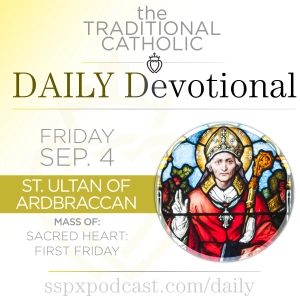
Saint Ultan of Ardbraccan is one of those early Irish saints whose biography comes to us in fragments, but one particular detail makes him stand out immediately.
He cared for abandoned children.
Ultan lived in seventh-century Ireland and became bishop and abbot at Ardbraccan, in what is now County Meath. He belonged to the remarkable age of Irish monasticism when monasteries were not simply places where monks prayed. They functioned as schools, farms, libraries, hospitals, and centers of charity for the surrounding countryside.
Then Ireland was struck by a terrible epidemic.
A plague sometimes called the Buidhe Chonaill, or Yellow Plague, swept through the country during the seventh century. Among its victims were enormous numbers of adults, leaving children without parents to care for them.
Ultan saw what was happening and stepped in.
Later Irish tradition remembers him gathering orphaned children around the monastery at Ardbraccan and personally helping care for them. One particularly memorable story says that there were so many infants needing to be fed that Ultan devised ways of supplying them with milk, including keeping cows specifically for the children.
It's a wonderfully practical image of sanctity.
A bishop surrounded by crying babies, trying to figure out how to feed everybody.
For that reason, Ultan became especially associated with the care of children and the poor. Centuries before orphanages or organized social services existed, monasteries like his often became the only safety net available when families were destroyed by disease or famine.
But Ultan wasn't only remembered for charity.
Irish tradition also describes him as a scholar and a collector of writings about Saint Brigid of Kildare. One medieval source even credits him with assembling hymns and accounts concerning her life. That gives us another glimpse of what an Irish bishop actually did in this period: care for the poor, govern a monastery, teach, preserve manuscripts, and somehow keep the local Church functioning.
Even the place connected with him is interesting.
Ardbraccan comes from the Irish Ard Breacáin, meaning the "height of Breacán." It became an important ecclesiastical center for centuries after Ultan's time. The old Diocese of Ardbraccan was eventually absorbed into the Diocese of Meath, but the area retained its religious importance long afterward.
Very little of Ultan's personal story survives.
But maybe the detail that survived is exactly the one worth remembering.
When plague swept through Ireland and children were left with nobody to care for them, Ultan didn't write a treatise about the problem. He picked them up. He fed them. And he gave them a home.
Saint Ultan of Ardbraccan, father of orphans and protector of abandoned children, pray for us.
- - - - - -
Explore more:
What is the SSPX Podcast?
The SSPX Podcast is produced by Angelus Press, which has as its mission the fortification of traditional Catholics so that they can defend the Faith, and reaching out to those who have not yet found Tradition.
What is the SSPX?
The main goal of the Society of Saint Pius X is to preserve the Catholic Faith in its fullness and purity, to teach its truths, and to diffuse its virtues, especially through the Roman Catholic priesthood.
Authentic spiritual life, the sacraments, and the traditional liturgy are its primary means of bringing this life of grace to souls.
Although the traditional Latin Mass is the most visible and public expression of the work of the Society, we are committed to defending Catholic Tradition in its entirety: all of Catholic doctrine and morals as the Church has always defended them. What people need is the Catholic Faith, without compromise, with all the truth and beauty which accompanies it.
https://sspx.org