It's a
Feria,
4th Class, with the color of
Green. In this episode: the meditation: "Sanctification of the Family Through Mass", today's news from the Church: "Discovery of Two Unpublished Sermons by St. Augustine", a preview of the Sermon: "Friend, Go Up Higher", and today's thought from the Archbishop Marcel Lefebvre.
Have feedback or questions about the DD or our other shows?
podcast@sspx.org
Sources Used Today:
- "Sanctification of the Family Through Mass" — From the Assumption to Advent
- "Discovery of Two Unpublished Sermons by St. Augustine" (FSSPX.news)
- "Friend, Go Up Higher" (SSPX Sermons)
- The Spiritual Life — Archbishop Marcel Lefebvre (Angelus Press)
Please support our new project, the Archbishop Lefebvre Biography Audiobook:
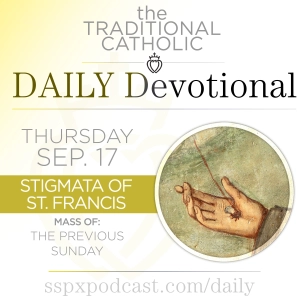
The Commemoration of the Stigmata of Saint Francis celebrates one of the strangest and most extraordinary events in the life of one of the Church's best-known saints.
It happened in September of 1224, just two years before Francis died.
By this point, the Franciscan Order had exploded across Europe. Thousands of friars had joined, and Francis increasingly withdrew from leadership. He was physically exhausted, often sick, and worried that the movement he had begun was becoming something much bigger and more complicated than he had ever intended.
So he went somewhere quiet.
Francis withdrew to Mount La Verna, a rugged mountain retreat in Tuscany, to spend several weeks fasting and praying in preparation for the feast of Saint Michael the Archangel.
According to the earliest Franciscan accounts, Francis prayed for two particular graces before his death: to understand something of the love Christ experienced during His Passion, and something of the suffering He endured on the Cross.
Then came the vision.
Around the feast of the Exaltation of the Holy Cross, Francis saw what appeared to be a seraph with six wings, bearing the figure of a crucified man.
When the vision disappeared, Francis discovered wounds on his own body.
His hands and feet bore marks corresponding to the nails of the Crucifixion, and his side carried a wound resembling the wound made by the soldier's lance.
Francis tried to hide them.
That's an important detail.
He wasn't showing people the wounds or using them to prove his holiness. He wrapped his hands, wore footwear when possible, and told very few people what had happened. Brother Leo and a handful of companions eventually saw enough to understand.
After Francis died in 1226, however, the wounds were seen openly by many who came to view his body.
The event became known as the stigmata, from the Greek word meaning a mark or brand. Francis is traditionally regarded as the first person in Christian history to receive the visible wounds of Christ in this extraordinary way.
La Verna remains one of the most moving Franciscan pilgrimage sites in Italy. Pilgrims can still walk through the mountain forest to the rocky place traditionally associated with the event. A chapel now stands there, and each day the friars process from the basilica to the Chapel of the Stigmata, singing and praying along the same cliffs where Francis once sought solitude.
The Church eventually gave the event its own liturgical commemoration on September 17.
And perhaps the most important part of the feast is easy to miss.
Francis had spent his entire Christian life trying to imitate Christ.
Near the end of that life, according to Franciscan tradition, that imitation became visible even in his flesh.
Saint Francis of Assisi, marked with the wounds of the Crucified Christ, pray for us.
- - - - - -
Explore more:
What is the SSPX Podcast?
The SSPX Podcast is produced by Angelus Press, which has as its mission the fortification of traditional Catholics so that they can defend the Faith, and reaching out to those who have not yet found Tradition.
What is the SSPX?
The main goal of the Society of Saint Pius X is to preserve the Catholic Faith in its fullness and purity, to teach its truths, and to diffuse its virtues, especially through the Roman Catholic priesthood.
Authentic spiritual life, the sacraments, and the traditional liturgy are its primary means of bringing this life of grace to souls.
Although the traditional Latin Mass is the most visible and public expression of the work of the Society, we are committed to defending Catholic Tradition in its entirety: all of Catholic doctrine and morals as the Church has always defended them. What people need is the Catholic Faith, without compromise, with all the truth and beauty which accompanies it.
https://sspx.org