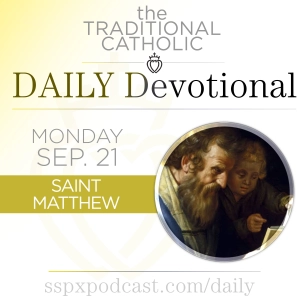
It's the Feast of
St. Matthew,
2nd Class, with the color of
Red. In this episode: the meditation: "The Love of God for Us", today's news from the Church: "The Jesuits leave Liège, 450 years after their arrival", a preview of the Sermon: "The Power of Humility", and today's thought from the Archbishop Marcel Lefebvre.
Have feedback or questions about the DD or our other shows?
podcast@sspx.org
Sources Used Today:
- "The Love of God for Us" — From the Assumption to Advent
- "The Jesuits leave Liège, 450 years after their arrival" (FSSPX.news)
- "The Power of Humility" (SSPX Sermons)
- The Spiritual Life — Archbishop Marcel Lefebvre (Angelus Press)
Please support our new project, the Archbishop Lefebvre Biography Audiobook:
Saint Matthew has one of the shortest conversion stories in the Gospel.
Jesus walks past a tax booth, sees Matthew sitting there, and says, "Follow Me."
Matthew gets up and goes.
But there's much more packed into that moment than it first appears.
Matthew was a publican, a tax collector working within the Roman system. Tax collectors were deeply disliked, partly because they cooperated with the occupying power and partly because the system gave plenty of opportunity for corruption. To respectable Jewish society, Matthew was not an obvious candidate for an Apostle.
Jesus chose him anyway.
And Matthew's first reaction is interesting.
He threw a dinner.
He invited Jesus, the disciples, and a collection of tax collectors and other people respectable society labeled "sinners." Matthew had only just begun following Christ, but he was already bringing his friends along.
After Pentecost, Matthew disappears from the New Testament record, and this is where ancient traditions begin to diverge.
Early Christian writers agreed that he preached first among the Jews. Papias of Hierapolis, writing in the early second century, recorded a tradition that Matthew compiled sayings of Jesus in the "Hebrew dialect." Exactly how that relates to the Greek Gospel of Matthew we possess today remains debated, but it shows how early Matthew was connected with preserving Christ's teaching in written form.
Later traditions send him much farther afield.
Some place his missionary work in Persia. Others speak of Syria or lands south of the Caspian Sea. The strongest later tradition associates his martyrdom with Ethiopia, although ancient sources differ enough that we shouldn't pretend we know exactly where or how he died.
His relics have an interesting story too.
By the Middle Ages, they were believed to have reached southern Italy and eventually the city of Salerno. Today, the Salerno Cathedral is dedicated to Saint Matthew, and his relics are venerated in the crypt beneath the cathedral. His presence became so important to the city that Matthew is still honored as Salerno's patron.
There's also a nice bit of symbolism in Christian art.
Matthew is represented by a winged man or angel, one of the four creatures associated with the Evangelists. The symbol fits because his Gospel begins with Christ's human genealogy: "The book of the generation of Jesus Christ."
But perhaps the most interesting thing about Matthew is still that tax booth.
Christ didn't wait for Matthew to clean up his reputation, find better friends, or prove himself worthy.
He simply said, "Follow Me."
And Matthew stood up.
Saint Matthew, Apostle and Evangelist, who left everything at the call of Christ, pray for us.
- - - - - -
Explore more:
What is the SSPX Podcast?
The SSPX Podcast is produced by Angelus Press, which has as its mission the fortification of traditional Catholics so that they can defend the Faith, and reaching out to those who have not yet found Tradition.
What is the SSPX?
The main goal of the Society of Saint Pius X is to preserve the Catholic Faith in its fullness and purity, to teach its truths, and to diffuse its virtues, especially through the Roman Catholic priesthood.
Authentic spiritual life, the sacraments, and the traditional liturgy are its primary means of bringing this life of grace to souls.
Although the traditional Latin Mass is the most visible and public expression of the work of the Society, we are committed to defending Catholic Tradition in its entirety: all of Catholic doctrine and morals as the Church has always defended them. What people need is the Catholic Faith, without compromise, with all the truth and beauty which accompanies it.
https://sspx.org