It's a
Feria,
4th Class, with the color of
Green. In this episode: the meditation: "Holiness and Charity", today's news from the Church: "St. Bernard's Birthplace will be Restored", a preview of the Sermon: "Who Are You, O Immaculata?", and today's thought from the Archbishop Marcel Lefebvre.
Have feedback or questions about the DD or our other shows?
podcast@sspx.org
Sources Used Today:
- "Holiness and Charity" — From the Assumption to Advent
- "St. Bernard's Birthplace will be Restored" (FSSPX.news)
- "Who Are You, O Immaculata?" (SSPX Sermons)
- The Spiritual Life — Archbishop Marcel Lefebvre (Angelus Press)
Please support our new project, the Archbishop Lefebvre Biography Audiobook:
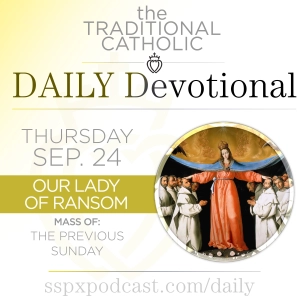
The Feast of Our Lady of Ransom has one of the more dramatic origins among the Church's Marian feasts. It grew out of a very real medieval problem: Christians were being captured, enslaved, and held for ransom around the Mediterranean.
In the early thirteenth century, Christian and Muslim powers were constantly fighting across Spain and the Mediterranean. Raids produced captives on both sides, and Christians taken into North Africa could spend years in slavery unless family, religious communities, or charitable organizations could raise enough money to free them.
Into that world came Peter Nolasco.
Peter had already begun using his own money to ransom Christian captives. According to Mercedarian tradition, however, something extraordinary happened on the night of August 1, 1218.
The Blessed Virgin appeared to Peter and asked him to establish a religious order dedicated specifically to freeing captives.
And the tradition says he wasn't the only one.
Our Lady also appeared separately to King James I of Aragon and to Saint Raymond of Peñafort. When the three men compared what had happened, the mission became clear.
The new community became the Order of the Blessed Virgin Mary of Mercy, better known as the Mercedarians.
Their members took the usual religious vows of poverty, chastity, and obedience.
Then they added a fourth.
If necessary, a Mercedarian promised to take the place of a Christian captive whose faith was in danger.
Think about that for a moment.
These men didn't simply collect donations for prisoners.
They promised that if the ransom couldn't be paid another way, they were willing to remain behind themselves.
Mercedarian friars traveled repeatedly into Muslim-controlled territories carrying money donated by Christians throughout Europe. They negotiated with captors, located prisoners, paid ransoms, and brought the freed men, women, and children home.
Over the centuries, the order traditionally claimed tens of thousands of captives redeemed through its work.
Devotion to Our Lady of Ransom, also called Our Lady of Mercy, naturally grew alongside the order. Mary was pictured sheltering captives beneath her mantle or holding broken chains, a powerful image for families waiting at home for someone who might never return.
The feast eventually spread beyond the Mercedarians and was placed on September 24 in the Roman calendar.
There's something wonderfully concrete about this title of Our Lady.
"Ransom" isn't poetic language here.
There were actual prisoners.
Actual chains.
Actual money exchanged.
And religious men willing to trade their own freedom for somebody else's.
That makes the title point beautifully toward Christ Himself, who said He came "to give His life a redemption for many."
Our Lady of Ransom, Mother of Mercy and hope of captives, pray for us.
- - - - - -
Explore more:
What is the SSPX Podcast?
The SSPX Podcast is produced by Angelus Press, which has as its mission the fortification of traditional Catholics so that they can defend the Faith, and reaching out to those who have not yet found Tradition.
What is the SSPX?
The main goal of the Society of Saint Pius X is to preserve the Catholic Faith in its fullness and purity, to teach its truths, and to diffuse its virtues, especially through the Roman Catholic priesthood.
Authentic spiritual life, the sacraments, and the traditional liturgy are its primary means of bringing this life of grace to souls.
Although the traditional Latin Mass is the most visible and public expression of the work of the Society, we are committed to defending Catholic Tradition in its entirety: all of Catholic doctrine and morals as the Church has always defended them. What people need is the Catholic Faith, without compromise, with all the truth and beauty which accompanies it.
https://sspx.org