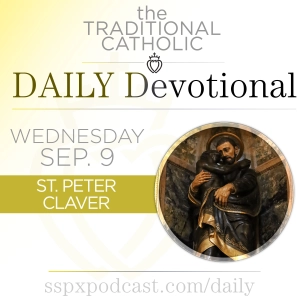
It's the Feast of
St Peter Claver,
3rd Class, with the color of
White. In this episode: the meditation: "A Salutary Meditation", today's news from the Church: "The Hymn of the Society of Saint Pius X", and today's thought from the Archbishop Marcel Lefebvre.
Have feedback or questions about the DD or our other shows?
podcast@sspx.org
Sources Used Today:
- "A Salutary Meditation" — From the Assumption to Advent
- "The Hymn of the Society of Saint Pius X" (FSSPX.news)
- The Spiritual Life — Archbishop Marcel Lefebvre (Angelus Press)
Please support our new project, the Archbishop Lefebvre Biography Audiobook:
Saint Peter Claver spent nearly forty years meeting ships that most people in seventeenth-century Cartagena wanted nothing to do with.
He was born in Spain in 1580 and entered the Jesuits as a young man. While studying on the island of Majorca, he met an elderly Jesuit brother, Saint Alphonsus Rodríguez, who became convinced that Peter's vocation was waiting for him across the Atlantic.
So Peter went to Colombia.
Cartagena was one of the great ports of the Spanish Empire, and tragically, one of the principal entry points for enslaved Africans brought to South America. Ships arrived carrying hundreds of people who had endured weeks below deck in horrific conditions. Many were sick. Some were dying. Few spoke Spanish.
Peter decided this would be his parish.
Whenever word came that a slave ship was approaching, he headed for the docks carrying whatever he could gather: water, fruit, bread, medicine, clothing, tobacco, and interpreters who spoke African languages.
Then he went below deck.
The conditions were awful. Heat, disease, filth, and fear filled the holds. Peter crawled into those spaces anyway, tending wounds and reassuring people who had no idea where they were or what was going to happen next.
He called himself "Petrus Claver, Aethiopum servus," Peter Claver, slave of the Africans.
And he meant it.
Peter understood that preaching Christianity to people while ignoring their suffering would ring hollow. So he cared for bodies first. He washed wounds, fed the starving, embraced people others refused to touch, and then, with interpreters and religious pictures, taught them about Christ and prepared many for baptism.
Tradition credits him with baptizing roughly 300,000 people during his ministry.
But his work didn't stop at the docks.
Peter visited plantations and prisons, confronted slave owners about mistreatment, and insisted that the Africans he baptized be treated as Christians with human dignity. He could not dismantle the enormous slave system surrounding him, but he refused to let that system convince him that the people trapped inside it were anything less than children of God.
Near the end of his life, Peter became seriously ill and spent several years largely confined to his room. The man who had cared for thousands was himself often neglected.
He died in 1654.
Today his remains are venerated in the San Pedro Claver Church and Convent, only a short distance from the harbor where he spent his life meeting those terrible ships.
There's something powerful about that location.
Cartagena remembers the wealth of an empire.
Peter Claver reminds us who paid for it.
Saint Peter Claver, servant of the enslaved and defender of forgotten souls, pray for us.
- - - - - -
Explore more:
What is the SSPX Podcast?
The SSPX Podcast is produced by Angelus Press, which has as its mission the fortification of traditional Catholics so that they can defend the Faith, and reaching out to those who have not yet found Tradition.
What is the SSPX?
The main goal of the Society of Saint Pius X is to preserve the Catholic Faith in its fullness and purity, to teach its truths, and to diffuse its virtues, especially through the Roman Catholic priesthood.
Authentic spiritual life, the sacraments, and the traditional liturgy are its primary means of bringing this life of grace to souls.
Although the traditional Latin Mass is the most visible and public expression of the work of the Society, we are committed to defending Catholic Tradition in its entirety: all of Catholic doctrine and morals as the Church has always defended them. What people need is the Catholic Faith, without compromise, with all the truth and beauty which accompanies it.
https://sspx.org