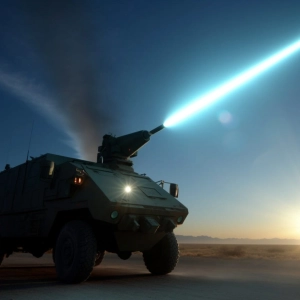
In the shadowed corridors of modern warfare, where drones swarm like locusts and missiles arc across borders with impersonal precision, a quiet revolution is unfolding. Israel’s Iron Beam, a high-powered laser defense system, stands poised to redefine the rules of engagement.
As we stand on the precipice of its full deployment by December 30, 2025, this technology—born from urgency and ingenuity—offers not just a shield against immediate threats, but a beacon of hope for a world long haunted by the specter of nuclear annihilation. Developed over more than a decade by Rafael Advanced Defense Systems and Elbit Systems, Iron Beam represents Israel’s audacious leap into directed-energy weapons, transforming science fiction into frontline reality.
The system’s journey has been one of relentless iteration, spurred by the brutal lessons of conflict. Unveiled in conceptual form years ago, Iron Beam accelerated after the October 7, 2023, Hamas assault, which unleashed thousands of rockets and drones, overwhelming traditional defenses. By September 2025, prototypes had already proven their mettle in combat, intercepting at least 40 Hezbollah drones in October 2024— a feat that saved civilian lives and safeguarded critical infrastructure without firing a single costly missile.
Brig. Gen. (res.) Danny Gold, head of the Israel Defense Ministry’s Directorate of Defense Research & Development (MAFAT), proclaimed, “Israel is the first country in the world to present a massive operational laser capability for intercepting threats.”
At its core, Iron Beam is a ground-based, 100-kilowatt fiber laser, capable of zapping rockets, mortars, and UAVs at ranges up to 10 kilometers—at the speed of light, no less. Each interception costs a mere half-dollar, akin to “turning on the lights,” as Defense Ministry Director-General Amir Baram aptly put it. This contrasts starkly with the $50,000 price tag of an Iron Dome interceptor, addressing the ammunition shortages exposed during the 12-day Iran-Israel War in June 2025, when nearly 600 Iranian missiles and over 1,000 drones tested Israel’s multilayered defenses to their limits.
What elevates Iron Beam beyond tactical brilliance is its seamless integration into Israel’s existing arsenal. It doesn’t replace Iron Dome, David’s Sling, or Arrow; it augments them.
Upon detecting an incoming threat, shared radar and command systems decide in seconds whether to deploy a laser zap or a kinetic missile, optimizing for cost and efficacy. Variants like Lite Beam (10 kW for vehicle mounting) and Iron Beam M (50 kW for trucks) promise mobile protection, extending this “unlimited magazine” to ground forces.
Of course, challenges remain—lasers falter in adverse weather, and are untested in full-spectrum barrages like October 7—but comprehensive trials, including those validated in 2025, affirm its reliability. As Gold noted at a Tel Aviv defense summit, “The Iron Beam laser system is expected to fundamentally change the rules of engagement on the battlefield.”
For Israel, besieged on multiple fronts, this isn’t just defense; it’s survival elevated to strategic supremacy.
Across the Atlantic, the United States mirrors this ambition with its own directed-energy pursuits, underscoring a transatlantic synergy vital to global security. The US Army’s Indirect Fire Protection Capability-High Energy Laser (IFPC-HEL) prototype program, overseen by the Rapid Capabilities & Critical Technologies Office, is the closest analog to Iron Beam. Awarded a $221 million contract to Lockheed Martin in 2023, IFPC-HEL aims to neutralize rockets, artillery, mortars, and drones with a 300 kW-class laser, offering near-unlimited shots at pennies per engagement. By late 2025, prototypes will be in advanced testing and integration phases, with initial fielding targeted for fiscal year 2026.
The US Navy’s HELIOS system, tested successfully in 2024 aboard the USS Preble against UAVs, complements this, while a 2024 congressional appropriation of $1.2 billion funneled directly to Israel’s Iron Beam procurement signals deep collaboration. Lockheed Martin’s 2022 partnership with Rafael to adapt Iron Beam for American needs hints at potential US adoption, should Israeli field trials—slated for imminent rollout—exceed expectations.
Yet, as a National Defense Industrial Association report laments, the US lacks a mature laser supply chain, positioning Israel’s breakthrough as a potential catalyst for accelerated deployment. This parallel path isn’t mere duplication; it’s a promise of shared resilience, where American scale meets Israeli innovation.
At its heart, Iron Beam’s promise transcends borders, whispering a profound possibility: the obsolescence of nuclear war. Directed-energy systems like this stand on the cusp of rendering nuclear arsenals relics, not through disarmament decrees, but through unassailable defense. Nuclear weapons derive their terror from assured penetration—mutually assured destruction hinges on missiles evading interception to deliver city-obliterating payloads. Iron Beam disrupts this calculus. Operating at light speed with pinpoint accuracy, lasers can engage intercontinental ballistic missiles (ICBMs) during boost phase, vaporizing warheads before separation, or midcourse, piercing decoys that confound kinetic interceptors like the US Ground-Based Midcourse Defense.
Cost barriers vanish, too: a single ICBM interception via a missile might run into the millions, but lasers scale infinitely with electricity alone. In the 2025 Iran-Israel clash, Iranian barrages strained stockpiles; imagine scaling that to nuclear salvos. Coupled with space-based relays or hypersonic countermeasures, these beams could create impenetrable shields, deterring launches outright. As Baram envisions, battlefields will teem with affordable lasers, neutralizing swarms before they coalesce into existential threats. This isn’t utopian fancy—it’s physics: energy directed with precision outpaces brute force.
Nuclear war, that 20th-century sword of Damocles, fades into history’s shadow, supplanted by a defensive web that renders aggression futile. Hope lies here, in the hum of fiber optics, promising a world where deterrence evolves from fear to fortitude.
Yet, this dawn carries shadows.
As Iron Beam and its kin mature, the West—Israel and the United States foremost—must vigilantly fortify against espionage from the 21st-century axis of adversaries: China, Russia, and to lesser degrees, Iran and North Korea. These regimes, through state-linked corporations, have honed corporate infiltration into an art of subversion. Chinese firms like Huawei have been implicated in pilfering dual-use tech, while Russian hackers target defense supply chains with impunity. Iran’s cyber units and North Korea’s illicit networks lurk as opportunistic vectors.
Full-spectrum countermeasures—zero-trust architectures, AI-driven anomaly detection, and draconian export controls—are imperative. The US CHIPS Act’s safeguards and Israel’s elite Unit 8200 must expand, auditing partners ruthlessly. To let this technology slip would arm tyrants with the means to pierce free-world defenses, inverting hope into peril. Vicious guardianship isn’t paranoia; it’s stewardship of humanity’s safeguard.
In weaving this future, the West confronts an internal foe: the creeping tolerance of antisemitism, especially in the United States. This venomous undercurrent erodes the very collaboration birthing Iron Beam—Jews and Israelis, engines of this innovation, face vilification that chills partnerships and stifles talent.
From campus protests to online vitriol, it fractures the trust essential for joint ventures like Lockheed-Rafael. Such bigotry is anathema to progress; it severs the intellectual arteries feeding directed-energy breakthroughs.
To protect the free world, America and its allies must excise this poison with unyielding resolve—through education and cultural recommitment, recalling the genocidal horrors that this sick ideology foments.
Only then can we harness Iron Beam’s light—and the light of similar, more potent projects—to illuminate, not just defend.
Yes, Virginia, there is a Santa Claus…and the probability of a secure tomorrow.
When we come back, our segment on America’s Third Watch, broadcast nationally from our flagship station WGUL, AM860 and FM93.7 in Tampa, Florida.
In Closing…
Iron Beam isn’t just another weapon; it’s the first real crack in the nuclear nightmare we’ve lived under since 1945. Light-speed, near-limitless, penny-per-shot defense is finally here, and it can turn ICBMs into expensive fireworks before they leave the atmosphere.
Israel is lighting the way, America is racing to catch up, and together they’re writing the obituary for mutually assured destruction.
But none of this survives if the technology leaks to Beijing or Moscow, and none of it flourishes while antisemitism is shrugged off as acceptable opinion. Guard the secrets, and guard the people who built them. The free world’s future is literally riding on a beam of light—don’t let anyone dim it.
Now that’s one hell of a Christmas present…to the world.
Until next time…
Get full access to Underground USA at
www.undergroundusa.com/subscribe