Climate change and the securitization of vulnerable nations

Climate change and the securitization of vulnerable nations

Author: Department of War Studies December 8, 2021 Duration: 39:00
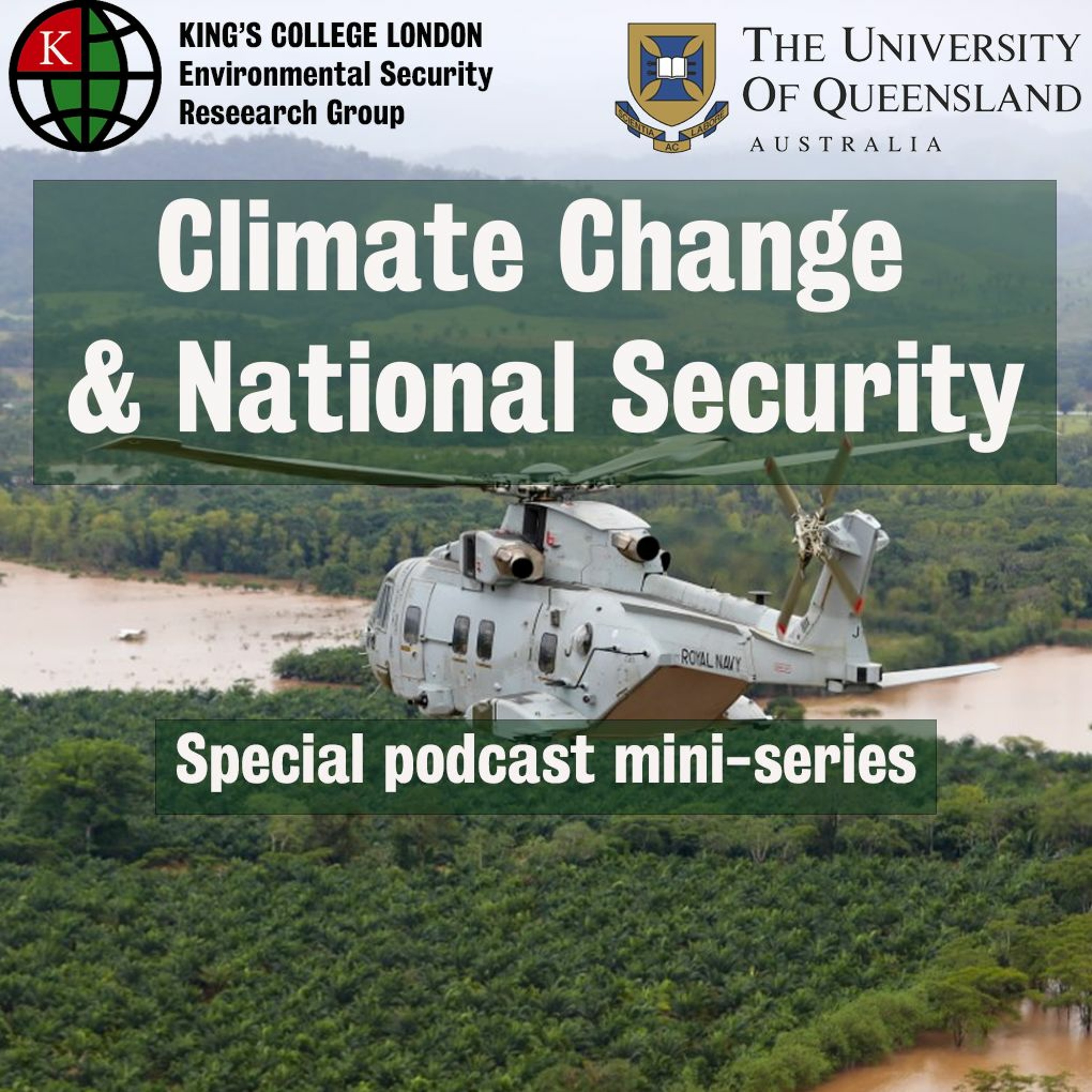
Vulnerable nations are really feeling the negative effects and implications of climate change and the associated security repercussions. To what extent is climate change a security issue in vulnerable states? How are the coalitions between under-developed nations helping in the fight against climate change? What are the key issues and divisions in the approaches of the global north and south? Recorded just after COP 26, the fourth episode of this five-part mini-series on Climate Change and National Security focuses on these challenges. Dr Duraid Jalili from the King’s Environmental Security Research Group and Professor Matt McDonald from the University of Queensland, speak to Dr Hillary Briffa, Lecturer in National Security Studies, Assistant Director of the Centre for Defence Studies and Co-founder of the Centre for Grand Strategy at King’s College London and Dr Simon Chin-Yee, Lecturer in International Development at University College London and Research Associate at King’s College London. They will discuss how we understand the unique challenges facing small island states and the global south more broadly on the existential problem of climate change and securitization, and the struggle of how these nations fight to get their voices heard and their successful influence on higher powers.

Drawn from the work of the School of Security Studies at King's College London, War Studies offers a direct line to one of the world's largest and most dedicated academic communities focused on security, defence, and international relations. This isn't about surface-level headlines; each episode digs into the intricate realities of conflict, diplomacy, and global power. You'll hear scholars and researchers unpack the underlying forces that shape world affairs, moving beyond theory to examine the tangible challenges faced by those navigating these complex spaces. The Department of War Studies produces this podcast to share its world-leading research, treating each conversation as an opportunity to question assumptions and deepen understanding. Tuning in means engaging with rigorous analysis that connects academic insight to the pressing security issues of our time. The consistent thread is a belief that examining the nature of war is essential for comprehending the broader landscape of human conflict and cooperation. Expect thoughtful, evidence-driven discussions that refuse to simplify the difficult questions.
Author: Language: English Episodes: 100

War Studies
Podcast Episodes
The fall of Assad and its impact on international dynamics [not-audio_url] [/not-audio_url]

Duration: 44:32
What does the fall of Bashar al-Assad’s regime mean for the future of Syria and the broader Middle East? How might the rise of Abu Mohammed al-Jolani reshape Syria’s governance and regional alliances? Can the rebel leade…
The legacy of the Yezidi genocide with Mirza Dinnayi [not-audio_url] [/not-audio_url]

Duration: 46:55
In 2014, the self-styled Islamic State committed genocide against the Yezidi population in Iraq. To mark the anniversary of the genocide, Dr Inna Rudolf speaks to renowned Yezidi human rights advocate Mirza Dinnayi about…
Trump and the future of the Russia-Ukraine war [not-audio_url] [/not-audio_url]

Duration: 53:45
What would Trump’s return to the White House mean for Ukraine’s future and Europe’s security? How might his strategy for the war in Ukraine differ from the current administration’s? Can he deliver on his pledge to end th…
The power of open-source intelligence with Henrietta Wilson [not-audio_url] [/not-audio_url]

Duration: 39:06
How is open-source data being used to uncover threats to human security, and what ethical challenges do practitioners face when working with open-source intelligence? In this episode, we delve into these questions with H…
The Strugle for Taiwan with Professor Sulmaan Khan [not-audio_url] [/not-audio_url]

Duration: 1:01:27
What makes Taiwan such a crucial flashpoint in global politics? How has its historical journey shaped its current role on the world stage? In this special 'War Studies Podcast Live' episode, Dr Charlie Laderman, Senior L…
The Great Global Rebalancing with Dr Samir Puri [not-audio_url] [/not-audio_url]

Duration: 48:11
Are we witnessing the decline of Western power and influence? What could this mean for the future of the global order? In this episode, Dr. Samir Puri—former UK diplomat and Visiting Lecturer in the Department of War Stu…
What is the ‘logic’ of intergroup conflict? [not-audio_url] [/not-audio_url]

Duration: 1:02:09
Why do groups enter into conflict when a peaceful resolution could be reached? Dr Nafees Hamid interviews Dr Hannes Rusch about his work examining the ‘logic’ of intergroup conflict. Dr Rusch talks us through the basic m…
Understanding conflict trauma and mental health in South Sudan [not-audio_url] [/not-audio_url]

Duration: 32:33
*This episode was recorded in early March 2024, before the recent escalation of violence in Sudan. South Sudan may be the youngest country in the world, but it’s already undergone a huge amount of violence – and the ongo…
Building resilience to violent extremism [not-audio_url] [/not-audio_url]

Duration: 51:11
What makes a person or a community resilient to violent extremism? Are these inherent characteristics or are they something that can be taught? ‘Resilience’ has become a buzzword in the field of countering violent extrem…
How greening initiatives can help promote peace [not-audio_url] [/not-audio_url]

Duration: 1:03:13
After two decades of violent conflict in the city of Mosul, Iraq, Dr Omar Mohammed, founder of the Mosul Eye organisation, started a tree-planting initiative to help bring communities together. In the United States, Dr M…