Climate change and the securitization of vulnerable nations

Climate change and the securitization of vulnerable nations

Author: Department of War Studies December 8, 2021 Duration: 39:00
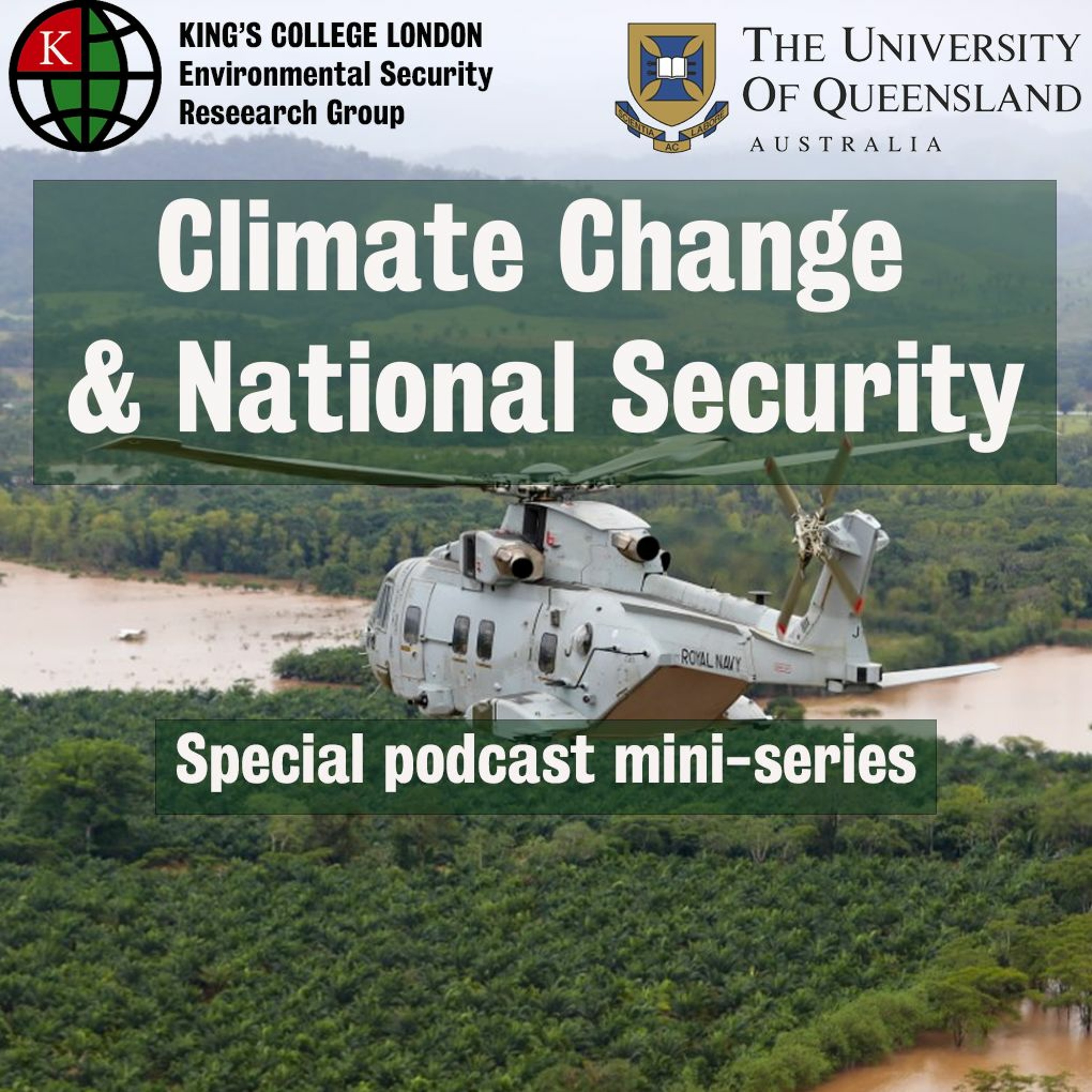
Vulnerable nations are really feeling the negative effects and implications of climate change and the associated security repercussions. To what extent is climate change a security issue in vulnerable states? How are the coalitions between under-developed nations helping in the fight against climate change? What are the key issues and divisions in the approaches of the global north and south? Recorded just after COP 26, the fourth episode of this five-part mini-series on Climate Change and National Security focuses on these challenges. Dr Duraid Jalili from the King’s Environmental Security Research Group and Professor Matt McDonald from the University of Queensland, speak to Dr Hillary Briffa, Lecturer in National Security Studies, Assistant Director of the Centre for Defence Studies and Co-founder of the Centre for Grand Strategy at King’s College London and Dr Simon Chin-Yee, Lecturer in International Development at University College London and Research Associate at King’s College London. They will discuss how we understand the unique challenges facing small island states and the global south more broadly on the existential problem of climate change and securitization, and the struggle of how these nations fight to get their voices heard and their successful influence on higher powers.

Drawn from the work of the School of Security Studies at King's College London, War Studies offers a direct line to one of the world's largest and most dedicated academic communities focused on security, defence, and international relations. This isn't about surface-level headlines; each episode digs into the intricate realities of conflict, diplomacy, and global power. You'll hear scholars and researchers unpack the underlying forces that shape world affairs, moving beyond theory to examine the tangible challenges faced by those navigating these complex spaces. The Department of War Studies produces this podcast to share its world-leading research, treating each conversation as an opportunity to question assumptions and deepen understanding. Tuning in means engaging with rigorous analysis that connects academic insight to the pressing security issues of our time. The consistent thread is a belief that examining the nature of war is essential for comprehending the broader landscape of human conflict and cooperation. Expect thoughtful, evidence-driven discussions that refuse to simplify the difficult questions.
Author: Language: English Episodes: 100

War Studies
Podcast Episodes
Reconciliation and reconstruction in post-conflict Iraq [not-audio_url] [/not-audio_url]

Duration: 56:08
Series: Breaking Cycles of Conflict "Let’s imagine tomorrow Mosul is brick by brick exactly what it was like before ISIS took over – the city has still fundamentally changed." In this episode, Dr Craig Larkin, Dr Inna Ru…
COP28 and Climate Security with Dr Pauline Heinrichs [not-audio_url] [/not-audio_url]

Duration: 36:43
Can countries work together at COP28 to agree on effective global actions for addressing climate change? In this episode we speak to Dr Pauline Heinrichs, Lecturer on climate and energy in the Department of War Studies,…
Estimative Intelligence in European Foreign Policymaking [not-audio_url] [/not-audio_url]

Duration: 45:45
What are the dynamics of intelligence and foreign policy in Europe? The editors of the book “Estimative Intelligence in European Foreign Policymaking”, Professor Michael Goodman, Professor Christoph Meyer, Dr Nikki Ikani…
24 hours in Charlottesville with Nora Neus [not-audio_url] [/not-audio_url]

Duration: 38:10
“White supremacy, hate groups and the alt-right movement thrive in secrecy and in dark places. Being able to bring this topic out into the light and have deeper conversations about what these people really stand for, and…
Making the military moral with Professor David Whetham [not-audio_url] [/not-audio_url]

Duration: 46:37
How can we help the armed forces make the best decision when faced with impossible choices? What can we do to minimise the damage to soldiers’ mental health after conflict? And how can we save the highest number of lives…
50 years after Chile's coup d'etat with Francisco Lobo [not-audio_url] [/not-audio_url]

Duration: 47:47
"Reconciliation happens when my enemy tells me my story and I am able to say: ‘That is my story" - Stanley Hauerwas. 11 September 1973. Military forces attack La Moneda Palace, the Hawker Hunter plane launches rockets th…
Afghanistan after the Fall of Kabul with Dr Christine Cheng [not-audio_url] [/not-audio_url]

Duration: 46:49
“They couldn’t scrape together enough food to feed a family… It was very, very, very desperate.” On August 15 2021, international troops withdrew from Afghanistan. Two years on, what has been the impact of the Taliban’s…
Five years in terrorist captivity with Shahbaz Taseer [not-audio_url] [/not-audio_url]

Duration: 55:22
Please note that this episode contains material of a highly sensitive nature including kidnapping, violence and abuse that may be triggering for some individuals. In late August 2011, a few months after the assassination…
Society, Sacrifice, and Devotion [not-audio_url] [/not-audio_url]

Duration: 54:12
‘I think people are willing to sacrifice, and go through all sorts of pain, but it can’t just be for oneself. There has to be some higher reasoning to it’. In this episode, we are joined once again by Dr Nafees Hamid, co…