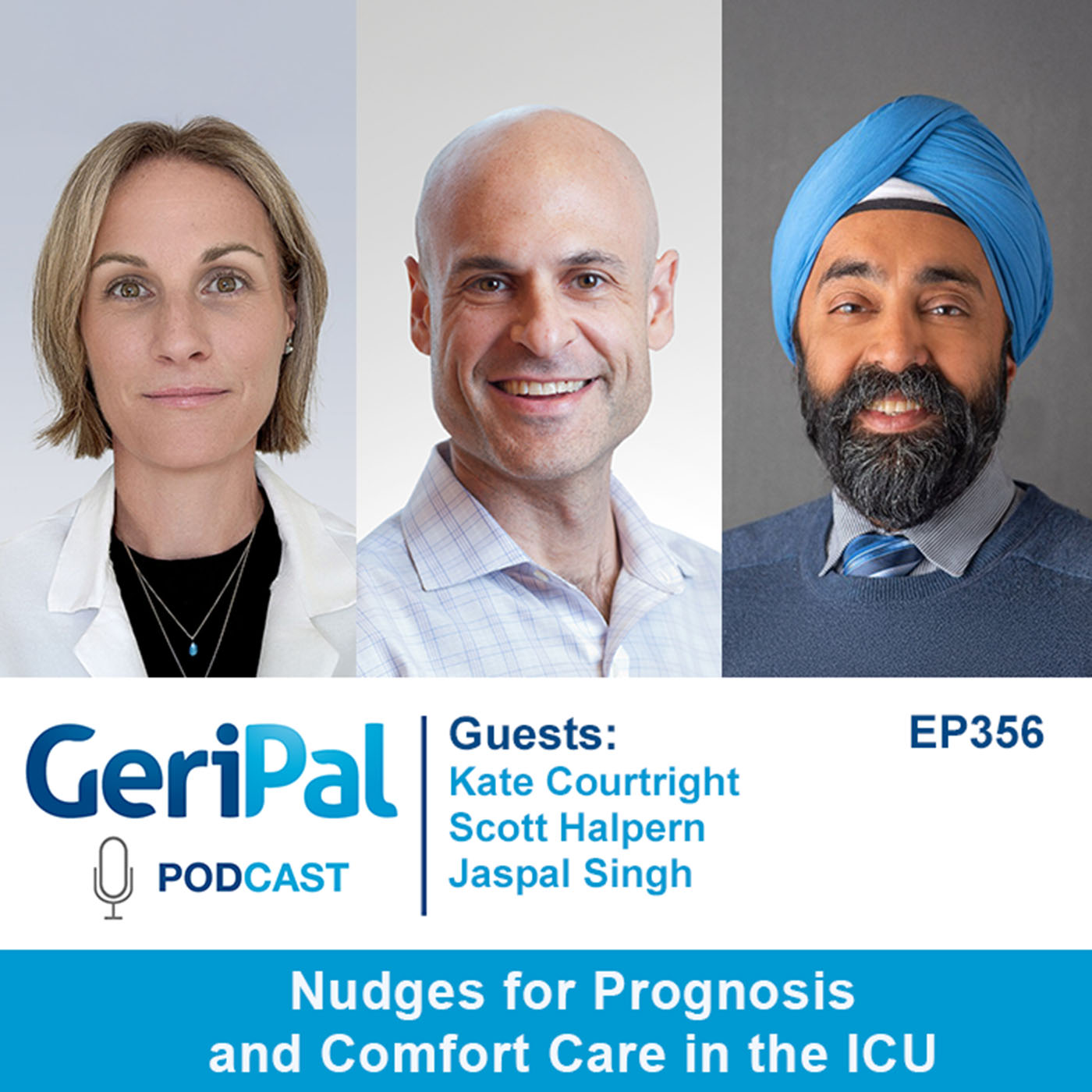
Nudges for Prognosis and Comfort Care in the ICU: Kate Courtright, Scott Halpern, & Jaspal Singh

Nudges for Prognosis and Comfort Care in the ICU: Kate Courtright, Scott Halpern, & Jaspal Singh

Author: Alex Smith, Eric Widera May 15, 2025 Duration: 48:27

Our main focus today was on nudging critical care clinicians to consider a more palliative approach to care.  Our guests are all trained in critical care: Kate Courtright, Scott Halpern, and Jaspal Singh.  Kate and Scott have additional training in palliative medicine. 

To start. we review:

  • What is a nudge? Also called behavioral interventions, heuristics, and cognitive biases.

  • Prior podcasts on the ethics of nudging, and a different trial conducted by Kate and Scott in which the default for hospitalized seriously ill patients was to receive a palliative care consult.

  • What is sludge?  I'd never heard the term, perhaps outside of Eric's pejorative reference to my coffee after adding copious creamers, flavoring, and sweeteners.  Sludge is apparently when you create barriers or extra work for someone.  For example, putting the healthy food at the back of the grocery store is sludge; making an applicant for health insurance climb the flight of stairs to the office - weeding out those less fit - is also sludge.  Prior-auth forms? Sludge.

  • Examples of nudges, some based in health care, others in coffee. 

This specific study, published in JAMA Internal Medicine, was conducted in 17 ICUs in North Carolina. Many were community hospitals.  Participants were critically ill and intubated.  Clinicians were randomized to 4 groups:

  1. Usual care

  2. Prognosis nudge - EHR prompt asking, do you think your patient will be alive in 6 months? This is called a focusing effect

  3. Comfort care nudge - EHR prompt asking if they'd offered comfort-focused care. This is called accountable justification - an appeal to standards of care for critically ill patients endorsed by multiple professional societies.

  4. Both the prognosis and comfort care nudge.


A few key points of discussion:

  • Is an EHR prompt a nudge or sludge?  

  • The intervention was a negative study for the primary outcome, hospital length of stay.  Why? 

  • The prognosis nudge did nothing.  What to make of that? Would you think an EHR nudge to consider prognosis might move the needle, at least on some outcomes?

  • The nudge toward offering comfort care led to more hospice and early comfort-care orders.  Is this due to chance alone, given the multiplicity of secondary outcomes examined?  Or is it a tantalizing finding that suggests a remarkably low cost EHR based nudge might, on a population level, lead to critical care clinicians offering comfort care and hospice more frequently?  Imagine!  

 -Alex Smith


Hosted by UCSF physicians Alex Smith and Eric Widera, GeriPal-A Geriatrics and Palliative Medicine Podcast creates a vital space for conversation at the intersection of aging and serious illness care. This isn't a dry lecture series; it's a dynamic dialogue where Eric and Alex bring on leading experts to unpack the complexities of geriatric and palliative medicine. They delve into the latest research that should change practice, tackle the ethical dilemmas that provoke debate, and explore the nuanced clinical challenges that professionals face daily. The tone is engaging and often surprisingly lighthearted, with moments of humor and even the occasional song, making profound topics more accessible. Whether you're a clinician, nurse, social worker, or any professional dedicated to this field, this podcast offers a blend of evidence-based insights and practical wisdom you can use. It’s a resource that acknowledges the weight of the work while fostering connection and continued learning. For those seeking formal education credits, AMA PRA Category 1 CME and MOC credit are also available through the show. Tune in to join a community committed to improving care for older adults and those with serious illness.
Author: Language: English Episodes: 100

GeriPal - A Geriatrics and Palliative Medicine Podcast
Podcast Episodes
How Pharma Invents Diseases: A Podcast with Adriane Fugh-Berman [not-audio_url] [/not-audio_url]

Duration: 47:03
Who gets to decide on what it means to have a disease? I posed this question a while back in reference to Alzheimer's disease. I'll save you from reading the article, but the main headline is that corporations are very m…
Palliative Care Nursing: Podcast with Betty Ferrell about ELNEC [not-audio_url] [/not-audio_url]

Duration: 47:39
As Betty Ferrell says on our podcast today, nurses play an essential role in care of people with serious illness. Who spends the most time with the patient in the infusion center? Doing home care? Hospice visits? In the…
The Promise and Pitfalls of AI in Medicine: Bob Wachter [not-audio_url] [/not-audio_url]

Duration: 44:32
Eric asks the question that is on many of our minds - is the future of AI more Skynet from Terminator, in which AI takes over the world and drives humanity to the brink of extinction, or Wall-E, in which a benevolent and…
Surrogate Decision Making: Bernie Lo and Laurie Dornbrand [not-audio_url] [/not-audio_url]

Duration: 48:30
In 1983, a 25 year old Nancy Cruzan was thrown from her car while driving home in Missouri, landing in a water filled ditch. She was resuscitated by EMS, but did not regain higher brain function, and was eventually diagn…
Electronic Frailty Indexes: Kate Callahan, Ariela Orkaby, & Dae Kim [not-audio_url] [/not-audio_url]

Duration: 44:21
What is frailty? Kate Callahan relates a clear metaphor on today's podcast. A frail person is like an origami boat: fine in still water, but can't withstand a breeze, or waves. Fundamentally, frailty is about vulnerabili…

«1...678910
