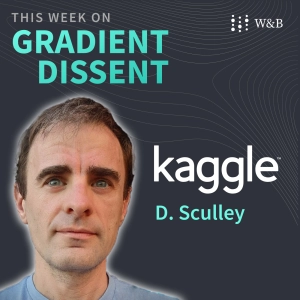
D. Sculley — Technical Debt, Trade-offs, and Kaggle

D. Sculley — Technical Debt, Trade-offs, and Kaggle

Author: Lukas Biewald December 1, 2022 Duration: 1:00:26

D. Sculley is CEO of Kaggle, the beloved and well-known data science and machine learning community.

D. discusses his influential 2015 paper "Machine Learning: The High Interest Credit Card of Technical Debt" and what the current challenges of deploying models in the real world are now, in 2022. Then, D. and Lukas chat about why Kaggle is like a rain forest, and about Kaggle's historic, current, and potential future roles in the broader machine learning community.

Show notes (transcript and links): http://wandb.me/gd-d-sculley

---

⏳ Timestamps:

0:00 Intro

1:02 Machine learning and technical debt

11:18 MLOps, increased stakes, and realistic expectations

19:12 Evaluating models methodically

25:32 Kaggle's role in the ML world

33:34 Kaggle competitions, datasets, and notebooks

38:49 Why Kaggle is like a rain forest

44:25 Possible future directions for Kaggle

46:50 Healthy competitions and self-growth

48:44 Kaggle's relevance in a compute-heavy future

53:49 AutoML vs. human judgment

56:06 After a model goes into production

1:00:00 Outro

---

Connect with D. and Kaggle:

📍 D. on LinkedIn: https://www.linkedin.com/in/d-sculley-90467310/

📍 Kaggle on Twitter: https://twitter.com/kaggle

---

Links:

📍 "Machine Learning: The High Interest Credit Card of Technical Debt" (Sculley et al. 2014): https://research.google/pubs/pub43146/

---

💬 Host: Lukas Biewald

📹 Producers: Riley Fields, Angelica Pan, Anish Shah, Lavanya Shukla

---

Subscribe and listen to our podcast today!

👉 Apple Podcasts: http://wandb.me/apple-podcasts​​

👉 Google Podcasts: http://wandb.me/google-podcasts​

👉 Spotify: http://wandb.me/spotify​


Lukas Biewald hosts Gradient Dissent: Conversations on AI, a series that moves beyond theoretical discussions to examine how artificial intelligence is actually built and deployed. Each episode features a direct, unscripted talk with a leading practitioner-you’ll hear from engineers and researchers at places like NVIDIA, Meta, Google, Lyft, and OpenAI. The focus is on the tangible challenges and breakthroughs they encounter, from initial research to the complex reality of putting models into production. This isn't about abstract futures; it's a grounded look at the decisions shaping the field right now. Biewald, bringing his perspective from Weights & Biases, steers conversations toward the practical trade-offs and collaborative efforts that define modern AI work. For anyone in technology or business who wants to understand the mechanics behind the headlines, this podcast offers a rare, candid window into the process. You’ll come away with a clearer sense of how ideas become functional systems and what it really takes to operate at the cutting edge.
Author: Language: English Episodes: 100

Gradient Dissent: Conversations on AI
Podcast Episodes
Pieter Abbeel — Robotics, Startups, and Robotics Startups [not-audio_url] [/not-audio_url]

Duration: 57:17
Pieter is the Chief Scientist and Co-founder at Covariant, where his team is building universal AI for robotic manipulation. Pieter also hosts The Robot Brains Podcast, in which he explores how far humanity has come in i…
Chris Albon — ML Models and Infrastructure at Wikimedia [not-audio_url] [/not-audio_url]

Duration: 56:15
In this episode we're joined by Chris Albon, Director of Machine Learning at the Wikimedia Foundation.Lukas and Chris talk about Wikimedia's approach to content moderation, what it's like to work in a place so transparen…
Emily M. Bender — Language Models and Linguistics [not-audio_url] [/not-audio_url]

Duration: 1:12:55
In this episode, Emily and Lukas dive into the problems with bigger and bigger language models, the difference between form and meaning, the limits of benchmarks, and why it's important to name the languages we study.Sho…
Josh Bloom — The Link Between Astronomy and ML [not-audio_url] [/not-audio_url]

Duration: 1:08:16
Josh explains how astronomy and machine learning have informed each other, their current limitations, and where their intersection goes from here.
Xavier Amatriain — Building AI-powered Primary Care [not-audio_url] [/not-audio_url]

Duration: 50:09
Xavier shares his experience deploying healthcare models, augmenting primary care with AI, the challenges of "ground truth" in medicine, and robustness in ML. --- Xavier Amatriain is co-founder and CTO of Curai, an ML-ba…
Spence Green — Enterprise-scale Machine Translation [not-audio_url] [/not-audio_url]

Duration: 43:46
Spence shares his experience creating a product around human-in-the-loop machine translation, and explains how machine translation has evolved over the years. --- Spence Green is co-founder and CEO of Lilt, an AI-powered…
Roger & DJ — The Rise of Big Data and CA's COVID-19 Response [not-audio_url] [/not-audio_url]

Duration: 1:04:53
Roger and DJ share some of the history behind data science as we know it today, and reflect on their experiences working on California's COVID-19 response. --- Roger Magoulas is Senior Director of Data Strategy at Astron…
Amelia & Filip — How Pandora Deploys ML Models into Production [not-audio_url] [/not-audio_url]

Duration: 40:49
Amelia and Filip give insights into the recommender systems powering Pandora, from developing models to balancing effectiveness and efficiency in production. --- Amelia Nybakke is a Software Engineer at Pandora. Her team…
Luis Ceze — Accelerating Machine Learning Systems [not-audio_url] [/not-audio_url]

Duration: 48:28
From Apache TVM to OctoML, Luis gives direct insight into the world of ML hardware optimization, and where systems optimization is heading. --- Luis Ceze is co-founder and CEO of OctoML, co-author of the Apache TVM Proje…