The Startup Powering The Data Behind AGI

The Startup Powering The Data Behind AGI

Author: Lukas Biewald September 16, 2025 Duration: 56:15

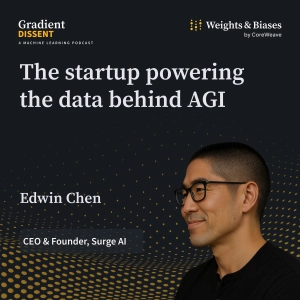
In this episode of Gradient Dissent, Lukas Biewald talks with the CEO & founder of Surge AI, the billion-dollar company quietly powering the next generation of frontier LLMs. They discuss Surge's origin story, why traditional data labeling is broken, and how their research-focused approach is reshaping how models are trained.

You’ll hear why inter-annotator agreement fails in high-complexity tasks like poetry and math, why synthetic data is often overrated, and how Surge builds rich RL environments to stress-test agentic reasoning. They also go deep on what kinds of data will be critical to future progress in AI—from scientific discovery to multimodal reasoning and personalized alignment.

It’s a rare, behind-the-scenes look into the world of high-quality data generation at scale—straight from the team most frontier labs trust to get it right.


Timestamps:

00:00 – Intro: Who is Edwin Chen?

03:40 – The problem with early data labeling systems

06:20 – Search ranking, clickbait, and product principles

10:05 – Why Surge focused on high-skill, high-quality labeling

13:50 – From Craigslist workers to a billion-dollar business

16:40 – Scaling without funding and avoiding Silicon Valley status games

21:15 – Why most human data platforms lack real tech

25:05 – Detecting cheaters, liars, and low-quality labelers

28:30 – Why inter-annotator agreement is a flawed metric

32:15 – What makes a great poem? Not checkboxes

36:40 – Measuring subjective quality rigorously

40:00 – What types of data are becoming more important

44:15 – Scientific collaboration and frontier research data

47:00 – Multimodal data, Argentinian coding, and hyper-specificity

50:10 – What's wrong with LMSYS and benchmark hacking

53:20 – Personalization and taste in model behavior

56:00 – Synthetic data vs. high-quality human data


Follow Weights & Biases:

https://twitter.com/weights_biases

https://www.linkedin.com/company/wandb


Lukas Biewald hosts Gradient Dissent: Conversations on AI, a series that moves beyond theoretical discussions to examine how artificial intelligence is actually built and deployed. Each episode features a direct, unscripted talk with a leading practitioner-you’ll hear from engineers and researchers at places like NVIDIA, Meta, Google, Lyft, and OpenAI. The focus is on the tangible challenges and breakthroughs they encounter, from initial research to the complex reality of putting models into production. This isn't about abstract futures; it's a grounded look at the decisions shaping the field right now. Biewald, bringing his perspective from Weights & Biases, steers conversations toward the practical trade-offs and collaborative efforts that define modern AI work. For anyone in technology or business who wants to understand the mechanics behind the headlines, this podcast offers a rare, candid window into the process. You’ll come away with a clearer sense of how ideas become functional systems and what it really takes to operate at the cutting edge.
Author: Language: English Episodes: 100

Gradient Dissent: Conversations on AI
Podcast Episodes
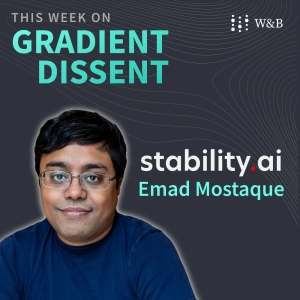
Emad Mostaque — Stable Diffusion, Stability AI, and What’s Next [not-audio_url] [/not-audio_url]

Duration: 1:10:29
Emad Mostaque is CEO and co-founder of Stability AI, a startup and network of decentralized developer communities building open AI tools. Stability AI is the company behind Stable Diffusion, the well-known, open source,…
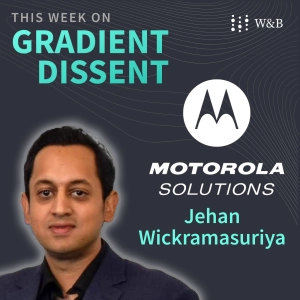
Jehan Wickramasuriya — AI in High-Stress Scenarios [not-audio_url] [/not-audio_url]

Duration: 1:00:02
Jehan Wickramasuriya is the Vice President of AI, Platform & Data Services at Motorola Solutions, a global leader in public safety and enterprise security.In this episode, Jehan discusses how Motorola Solutions uses AI t…
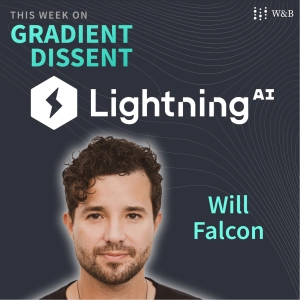
Will Falcon — Making Lightning the Apple of ML [not-audio_url] [/not-audio_url]

Duration: 45:21
Will Falcon is the CEO and co-founder of Lightning AI, a platform that enables users to quickly build and publish ML models.In this episode, Will explains how Lightning addresses the challenges of a fragmented AI ecosyst…
Aaron Colak — ML and NLP in Experience Management [not-audio_url] [/not-audio_url]

Duration: 50:00
Aaron Colak is the Leader of Core Machine Learning at Qualtrics, an experiment management company that takes large language models and applies them to real-world, B2B use cases.In this episode, Aaron describes mixing cla…
Jordan Fisher — Skipping the Line with Autonomous Checkout [not-audio_url] [/not-audio_url]

Duration: 57:58
Jordan Fisher is the CEO and co-founder of Standard AI, an autonomous checkout company that’s pushing the boundaries of computer vision.In this episode, Jordan discusses “the Wild West” of the MLOps stack and tells Lukas…
Drago Anguelov — Robustness, Safety, and Scalability at Waymo [not-audio_url] [/not-audio_url]

Duration: 1:09:01
Drago Anguelov is a Distinguished Scientist and Head of Research at Waymo, an autonomous driving technology company and subsidiary of Alphabet Inc.We begin by discussing Drago's work on the original Inception architectur…
Boris Dayma — The Story Behind DALL·E mini, the Viral Phenomenon [not-audio_url] [/not-audio_url]

Duration: 35:59
Check out this report by Boris about DALL-E mini:https://wandb.ai/dalle-mini/dalle-mini/reports/DALL-E-mini-Generate-images-from-any-text-prompt--VmlldzoyMDE4NDAyhttps://wandb.ai/_scott/wandb_example/reports/Collaboratio…
Tristan Handy — The Work Behind the Data Work [not-audio_url] [/not-audio_url]

Duration: 1:00:48
Tristan Handy is CEO and founder of dbt Labs. dbt (data build tool) simplifies the data transformation workflow and helps organizations make better decisions.Lukas and Tristan dive into the history of the modern data sta…
Johannes Otterbach — Unlocking ML for Traditional Companies [not-audio_url] [/not-audio_url]

Duration: 44:50
Johannes Otterbach is VP of Machine Learning Research at Merantix Momentum, an ML consulting studio that helps their clients build AI solutions.Johannes and Lukas talk about Johannes' background in physics and applicatio…