The Startup Powering The Data Behind AGI

The Startup Powering The Data Behind AGI

Author: Lukas Biewald September 16, 2025 Duration: 56:15

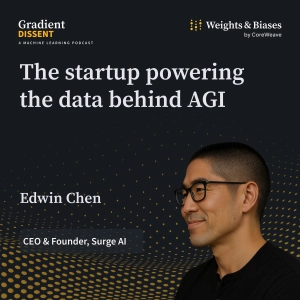
In this episode of Gradient Dissent, Lukas Biewald talks with the CEO & founder of Surge AI, the billion-dollar company quietly powering the next generation of frontier LLMs. They discuss Surge's origin story, why traditional data labeling is broken, and how their research-focused approach is reshaping how models are trained.

You’ll hear why inter-annotator agreement fails in high-complexity tasks like poetry and math, why synthetic data is often overrated, and how Surge builds rich RL environments to stress-test agentic reasoning. They also go deep on what kinds of data will be critical to future progress in AI—from scientific discovery to multimodal reasoning and personalized alignment.

It’s a rare, behind-the-scenes look into the world of high-quality data generation at scale—straight from the team most frontier labs trust to get it right.


Timestamps:

00:00 – Intro: Who is Edwin Chen?

03:40 – The problem with early data labeling systems

06:20 – Search ranking, clickbait, and product principles

10:05 – Why Surge focused on high-skill, high-quality labeling

13:50 – From Craigslist workers to a billion-dollar business

16:40 – Scaling without funding and avoiding Silicon Valley status games

21:15 – Why most human data platforms lack real tech

25:05 – Detecting cheaters, liars, and low-quality labelers

28:30 – Why inter-annotator agreement is a flawed metric

32:15 – What makes a great poem? Not checkboxes

36:40 – Measuring subjective quality rigorously

40:00 – What types of data are becoming more important

44:15 – Scientific collaboration and frontier research data

47:00 – Multimodal data, Argentinian coding, and hyper-specificity

50:10 – What's wrong with LMSYS and benchmark hacking

53:20 – Personalization and taste in model behavior

56:00 – Synthetic data vs. high-quality human data


Follow Weights & Biases:

https://twitter.com/weights_biases

https://www.linkedin.com/company/wandb


Lukas Biewald hosts Gradient Dissent: Conversations on AI, a series that moves beyond theoretical discussions to examine how artificial intelligence is actually built and deployed. Each episode features a direct, unscripted talk with a leading practitioner-you’ll hear from engineers and researchers at places like NVIDIA, Meta, Google, Lyft, and OpenAI. The focus is on the tangible challenges and breakthroughs they encounter, from initial research to the complex reality of putting models into production. This isn't about abstract futures; it's a grounded look at the decisions shaping the field right now. Biewald, bringing his perspective from Weights & Biases, steers conversations toward the practical trade-offs and collaborative efforts that define modern AI work. For anyone in technology or business who wants to understand the mechanics behind the headlines, this podcast offers a rare, candid window into the process. You’ll come away with a clearer sense of how ideas become functional systems and what it really takes to operate at the cutting edge.
Author: Language: English Episodes: 100

Gradient Dissent: Conversations on AI
Podcast Episodes
Pieter Abbeel — Robotics, Startups, and Robotics Startups [not-audio_url] [/not-audio_url]

Duration: 57:17
Pieter is the Chief Scientist and Co-founder at Covariant, where his team is building universal AI for robotic manipulation. Pieter also hosts The Robot Brains Podcast, in which he explores how far humanity has come in i…
Chris Albon — ML Models and Infrastructure at Wikimedia [not-audio_url] [/not-audio_url]

Duration: 56:15
In this episode we're joined by Chris Albon, Director of Machine Learning at the Wikimedia Foundation.Lukas and Chris talk about Wikimedia's approach to content moderation, what it's like to work in a place so transparen…
Emily M. Bender — Language Models and Linguistics [not-audio_url] [/not-audio_url]

Duration: 1:12:55
In this episode, Emily and Lukas dive into the problems with bigger and bigger language models, the difference between form and meaning, the limits of benchmarks, and why it's important to name the languages we study.Sho…
Josh Bloom — The Link Between Astronomy and ML [not-audio_url] [/not-audio_url]

Duration: 1:08:16
Josh explains how astronomy and machine learning have informed each other, their current limitations, and where their intersection goes from here.
Xavier Amatriain — Building AI-powered Primary Care [not-audio_url] [/not-audio_url]

Duration: 50:09
Xavier shares his experience deploying healthcare models, augmenting primary care with AI, the challenges of "ground truth" in medicine, and robustness in ML. --- Xavier Amatriain is co-founder and CTO of Curai, an ML-ba…
Spence Green — Enterprise-scale Machine Translation [not-audio_url] [/not-audio_url]

Duration: 43:46
Spence shares his experience creating a product around human-in-the-loop machine translation, and explains how machine translation has evolved over the years. --- Spence Green is co-founder and CEO of Lilt, an AI-powered…
Roger & DJ — The Rise of Big Data and CA's COVID-19 Response [not-audio_url] [/not-audio_url]

Duration: 1:04:53
Roger and DJ share some of the history behind data science as we know it today, and reflect on their experiences working on California's COVID-19 response. --- Roger Magoulas is Senior Director of Data Strategy at Astron…
Amelia & Filip — How Pandora Deploys ML Models into Production [not-audio_url] [/not-audio_url]

Duration: 40:49
Amelia and Filip give insights into the recommender systems powering Pandora, from developing models to balancing effectiveness and efficiency in production. --- Amelia Nybakke is a Software Engineer at Pandora. Her team…
Luis Ceze — Accelerating Machine Learning Systems [not-audio_url] [/not-audio_url]

Duration: 48:28
From Apache TVM to OctoML, Luis gives direct insight into the world of ML hardware optimization, and where systems optimization is heading. --- Luis Ceze is co-founder and CEO of OctoML, co-author of the Apache TVM Proje…