The origins of Darwin's ideas

The origins of Darwin's ideas

Author: Kensy Cooperrider – Diverse Intelligences Summer Institute July 3, 2026 Duration: 1:19:24

No discipline, no sphere of intellectual life, has been untouched by the work of Charles Darwin. He died in 1882 but his ideas are very much alive; they're now central to how we understand the natural world, the human mind, non-human minds, plants, biogeography, morality and emotion, culture, language, and more. But where did his ideas come from? How did they grow out of his travels, his social circle, his hobbies, his particular cast of mind? 

My guest today is Dr. Janet Browne. Janet is Professor Emerita at Harvard University in the department of the History of Science. She is perhaps best known for her widely acclaimed two-volume biography of Charles Darwin. And she has now published an updated and abridged single-volume version.  

Here, Janet and I talk about Darwin's life and ideas. We pick up the story during his travels on the Beagle, a five-year voyage that laid the foundation for the rest of his career. We talk about what he was reading, what he was seeing, and how these experiences helped form his most influential work, On the Origin of Species. We discuss Darwin's style as a thinker, as a naturalist, as a writer, and as an experimentalist. We touch on his relationships with contemporaries like Charles Lyell and Alfred Russel Wallace. And we consider his long—and often overlooked—engagements with pigeons, barnacles, plants, and worms. 

I greatly enjoyed Janet's two-volume biography of Darwin, and I enjoyed this new single-volume edition just as much. So if this episode sparks your interest, I heartily recommend that you check these books out.

Alright friends, on to my conversation with Dr. Janet Browne. Enjoy!


Notes

3:30 – Darwin's autobiography is available here. All of Darwin's letters are readable (and searchable) at the Darwin Correspondence Project.

11:00 – Darwin's account of his five-year stint on the HMS Beagle can be found in his book, The Voyage of the Beagle. 

17:00 – Charles Lyell's Principles of Geology (Vol. 1).

27:00 – For a recently published history of Lamarck and his ideas, see here. 

31:00 – For more on Darwin's interest in pigeons and pigeon breeding, see here. 

34:00 – For more on Darwin's barnacle studies, see here.

40:00 – For a brief account of the relationship between Wallace and Darwin, see Dr. Browne's article here.

44:00 – Alfred Russel Wallace's The Malay Archipelago is here. Wallace's own essay on natural selection, sent to Darwin before the publication of On the Origin of Species, is here. The proceedings in which Darwin's and Wallace's first papers on natural selection appeared together.

53:00 – For a modern treatment of the concept of sexual selection, see here. For an online version of Darwin's The Descent of Man, see here. For a recent collection of essays on Darwin's Descent, including one by Dr. Browne, see here. 

58:00 – Darwin's The Expression of the Emotions in Man and Animals. 

1:03:00 – Darwin's short article, 'A biographical sketch of an infant.'

1:08:00 – Darwin's The Power of Movement in Plants. For more about Darwin's last book, The Formation of Vegetable Mould, through the Action of Worms, see here. For more about Darwin's "root-brain hypothesis," see our earlier episode.

1:14:00 – For more on Darwin's theory of gemmules and pangenesis, see here.

1:15:00 – For more on Darwin's substantial archive, see here. 


Recommendations

Darwin and the Barnacle, Rebecca Stott

Natural Magic, Renée Bergland


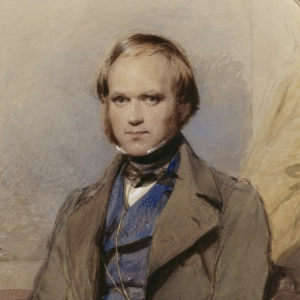
Tile art credit: Painting by George Richmond (detail)


Many Minds is a project of the Diverse Intelligences Summer Institute, which is made possible by a generous grant from the John Templeton Foundation to Indiana University. The show is hosted and produced by Kensy Cooperrider, with help from Assistant Producer Urte Laukaityte and with creative support from DISI Directors Erica Cartmill and Jacob Foster. Our artwork is by Ben Oldroyd.

Subscribe to Many Minds on Apple, Stitcher, Spotify, Pocket Casts, Google Play, or wherever you listen to podcasts. You can also now subscribe to the Many Minds newsletter here!

We welcome your comments, questions, and suggestions. Feel free to email us at: manymindspodcast@gmail.com.

For updates about the show, visit our website or follow us on Bluesky (@manymindspod.bsky.social).

 

There's a quiet revolution happening in how we understand intelligence, and it's not just about humans. Many Minds, hosted by Kensy Cooperrider of the Diverse Intelligences Summer Institute, digs into this expansive idea. Each episode is a journey into the inner worlds of creatures and creations we share the planet with. You'll hear from researchers who decode the complex social minds of crows, who map the sensory universe of an octopus, or who grapple with the emerging cognition of artificial systems. This isn't a dry lecture series; it's a collection of thoughtful conversations that feel like pulling up a chair with experts who are genuinely redefining what it means to think, feel, and learn. The Many Minds podcast operates from a simple but profound premise: to grasp our own human experience, we need to listen to the many other kinds of minds around us. Tune in every other week for explorations that are as much about philosophy and wonder as they are about science and education, all grounded in rigorous research and a deep curiosity about the beings-animal, human, and artificial-that fill our world.
Author: Language: English Episodes: 50

Many Minds
Podcast Episodes
What can AI teach us about the mind? [not-audio_url] [/not-audio_url]

Duration: 1:21:19
Everyone is talking about AI these days. Often these conversations are about how AI might upend education, or work, or social life, or maybe civilization itself. But among cognitive scientists and psychologists the conve…
Mutualisms all the way down [not-audio_url] [/not-audio_url]

Duration: 1:08:41
No one is an island. We all depend on each other in critical, often tangled ways. And when I say "we" and "each other" I don't just mean humans. Yes, we humans rely on other humans. But we also rely on bees, yeasts, dogs…
Seven metaphors for AI [not-audio_url] [/not-audio_url]

Duration: 55:46
If you wanted a petri dish for understanding metaphors—how they emerge and evolve and jostle with each other—it would be hard to do better than the world of AI. We talk about AI systems variously as coaches or co-pilots,…
Origins of the kiss [not-audio_url] [/not-audio_url]

Duration: 1:01:02
Humans do some pretty weird things. Some of us will sit in searingly hot rooms or jump into icy ponds. Others risk their lives trying to climb to new heights or dive to new depths. And every once in a while, two otherwis…
The aura of metaphor [not-audio_url] [/not-audio_url]

Duration: 1:36:01
Metaphors matter. They enliven our speech and our prose; they animate our arguments and stir our passions. Some metaphors power political movements; others propel scientific revolutions. These little figures of speech de…
From the archive: How should we think about IQ? [not-audio_url] [/not-audio_url]

Duration: 1:33:45
Hello friends, and happy new year! We're gearing up for a new run of episodes starting later in January. In the meanwhile, enjoy this pick from our archives. ------ [originally aired October 16, 2024] IQ is, to say the l…
From 'On Humans': Can the brain understand itself? [not-audio_url] [/not-audio_url]

Duration: 1:01:26
Hello there, friends! We hope you're having a restful holiday, or a lively holiday, or whatever mix of those you prefer. As the year draws to a close, we at Many Minds are taking a much needed pause ourselves. But we wan…
In search of names [not-audio_url] [/not-audio_url]

Duration: 28:34
Alright, friends—we've come to the end of the 2025 run of Many Minds! Our final episode of the year is an audio essay by yours truly. This is a classic format for the show, one that we only do every so often. Today's ess…
The value of animal cultures [not-audio_url] [/not-audio_url]

Duration: 1:12:00
Not long ago culture was considered rare in nature, maybe even uniquely human. But that's changed. We now know that the tree of life is buzzing with culture—and not just on a few lonely branches. Creatures great and smal…
What is memory for? [not-audio_url] [/not-audio_url]

Duration: 1:24:05
Everyone loves a good evolutionary puzzle. Why do we have appendices? Why do we dream? Why do we blush? At first glance, memory would not seem to be in this category. It's clearly useful to remember stuff, after all—to k…