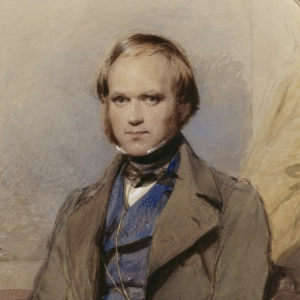
No discipline, no sphere of intellectual life, has been untouched by the work of Charles Darwin. He died in 1882 but his ideas are very much alive; they're now central to how we understand the natural world, the human mind, non-human minds, plants, biogeography, morality and emotion, culture, language, and more. But where did his ideas come from? How did they grow out of his travels, his social circle, his hobbies, his particular cast of mind?
My guest today is Dr. Janet Browne. Janet is Professor Emerita at Harvard University in the department of the History of Science. She is perhaps best known for her widely acclaimed two-volume biography of Charles Darwin. And she has now published an updated and abridged single-volume version.
Here, Janet and I talk about Darwin's life and ideas. We pick up the story during his travels on the Beagle, a five-year voyage that laid the foundation for the rest of his career. We talk about what he was reading, what he was seeing, and how these experiences helped form his most influential work, On the Origin of Species. We discuss Darwin's style as a thinker, as a naturalist, as a writer, and as an experimentalist. We touch on his relationships with contemporaries like Charles Lyell and Alfred Russel Wallace. And we consider his long—and often overlooked—engagements with pigeons, barnacles, plants, and worms.
I greatly enjoyed Janet's two-volume biography of Darwin, and I enjoyed this new single-volume edition just as much. So if this episode sparks your interest, I heartily recommend that you check these books out.
Alright friends, on to my conversation with Dr. Janet Browne. Enjoy!
Notes
3:30 – Darwin's autobiography is available here. All of Darwin's letters are readable (and searchable) at the Darwin Correspondence Project.
11:00 – Darwin's account of his five-year stint on the HMS Beagle can be found in his book, The Voyage of the Beagle.
17:00 – Charles Lyell's Principles of Geology (Vol. 1).
27:00 – For a recently published history of Lamarck and his ideas, see here.
31:00 – For more on Darwin's interest in pigeons and pigeon breeding, see here.
34:00 – For more on Darwin's barnacle studies, see here.
40:00 – For a brief account of the relationship between Wallace and Darwin, see Dr. Browne's article here.
44:00 – Alfred Russel Wallace's The Malay Archipelago is here. Wallace's own essay on natural selection, sent to Darwin before the publication of On the Origin of Species, is here. The proceedings in which Darwin's and Wallace's first papers on natural selection appeared together.
53:00 – For a modern treatment of the concept of sexual selection, see here. For an online version of Darwin's The Descent of Man, see here. For a recent collection of essays on Darwin's Descent, including one by Dr. Browne, see here.
58:00 – Darwin's The Expression of the Emotions in Man and Animals.
1:03:00 – Darwin's short article, 'A biographical sketch of an infant.'
1:08:00 – Darwin's The Power of Movement in Plants. For more about Darwin's last book, The Formation of Vegetable Mould, through the Action of Worms, see here. For more about Darwin's "root-brain hypothesis," see our earlier episode.
1:14:00 – For more on Darwin's theory of gemmules and pangenesis, see here.
1:15:00 – For more on Darwin's substantial archive, see here.
Recommendations
Darwin and the Barnacle, Rebecca Stott
Natural Magic, Renée Bergland
Tile art credit: Painting by George Richmond (detail)
Many Minds is a project of the Diverse Intelligences Summer Institute, which is made possible by a generous grant from the John Templeton Foundation to Indiana University. The show is hosted and produced by Kensy Cooperrider, with help from Assistant Producer Urte Laukaityte and with creative support from DISI Directors Erica Cartmill and Jacob Foster. Our artwork is by Ben Oldroyd.
Subscribe to Many Minds on Apple, Stitcher, Spotify, Pocket Casts, Google Play, or wherever you listen to podcasts. You can also now subscribe to the Many Minds newsletter here!
We welcome your comments, questions, and suggestions. Feel free to email us at: manymindspodcast@gmail.com.
For updates about the show, visit our website or follow us on Bluesky (@manymindspod.bsky.social).