”Decoding Our Thoughts: How to Build a Better Future with the Power of Our Mind” PART 2 Review of Dr. Joe Dispenza’s Work
Author: Andrea Samadi
October 27, 2023
Duration: 36:58
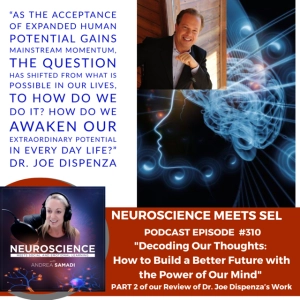
“As the acceptance of expanded human potential gains mainstream momentum, the question has shifted from “What is possible in our lives?” to “How do we do it? How do we awaken our extraordinary potential in everyday life?” Welcome to PART 2 of our review of Dr. Joe Dispenza’s work.
On today's EPISODE #310 on "Decoding Our Thoughts: How to Build a Better Future with the Power of Our Mind" and PART 2 of our Review of Dr. Joe Dispenza's work, we will cover:
✔ 3 Important Concepts in Dr. Joe Dispenza's book, Becoming Supernatural that have the ability to change YOUR life, when implemented.
IMPORTANT CONCEPT 1: Accessing the Present Moment
IMPORTANT CONCEPT 2: Mental Rehearsal: Priming Your Brain and Body for a New Future
IMPORTANT CONCEPT 3: Elevated Emotion
✔ What science has to say about these timeless success principles?
✔ Strategies to IMPLEMENT these principles into our daily life for improved results.
✔ How to use our emotions FOR us, rather than AGAINST us.
✔ Why we must continue to learn more about WHO WE ARE for improved results
✔ How METACOGNITION (and our awareness of how we think, act and feel) creates AHA Moments of Learning in our daily life.
Today we will continue our exploration of how exactly we live up to the full potential we all have within us, or like the name of Joe Dispenza’s book, Becoming Supernatural: How Common People are Doing the Uncommon.
Today as we cover PART 2 of this exploration we will identify clear strategies to awaken the extraordinary potential in each of us, and these will be evidence-based strtegies, that are proven with science. Becoming Supernatural, is the first-of-its-kind manual that does precisely this: it leads us on a step-by-step journey to achieving our greatest potential in body, health, relationships, and our life purpose and allows us to make that journey at our own pace.
We only cover ideas and concepts on this podcast that have the potential to change our lives, and I’m on a mission to connect the most current brain research to concepts that have been taught successfully to students for centuries, connecting the science to these age-old success principles.
This book study has taken me some time to think, and consolidate what I’m learning since we released PART 1 the end of September. I needed this time to put Dr. Dispenza’s ideas and meditations into practice, and have spent the past month immersed in his teachings. As mentioned in the first part of this study, this is a shallow dive, and is just the beginning. I do hope that our review today helps us to ALL unlock more of the mysteries within the unseen world, as we learn to put these concepts into practice in our daily life. I’m sure we will return to this episode in the future, but this is where we will start our journey today.
Welcome back to The Neuroscience Meets Social and Emotional Learning Podcast, where we connect the science-based evidence behind social and emotional learning (that’s finally being taught in our schools today) and emotional intelligence training (used in our modern workplaces) for improved well-being, achievement, productivity and results—using what I saw as the missing link (since we weren’t taught this when we were growing up in school), the application of practical neuroscience. I’m Andrea Samadi, an author, and an educator with a passion for learning and launched this podcast 5 years ago with the goal of bringing ALL the leading experts together (in one place) to uncover the most current research that would back up how the brain learns best, taking us ALL to new, and often unimaginable heights.
For those tuning into this episode, and you’ve not listened to EP 306[i] yet, I do encourage you to begin there. You will learn the background of where I first heard of Dr. Joe Dispenza, and how I was forbidden to cover his work on this podcast, since my neuroscience certification coach, researcher Mark Waldman, would consider his work pseudoscience.
We covered how even Dr. Joe Disp