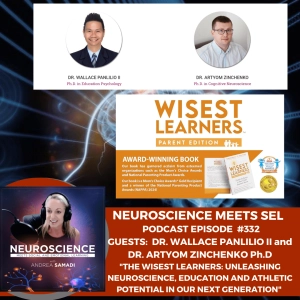
Dr. Wallace Panlilio and Dr. Artyom Zinchecko on "Unleashing The Wisest Learners in Our Next Generation"
Author: Andrea Samadi
May 17, 2024
Duration: 1:01:09
In the 332nd episode of the Neuroscience Meets Social and Emotional Learning podcast, we have an informative discussion with the distinguished authors of the 'Wisest Learners' series, Dr. Wallace and Dr. Artyom. We delve deep into the intersection of neuroscience, social and emotional learning, and its implications for personal growth and productivity. Listeners will discover invaluable insights on learning strategies, the role of emotions in cognitive control, and how environmental regularities shape memory and attention.
See this interview on YouTube here https://youtu.be/lk7jJZDqrPo
Our conversation explores the significant developmental transitions children undergo around the age of 12 and the bewilderment many parents experience during this time. By discussing the principles laid out in their book, our guests illuminate the importance of a holistic approach to child development from an early age and its profound impact on academic performance and lifelong learning. Specific focus is given to the concept of 'automaticity', which simplifies complex cognitive functions in children.
Moving on to practical application, the discussion underscores the critical role of granting children autonomy in their learning journey. Real-life examples highlight how granting autonomy in choices, like book selection, can inculcate a lifelong love for reading and writing. However, an important balance is emphasized to avoid stifling a child's natural curiosity with excessive parental control.
A notable part of our conversation is an analogy comparing essential life skills to multivitamins, emphasizing the necessity for multiple principles in education rather than relying on single solutions. The role of parents in a child's education is underlined with varied involvement approaches and their effects. The interaction concludes with important practical suggestions for parents, emphasizing the importance of role-modelling and consistent communication with children.
This enlightening episode provides a unique fusion of theoretical understanding and practical guidance, making it essential listening for anyone seeking to better understand how to nurture resilient and joyful learners. Whether you're a parent, educator, or just interested in the fascinating world of cognitive neuroscience, buckle up for this insightful journey into the art and science of parenting based on neuroscience and social and emotional learning.
EPISODE #332 with Dr. Wallace Panlilio and Dr. Artyom Zinchenko “The Wisest Learners: Unleashing Neuroscience, Education, and Athletic Ability” we will cover:
✔ How a Cognitive Neuroscientist from Germany, met an experienced School Administrator in the Philippines, to create “The Wisest Learners” book series.
✔ How can we use an understanding of our brain, to bring the joy back into learning for our children and students?
✔ What KEY take-aways should we know about using our brain to be “wise” learners?
✔ How to apply these scientific principles in your school, workplace or sports environment to take your students/children to greater heights?
On today's episode #332, we meet Dr. Wallace Panlilio II and Dr. Artyom Zinchenko, the authors of the Wisest Learners[i] Book Series. Dr. Artyom Ph.D is an accomplished author and cognitive neuroscientist with extensive experience in the field. He earned his Doctorate in Cognitive Neuroscience from the Max Plank Institute for Cognitive Human and Brain Sciences in Germany and is now a researcher and a faculty member at LMU in Munich. He’s also a father of 2 children.
Dr. Wallace is an experienced educator and entrepreneur with a Ph.D. in Educational Psychology from the University of Philippines and has served as a headmaster (school administrator) for 14 years. He holds 2 master’s degrees in entrepreneurship and educational leadership and is always looking at ways to further optimize the results of the students in his schools.
Without further ado, let’s meet the authors of The Wisest