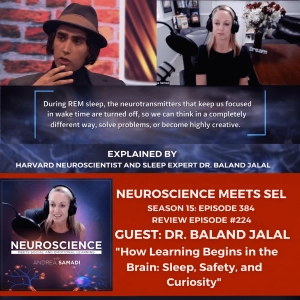
How Learning Begins in the Brain: Sleep, Safety and Curiosity (Revisiting Dr. Baland Jalal)
Author: Andrea Samadi
February 1, 2026
Duration: 26:17
Andrea Samadi revisits a conversation with neuroscientist Dr. Baland Jalal about how curiosity launched his career and how transitional sleep states fuel creativity. The episode explores sleep paralysis research and the hypnagogic window—the moments before sleep and after waking when the brain makes unexpected connections.
This week, Episode 384—based on our review of Episode 224, recorded in June 2022—we’ll explore:
✔ Why learning, creativity, and curiosity depend on a regulated nervous system✔ How sleep—especially REM—creates the conditions for insight and problem-solving✔ What happens in the brain when focus shuts down and imagination turns on✔ Why safety, rhythm, and rest are prerequisites for learning—not rewards after it✔ How understanding sleep changes the way we approach performance, education, and growth
Listeners learn practical tips for capturing insights at the edge of sleep, setting intentions before bed, and protecting morning silence to preserve creative flashes. The episode emphasizes that learning and creativity emerge best when the nervous system feels safe and regulated.
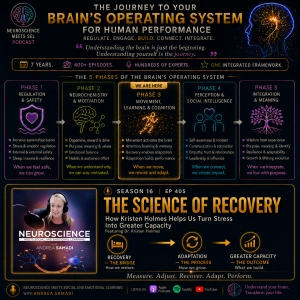
This episode launches Season 15’s Phase 1 focus on regulation and safety, framing sleep, rhythm, and emotional regulation as the essential foundation for motivation, learning, and sustained performance.
Welcome back to Season 15 of the Neuroscience Meets Social and Emotional Learning Podcast.
I’m Andrea Samadi, and here we bridge the science behind social and emotional learning, emotional intelligence, and practical neuroscience—so you can create measurable improvements in well-being, achievement, productivity, and results.
When we launched this podcast seven years ago, it was driven by a question I had never been taught to ask—not in school,not in business,and not in life:
If results matter—and they matter now more than ever—how exactly are we using our brain to make these results happen?
Most of us were taught what to do.Very few of us were taught how to think under pressure,how to regulate emotion,how to sustain motivation,or even how to produce consistent results without burning out.
That question led me into a deep exploration of the mind–brain–results connection—and how neuroscience applies to everyday decisions, conversations, and performance.
That’s why this podcast exists.
Each week, we bring you leading experts to break down complex science and translate it into practical strategies you can apply immediately.
If you’ve been with us through Season 14, you may have felt something shift.
That season wasn’t about collecting ideas.It was about integrating these ideas into our daily life.
Across conversations on neuroscience, social and emotional learning, sleep, stress, exercise, nutrition, and mindset frameworks—from voices like Bob Proctor, José Silva, Dr. Church, Dr. John Medina, and others—one thing became clear:
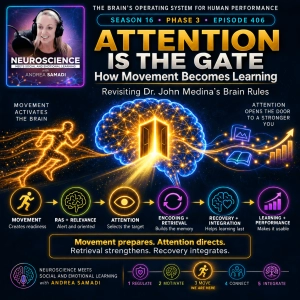
These aren’t separate tools.They’re parts of one operating system.
When the brain, body, and emotions are aligned, performance stops feeling forced—and starts to feel sustainable.
Season 14 showed us what alignment looks like in real life.
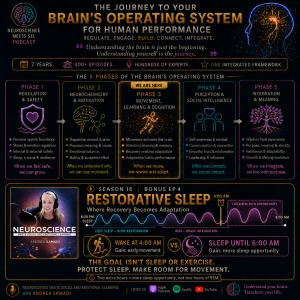
And now we move into Season 15 that is about understanding how that alignment is built—so we can build it ourselves, using predictable, science-backed principles.
Because alignment doesn’t happen all at once.It happens by using a sequence.
By repeating this sequence over and over again, until magically (or predictably) we notice our results have changed.
So this season, we’re revisiting past conversations—not to repeat them—but to understand how they fit together, so we can replicate them ourselves.
Because the brain doesn’t develop skills in isolation.Learning doesn’t happen in isolation.And neither does performance, resilience, or well-being.
The brain operates as a set of interconnected systems. When one system is out of balance, everything else is affected.
So Season 15 we’ve organized as a review roadmap, where each episode explores one foundational brain system—and each