The 4:00 AM Tradeoff: Movement, REM and Recovery (Bonus Episode)
Author: Andrea Samadi
August 30, 2026
Duration: 29:45
In this episode Andrea Samadi explores how movement and sleep work together in a "brain operating system" for human performance, focusing on restorative sleep (deep + REM), personal WHOOP data, and the trade-offs created by early-morning exercise.
She shares four lessons and a simple experiment to help listeners protect REM and deep sleep while maintaining an active life, emphasizing weekly rhythms, small changes, and tracking patterns rather than chasing perfect numbers.
SEASON 16 | BONUS EPISODE 4
RESTORATIVE SLEEP
Where Adaptation Happens
Why deep sleep restores the body, REM helps integrate experience, and healthy habits must work together.
ON BONUS EPISODE 4, YOU’LL LEARN:
✔ What restorative sleep really measures
✔ How deep sleep and REM support different forms of recovery
✔ Why REM percentage and duration tell different stories
✔ What my six-month sleep data revealed
✔ The hidden tradeoff behind my 4:00 AM hiking routine
✔ What happened when I slept just 21 minutes longer
✔ Why healthy habits can sometimes compete
✔ How to protect sleep without giving up movement
✔ 4 Lessons and a simple experiment for discovering your own best rhythm
Episode Introduction
Welcome back to the Neuroscience Meets Social and Emotional Learning Podcast, where we bridge neuroscience, social and emotional learning, and human performance to create measurable improvements in well-being, achievement, leadership, productivity and results.
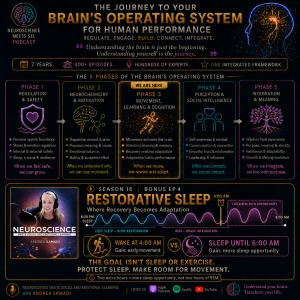
I’m Andrea Samadi, and throughout Season 16 we have been building what I call the Brain’s Operating System for Human Performance—a neuroscience-based framework for understanding how the systems of the brain and body work together to influence how we learn, adapt, connect, lead and ultimately perform.
We are currently in Phase 3: Movement, Learning and Cognition.
Movement is the foundation of this phase because it affects far more than our muscles.
When we move, we activate processes throughout the brain and body.
Movement supports neurogenesis—the development of new neurons—particularly in areas involved in learning and memory.
It strengthens connections between neurons through synaptic plasticity. We covered neurogenesis on EP 141[i] if you want to revisit that episode, if you are as curious as I am about how to regrow our brain cells.
Movement that we are learning in this phase, also influences brain chemicals such as dopamine, serotonin, norepinephrine and acetylcholine, which affect motivation, mood, attention and learning.
Movement can also strengthen our resilience by helping us manage stress and become more emotionally flexible.
It builds sleep pressure, (the longer we stay awake, the more adenosine accumulates that increases our need or “pressure” to rest) which can support deeper, more restorative sleep.
And over time, these changes may contribute to greater creativity, insight, endurance and human potential.
But movement only creates the stimulus.
The benefits don’t come from movement alone.
They come from the way the brain and body respond to that movement—and that response is called adaptation.
Movement changes the brain.
Adaptation changes the body.
Recovery is what connects the effort we make today with the strength, resilience and capacity we hope to build tomorrow.
Without adequate recovery, we can receive the stimulus without fully receiving the benefit.
That is why sleep belongs inside the Movement Loop.
Sleep is not separate from movement, learning or performance. It is one of the primary places where the brain and body respond to what we have asked them to do.
Throughout Season 16, I’ve been sharing some of my own health and performance data as a living case study—not because everyone should try to reproduce my numbers, but because our individual trends can help us understand how neuroscience shows up in everyday life.
I thought that if I was curious about understanding my numbers—and using them to improve my health, well-being and productivity—then other people might benefit from